
用队列实现栈
思路
栈是一种 后进先出(last in - first out, LIFO)的数据结构,栈内元素从顶端压入(push),从顶端弹出(pop)。一般我们用数组或者链表来实现栈,但是这篇文章会来介绍如何用队列来实现栈。队列是一种与栈相反的 先进先出(first in - first out, FIFO)的数据结构,队列中元素只能从 后端(rear)入队(push),然后从 前端(front)端出队(pop)。为了满足栈的特性,我们需要维护两个队列 q1 和 q2。同时,我们用一个额外的变量来保存栈顶元素。
算法
压入(push)
新元素永远从 q1 的后端入队,同时 q1 的后端也是栈的 栈顶(top)元素。
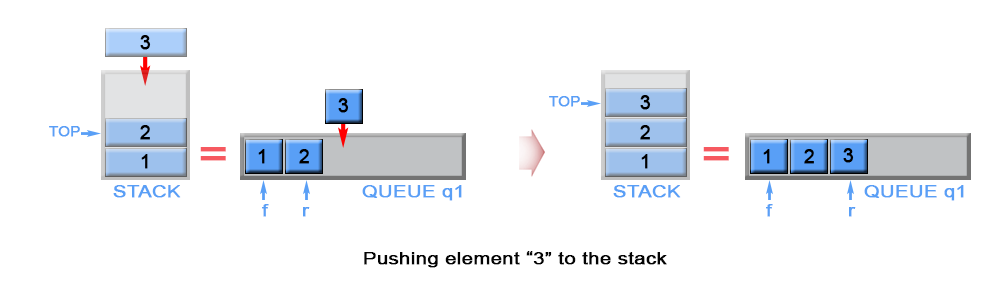
使用队列实现栈的下列操作:
push(x) -- 元素 x 入栈
pop() -- 移除栈顶元素
top() -- 获取栈顶元素
empty() -- 返回栈是否为空
class MyStack {
public:
    //单链表实现
    /** Initialize your data structure here. */
    MyStack() {

    }

    /** Push element x onto stack. */
    void push(int x) {
        int size = q.size();
        q.push(x);
        int tmp;
        for(int i = 0; i < size; i++){
            q.push(q.front());
            q.pop();
        }
    }

    /** Removes the element on top of the stack and returns that element. */
    int pop() {
        int tmp = q.front();
        q.pop();
        return tmp;
    }

    /** Get the top element. */
    int top() {
        return q.front();
    }

    /** Returns whether the stack is empty. */
    bool empty() {
        return q.empty();
    }

    private:
        queue<int> q;
};
class MyStack {
//双队列实现栈
public:
    /** Initialize your data structure here. */
    MyStack() {

    }

    /** Push element x onto stack. */
    void push(int x) {
        pushQueue.push(x);
        topValue = x;
    }

    /** Removes the element on top of the stack and returns that element. */
    int pop() {
        while(pushQueue.size()>1){
            topValue = pushQueue.front();
            popQueue.push(topValue);
            pushQueue.pop();
        }
        int result = pushQueue.front();
        pushQueue.pop();
        queue<int> tmp = pushQueue;
        pushQueue = popQueue;
        popQueue = tmp;
        return result;
    }

    /** Get the top element. */
    int top() {
        return topValue;
    }

    /** Returns whether the stack is empty. */
    bool empty() {
        return pushQueue.empty();
    }

private:
    queue<int> pushQueue;
    queue<int> popQueue;
    int topValue;
};
-------------------------------------------
个性签名:独学而无友,则孤陋而寡闻。做一个灵魂有趣的人!
如果觉得这篇文章对你有小小的帮助的话,记得在右下角点个“推荐”哦,博主在此感谢!

 浙公网安备 33010602011771号