
PiCIE: Unsupervised Semantic Segmentation using Invariance and Equivariance in Clustering
概
利用聚类和 invariance to photometric transformations and equivariance to geometric transformations 来无监督地语义分割.
符号说明
- $x_i \in \mathbb{R}^{CHW}, i=1,2,\cdots, n $, unlabeled images;
- \(f_{\theta}: \mathbb{R}^{CHW} \rightarrow \mathbb{R}^{DHW}\), 将图片 \(x\) 映射为后续所用的特征;
- \(y_{i}[p]\), 为 \(x_{i}[p]\) 所对应的(预测)标签;
- \(\mu_k \in \mathbb{R}^D, k=1,2,\cdots, K\), 为 \(K\) 个聚类中心;
- \(P\), photometric 变换, 满足 \(x, P(x)\) 的语义分割是一致的;
- \(G\), geometric 变换, 满足 \(G(x)\) 的语义分割为 \(G(y)\);
流程
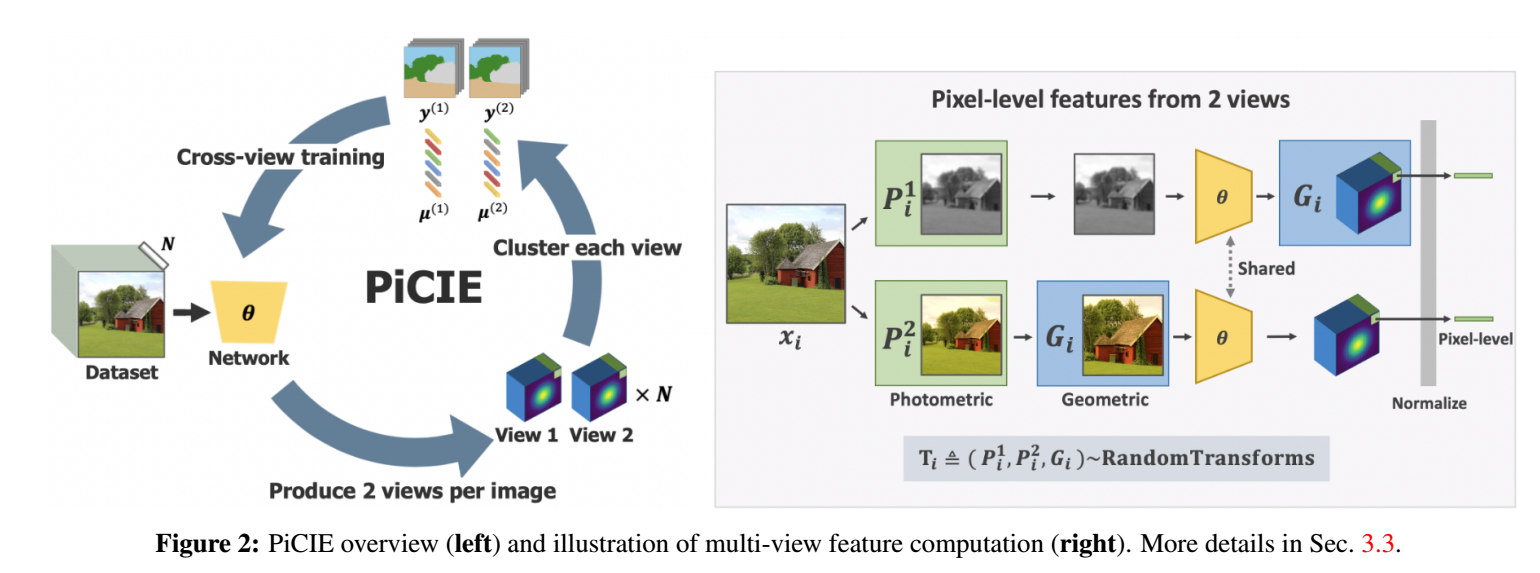
-
采样样本 \(x\), photometric 变换 \(P^{(1)}, P^{(2)}\), geometric 变换 \(G\);
-
得到特征:
\[z^{(1)} \leftarrow G (f_{\theta}(P^{(1)}(x))), \\ z^{(2)} \leftarrow f_{\theta}(G(P^{(1)}(x))); \\ \] -
通过 K-means 计算类别中心, 并为 \(z_i[p]\) 指定标签:
\[\mu^{(1)}, y^{(1)} \leftarrow \text{KMeans}(\{z_i^{(1)}[p]: i \in [n], p \in [HW] \}), \\ \mu^{(2)}, y^{(2)} \leftarrow \text{KMeans}(\{z_i^{(2)}[p]: i \in [n], p \in [HW] \}); \\ \] -
我们希望特征 \(z[p]\) 靠近所指定的类别, 即需要关于 \(\theta\) 最小化如下损失:
\[\mathcal{L}_{within} = \sum_{i, p} \mathcal{L}_{clust}(z_{i}^{(1)}[p], y_{i}^{(1)}[p], \mu^{(1)}) + \mathcal{L}_{clust}(z_{i}^{(2)}[p], y_{i}^{(2)}[p], \mu^{(2)}), \]其中
\[\mathcal{L}_{clust}(z_i[p], y_i[p], \mu) := -\log \frac{\exp(-d(z_i[p], \mu_{ip}))}{\sum_{k} \exp(-d(z_i[p], \mu_{k}))}, \]以及 \(d(\cdot, \cdot)\) 为 cosine similarity;
-
但是注意到, 即便 \(z\) 中的各个元素都靠近了各自的聚类中心, 我们没法保证聚类是按照 '语义' 来分割的, 为此, 我们引入 Invariance 和 Equivariance:
\[\mathcal{L}_{cross} = \sum_{i, p} \mathcal{L}_{clust}(z_{i}^{(1)}[p], y_{i}^{(2)}[p], \mu^{(2)}) + \mathcal{L}_{clust}(z_{i}^{(2)}[p], y_{i}^{(1)}[p], \mu^{(1)}), \]即采用了 photometric 和 geometric 变换后的特征保持语义分割上的一致.
代码
[official]

 浙公网安备 33010602011771号