

实验3 类与数组、指针
实验任务1


#pragma once

#include <iostream>
using std::cout;
using std::endl;

class Point {
public:
    Point(int x0 = 0, int y0 = 0);
    ~Point() = default;

    int get_x() const;
    int get_y() const;
    void show() const;
    void move(int new_x, int new_y);

private:
    int x, y;
};

Point::Point(int x0, int y0): x{x0}, y{y0} {
}

int Point::get_x() const {
    return x;
}

int Point::get_y() const {
    return y;
}

void Point::show() const {
    cout << "(" << x << ", " << y << ")" << endl;
}

void Point::move(int new_x, int new_y) {
    x = new_x;
    y = new_y;
}
#include <iostream>
#include "point.hpp"
#include <vector>

using std::vector;
using std::cin;

void output(const vector<Point> &v) {
    for(auto &t: v)
        t.show();
}

void test() {
    int n;
    cout << "输入动态Point数组类对象中元素个数: ";
    cin >> n;

    vector<Point> x(n);
    cout << "x对象中所有点坐标信息: " << endl;
    output(x);

    vector<Point> y(x);
    cout << "\ny对象中所有点坐标信息: " << endl;
    output(y);

    cout << "\n更新x对象......" << endl;
    x.at(0).move(30, 50);
    x.push_back(Point(2, 2));

    cout << "\nx对象中所有点坐标信息: " << endl;
    output(x);
    cout << "\ny对象中所有点坐标信息: " << endl;
    output(y);
}

int main() {
    test();
}
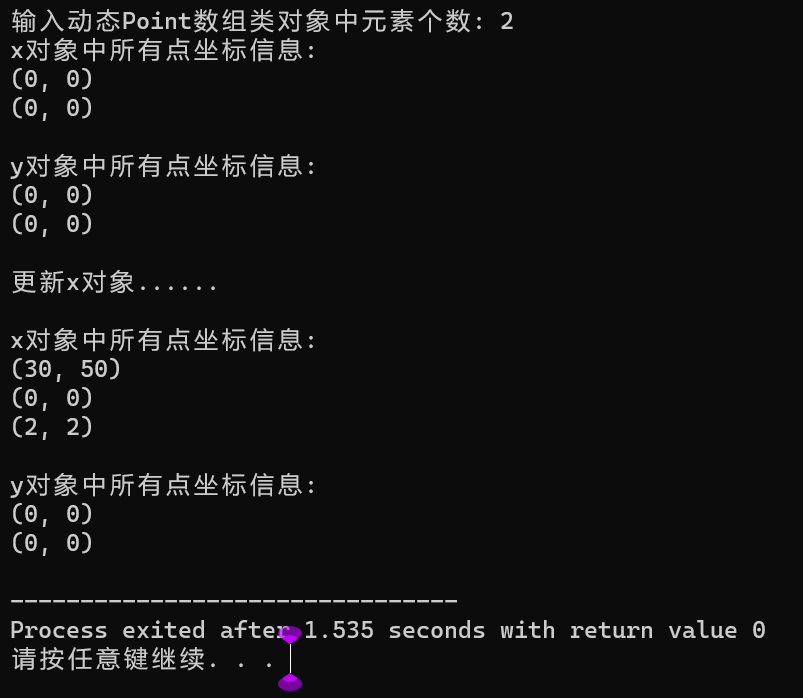
问题1:对x对象进行更新时,基于 vector <Point>对象x创建的对象y不发生变化
问题2:标准库模板类vector在复制一个动态数组对象时,实现的是深复制
实验任务2
#pragma once

#include <iostream>
using std::cout;
using std::endl;

class Point {
public:
    Point(int x0 = 0, int y0 = 0);
    ~Point() = default;

    int get_x() const;
    int get_y() const;
    void show() const;
    void move(int new_x, int new_y);

private:
    int x, y;
};

Point::Point(int x0, int y0): x{x0}, y{y0} {
}

int Point::get_x() const {
    return x;
}

int Point::get_y() const {
    return y;
}

void Point::show() const {
    cout << "(" << x << ", " << y << ")" << endl;
}

void Point::move(int new_x, int new_y) {
    x = new_x;
    y = new_y;
}
#pragma once

#include "point.hpp"
#include <cassert>
#include <iostream>

class vectorPoint{
public:
    vectorPoint(int n);
    ~vectorPoint();

    int get_size() const;
    Point& at(int index);
    Point& at(int index) const;
    vectorPoint(const vectorPoint &vp);

private:
    int size;
    Point *ptr;
};

vectorPoint::vectorPoint(int n) : size{n} {
    ptr = new Point[n];
}

vectorPoint::~vectorPoint() {
    delete[] ptr;
}

int vectorPoint::get_size() const {
    return size;
}

Point& vectorPoint::at(int index) {
    assert(index >= 0 && index < size);
    return ptr[index];
}

Point& vectorPoint::at(int index) const {
    assert(index >= 0 && index < size);
    return ptr[index];
}

vectorPoint::vectorPoint(const vectorPoint &vp): size{vp.size}, ptr{vp.ptr} {
}
#include "vectorPoint.hpp"
#include <iostream>

void output(const vectorPoint &v) {
    for(auto i = 0; i < v.get_size(); ++i)
        v.at(i).show();
}


void test() {
    using namespace std;

    int n;
    cout << "输入vectorPoint对象中元素个数: ";
    cin >> n;

    vectorPoint x(n);
    cout << "x对象中所有点坐标信息: " << endl;
    output(x);

    vectorPoint y(x);
    cout << "\ny对象中所有点坐标信息: " << endl;
    output(y);

    cout << "\n更新x对象中点坐标信息......" << endl;
    x.at(0).move(30, 50);
    x.at(1).move(-1, -1);

    cout << "x对象中所有点坐标信息: " << endl;
    output(x);

    cout << "\ny对象中所有点坐标信息: " << endl;
    output(y);
}

int main() {
    test();
}

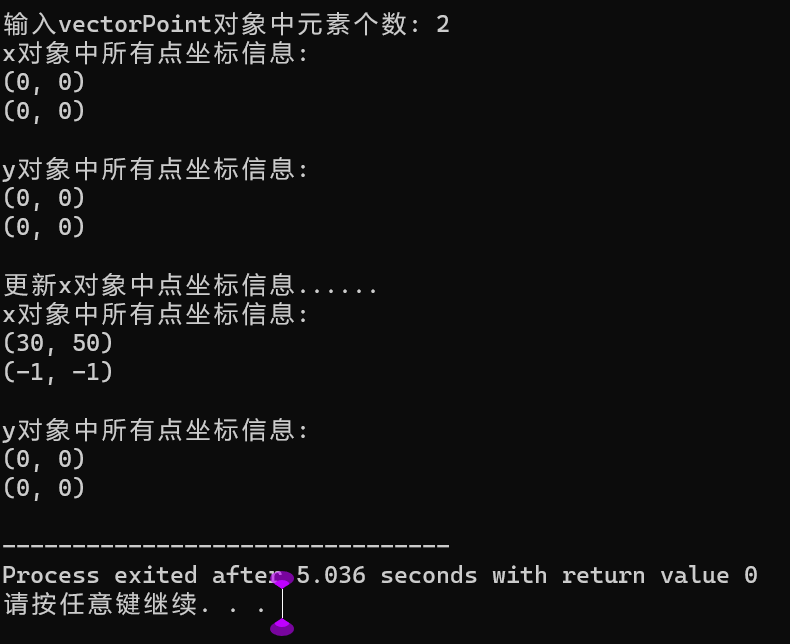
问题1:观察更新对象x后,基于 vectorPoint 对象x创建的对象y发生变化。
问题2:编译器为vectorPoint类创建的默认复制构造函数,在复制一个动态数组对象时,实现的是浅复制。
问题3:在类vectorPoint内部,手动增加的以下复制构造函数声明和定义,实现的是浅复制。
声明:vectorPoint(const vectorPoint &vp);
实现:vectorPoint::vectorPoint(const vectorPoint &vp): size{vp.size}, ptr{vp.ptr} { }
实验任务3
#pragma once

#include <iostream>
using std::cout;
using std::endl;

class Point {
public:
    Point(int x0 = 0, int y0 = 0);
    ~Point() = default;

    int get_x() const;
    int get_y() const;
    void show() const;
    void move(int new_x, int new_y);

private:
    int x, y;
};

Point::Point(int x0, int y0): x{x0}, y{y0} {
}

int Point::get_x() const {
    return x;
}

int Point::get_y() const {
    return y;
}

void Point::show() const {
    cout << "(" << x << ", " << y << ")" << endl;
}

void Point::move(int new_x, int new_y) {
    x = new_x;
    y = new_y;
}
#pragma once

#include "point.hpp"
#include <cassert>
#include <iostream>

class vectorPoint{
public:
    vectorPoint(int n);
    vectorPoint(const vectorPoint &vp);
    ~vectorPoint();

    int get_size() const;
    Point& at(int index);
    Point& at(int index) const;

private:
    int size;
    Point *ptr;
};

vectorPoint::vectorPoint(int n) : size{n} {
    ptr = new Point[n];
}

vectorPoint::vectorPoint(const vectorPoint &vp): size{vp.size}, ptr{new Point[size]} {
    for(auto i = 0; i < size; ++i)
        ptr[i] = vp.ptr[i];
}

vectorPoint::~vectorPoint() {
    delete[] ptr;
}

int vectorPoint::get_size() const {
    return size;
}

Point& vectorPoint::at(int index) {
    assert(index >= 0 && index < size);
    return ptr[index];
}

Point& vectorPoint::at(int index) const {
    assert(index >= 0 && index < size);
    return ptr[index];
}
#include "vectorPoint.hpp"
#include <iostream>

void output(const vectorPoint &v) {
    for(auto i = 0; i < v.get_size(); ++i)
        v.at(i).show();
}

void test() {
    using namespace std;

    int n;
    cout << "输入vectorPoint对象中元素个数: ";
    cin >> n;

    vectorPoint x(n);
    cout << "x对象中所有点坐标信息: " << endl;
    output(x);

    vectorPoint y(x);
    cout << "\ny对象中所有点坐标信息: " << endl;
    output(y);

    cout << "\n更新x对象中点坐标信息......" << endl;
    x.at(0).move(30, 50);
    x.at(1).move(-1, -1);

    cout << "x对象中所有点坐标信息: " << endl;
    output(x);

    cout << "\ny对象中所有点坐标信息: " << endl;
    output(y);
}

int main() {
    test();
}
问题1:观察更新对象x后,基于 vectorPoint 对象x创建的对象y不发生变化。
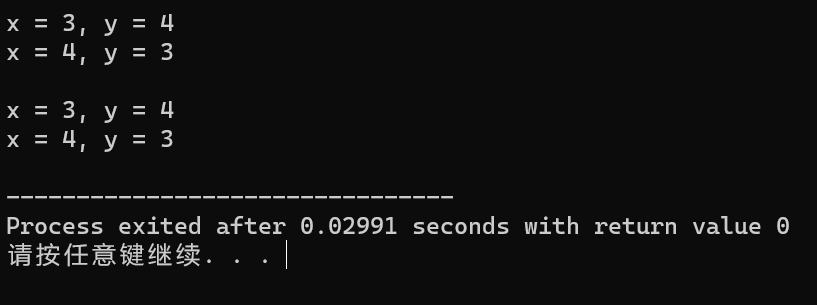
问题2:这个vectorPoint 类的实现中,复制构造函数实现的是深复制。
问题3:基于实验任务2和3,总结当类的成员中包含指针域成员时深复制与浅复制的区别。
浅复制只是复制指针本身,而不会复制指针所指向的内存区域,这样会导致多个指针指向同一块内存区域,当其中一个指针释放内存时,其他指针也会受到影 响。而深复制则会复制指针所指向的内存区域,这样每个指针都有自己独立的内存空间,互不干扰。深复制需要在类中定义复制构造函数。
实验任务4
#include <iostream>
using namespace std;

void swap1(int &rx, int &ry);
void swap2(int *px, int *py);
void print(int x, int y);

void test() {
    int x = 3, y = 4;

    print(x, y);
    swap1(x, y);
    print(x, y);

    cout << endl;

    x = 3, y = 4;
    print(x, y);
    swap2(&x, &y);
    print(x, y);
}

int main() {
    test();
}


void swap1(int &rx, int &ry) {
    int t;

    t = rx;  rx = ry;  ry = t;
}

void swap2(int *px, int *py) {
    int t;

    t = *px;  *px = *py;  *py = t;
}

void print(int x, int y) {
    std::cout << "x = " << x << ", y = " << y << "\n";
}
#include <iostream>
#include <typeinfo>
using namespace std;

int main() {
    int a;

    int &ra = a;
    ra = 4;

    int *pa = &a;
    *pa = 5;

    cout << "&a = " << hex << &a << endl;
    cout << "&ra = " << hex << &ra << endl;
    cout << "&pa = " << hex << &pa << "\n\n";

    cout << "a = " << a << endl;
    cout << "ra = " << a << endl;
    cout << "pa = " << hex << pa << endl;

    cout << "*pa = " << *pa << "\n\n";

    cout << "type a: " << typeid(a).name() << endl;
    cout << "type ra: " << typeid(ra).name() << endl;
    cout << "type pa: " << typeid(pa).name() << endl;
}
#include <iostream>
#include <vector>

using namespace std;

template<typename T>
void output(const T &x) {
    for(auto i: x)
        std::cout << i << ", ";
    std::cout << "\b\b \n";
}

template<typename T>
void square1(T &x) {
    for(auto i: x)
        i *= i;
}

template<typename T>
void square2(T &x) {
    for(auto &i: x)
        i *= i;
}

void test1() {
    vector<int> x {1, 2, 3, 4, 5};

    cout << "动态int型数组对象x内的元素值: ";
    output(x);

    cout << "调用函数square1()......" << endl;
    square1(x);

    cout << "动态int型数组对象x内的元素值: ";
    output(x);
}

void test2() {
    vector<int> x {1, 2, 3, 4, 5};

    cout << "动态int型数组对象x内的元素值: ";
    output(x);

    cout << "调用函数square2()......" << endl;
    square2(x);

    cout << "动态int型数组对象x内的元素值: ";
    output(x);
}

int main() {
    cout << "测试1: " << endl;
    test1();

    cout << "\n测试2: " << endl;
    test2();
}
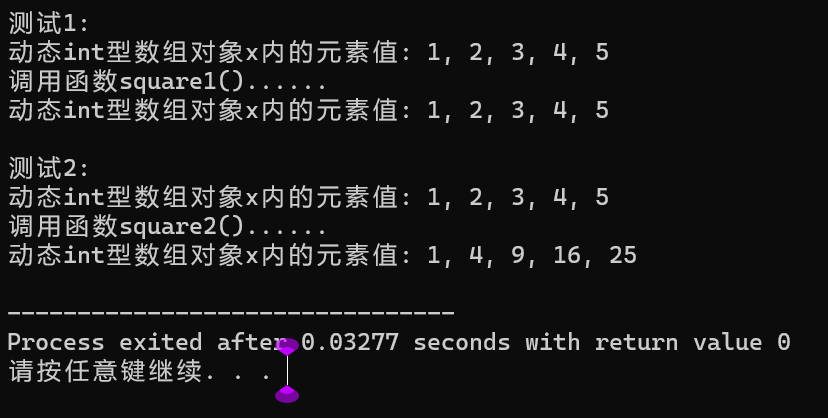
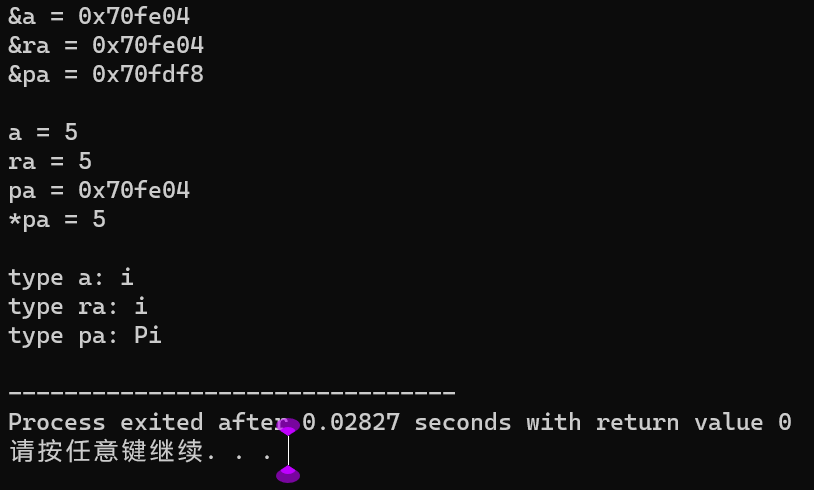
总结引用类型、指针类型的区别:引用没有自己的地址。引用变量的类型和值,与它所绑定的普通变量是相同的。
指针变量有自己的地址。指针变量的类型决定了它所指向的变量的类型,而指针变量的值则存储了它所指向的普通变量的地址。
实验任务5
#pragma once

#include <iostream>
#include <cassert>

using namespace std;

class vectorInt {
public:
    vectorInt(int n);
    vectorInt(int n, int value);
    vectorInt(const vectorInt &vi);
    ~vectorInt();

    int get_size() const;
    int& at(int index);
    int& at(int index) const;

private:
    int size;
    int *ptr;
};

vectorInt::vectorInt(int n) : size{n} {
   ptr = new int[size];
   cout << "constructor vectorInt(int n) called." << endl;
}

vectorInt::vectorInt(int n, int value) : size{n} {
   ptr = new int[size];
   for (int i = 0; i < size; i++) {
            ptr[i] = value;
        }
   cout << "constructor vectorInt(int n, int value) called." << endl;
}

vectorInt::vectorInt(const vectorInt &vi): size{vi.size}, ptr{new int[size]} {
   for(auto i = 0; i < size; ++i)
      ptr[i] = vi.ptr[i];
   cout << "copy constructor called." << endl;
}

vectorInt::~vectorInt() {
   delete[] ptr;
   cout << "destructor called." << endl;
}

int vectorInt::get_size() const {
   return size;
}

int& vectorInt::at(int index) {
   assert(index >= 0 && index < size);
   return ptr[index];
}

int& vectorInt::at(int index) const {
   assert(index >= 0 && index < size);
   return ptr[index];
}
#include "vectorInt.hpp"
#include <iostream>

using std::cout;
using std::cin;
using std::endl;

void output(const vectorInt &vi) {
    for(auto i = 0; i < vi.get_size(); i++)
       cout << vi.at(i) << ", ";
    cout << "\b\b \n";
}

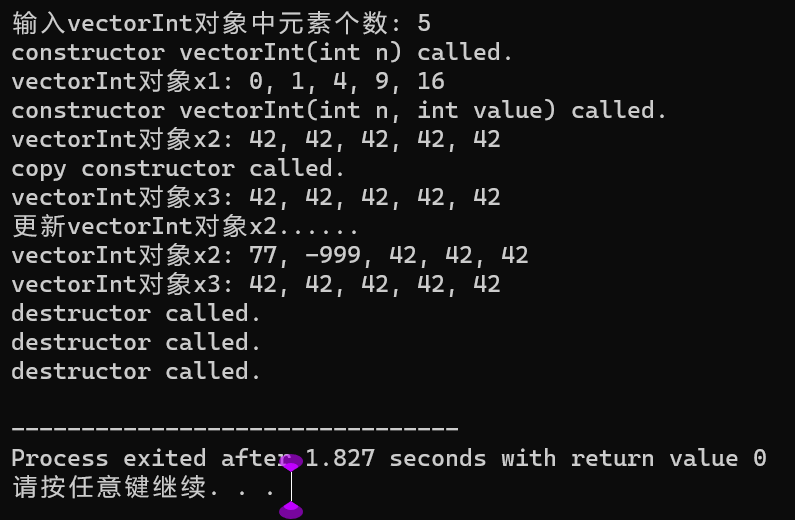
void test() {
    int n;
    cout << "输入vectorInt对象中元素个数: ";
    cin >> n;

    vectorInt x1(n);
    for(auto i = 0; i < n; ++i)
        x1.at(i) = i*i;
    cout << "vectorInt对象x1: " ;
    output(x1);


    vectorInt x2(n, 42);
    cout << "vectorInt对象x2: " ;
    output(x2);
    vectorInt x3(x2);
    cout << "vectorInt对象x3: " ;
    output(x3);

    cout << "更新vectorInt对象x2......\n" ;
    x2.at(0) = 77;
    x2.at(1) = -999;

    cout << "vectorInt对象x2: ";
    output(x2);
    cout << "vectorInt对象x3: ";
    output(x3);
}

int main() {
    test();
}
实验任务6
#pragma once

#include <iostream>
#include <cassert>

using std::cout;
using std::endl;

class Matrix {
public:
    Matrix(int n, int m);
    Matrix(int n);
    Matrix(const Matrix &x);
    ~Matrix();

    void set(const double *pvalue);
    void set(int i, int j, double value);
    double& at(int i, int j) const;
    double& at(int i, int j);

    int get_lines() const;
    int get_cols() const;

    void print() const;

private:
    int lines;
    int cols;
    double *ptr;
};

Matrix::Matrix(int n, int m): lines{n}, cols{m} {
    assert(n > 0 && m > 0);
    ptr = new double[n * m];
}

Matrix::Matrix(int n) : Matrix(n, n) {}

Matrix::Matrix(const Matrix& x) : lines{x.lines}, cols{x.cols} {
    ptr = new double[lines * cols];
    for (int i = 0; i < lines * cols; ++i) {
        ptr[i] = x.ptr[i];
    }
}

Matrix::~Matrix() {
    delete[] ptr;
}

void Matrix::set(const double* pvalue) {
    for (int i = 0; i < lines * cols; ++i) {
        ptr[i] = pvalue[i];
    }
}

void Matrix::set(int i, int j, double value) {
    assert(i >= 0 && i < lines && j >= 0 && j < cols);
    ptr[i * cols + j] = value;
}

double& Matrix::at(int i, int j) const {
    assert(i >= 0 && i < lines && j >= 0 && j < cols);
    return ptr[i * cols + j];
}

double& Matrix::at(int i, int j) {
    assert(i >= 0 && i < lines && j >= 0 && j < cols);
    return ptr[i * cols + j];
}

int Matrix::get_lines() const {
    return lines;
}

int Matrix::get_cols() const {
    return cols;
}

void Matrix::print() const {
    for (int i = 0; i < lines; ++i) {
        for (int j = 0; j < cols; ++j) {
            cout << ptr[i * cols + j] << " ";
        }
        cout << endl;
    }
}
#include <iostream>
#include "matrix.hpp"

using namespace std;

const int N1 = 3;
const int N2 = 2;

void output(const Matrix &m, int index) {
    for(auto j = 0; j < m.get_cols(); ++j)
        cout << m.at(index, j) << ", ";
    cout << "\b\b \n";
}

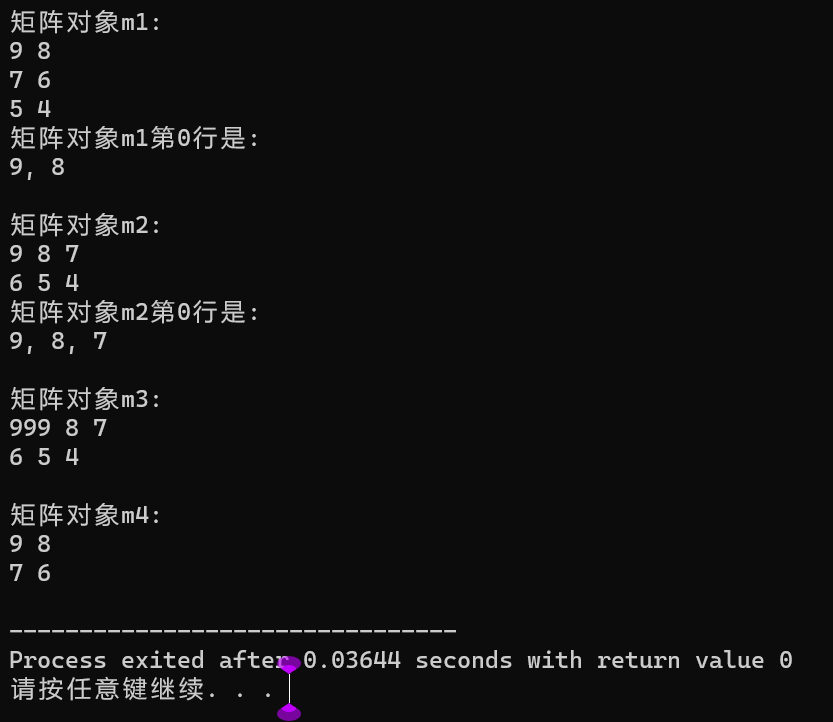
void test() {


    double x[N1*N2] = {9, 8, 7, 6, 5, 4};

    Matrix m1(N1, N2);
    m1.set(x);
    cout << "矩阵对象m1: " << endl;
    m1.print();
    cout << "矩阵对象m1第0行是: " << endl;
    output(m1, 0);
    cout << endl;

    Matrix m2(N2, N1);
    m2.set(x);
    cout << "矩阵对象m2: " << endl;
    m2.print();
    cout << "矩阵对象m2第0行是: " << endl;
    output(m2, 0);
    cout << endl;

    Matrix m3(m2);
    m3.set(0, 0, 999);
    cout << "矩阵对象m3:" << endl;
    m3.print();
    cout << endl;

    Matrix m4(2);
    m4.set(x);
    cout << "矩阵对象m4:" << endl;
    m4.print();
}

int main() {
    test();
}

 浙公网安备 33010602011771号