
Homework3
软件测试第三次作业
/**
     * Finds and prints n prime integers
     * Jeff Offutt, Spring 2003
     */


    private static void printPrimes(int n) {
        int curPrime; //Value currently considered for primeness
        int numPrimes; // Number of primes found so far;
        boolean isPrime; //Is curPrime prime?

  int[] primes = new int[MAXPRIMES];// The list of primes.

        // Initialize 2 into the list of primes.
        primes[0] = 2;
        numPrimes = 1;
        curPrime = 2;
        while(numPrimes < n) {
            curPrime++; // next number to consider...
            isPrime = true;
            for(int i = 0; i <= numPrimes; i++ ) {
                //for each previous prime.
                if(isDivisible(primes[i],curPrime)) {
                    //Found a divisor, curPrime is not prime.

                    break;
                }
            }
            if(isPrime) {
                // save it!
                primes[numPrimes] = curPrime;
                numPrimes++;

            }
        }// End while

        // print all the primes out
        for(int i = 0; i < numPrimes; i++) {
            System.out.println("Prime: " + primes[i] );

        }

    }// End printPrimes.
(a) Draw the control flow graph for the printPrime() method.
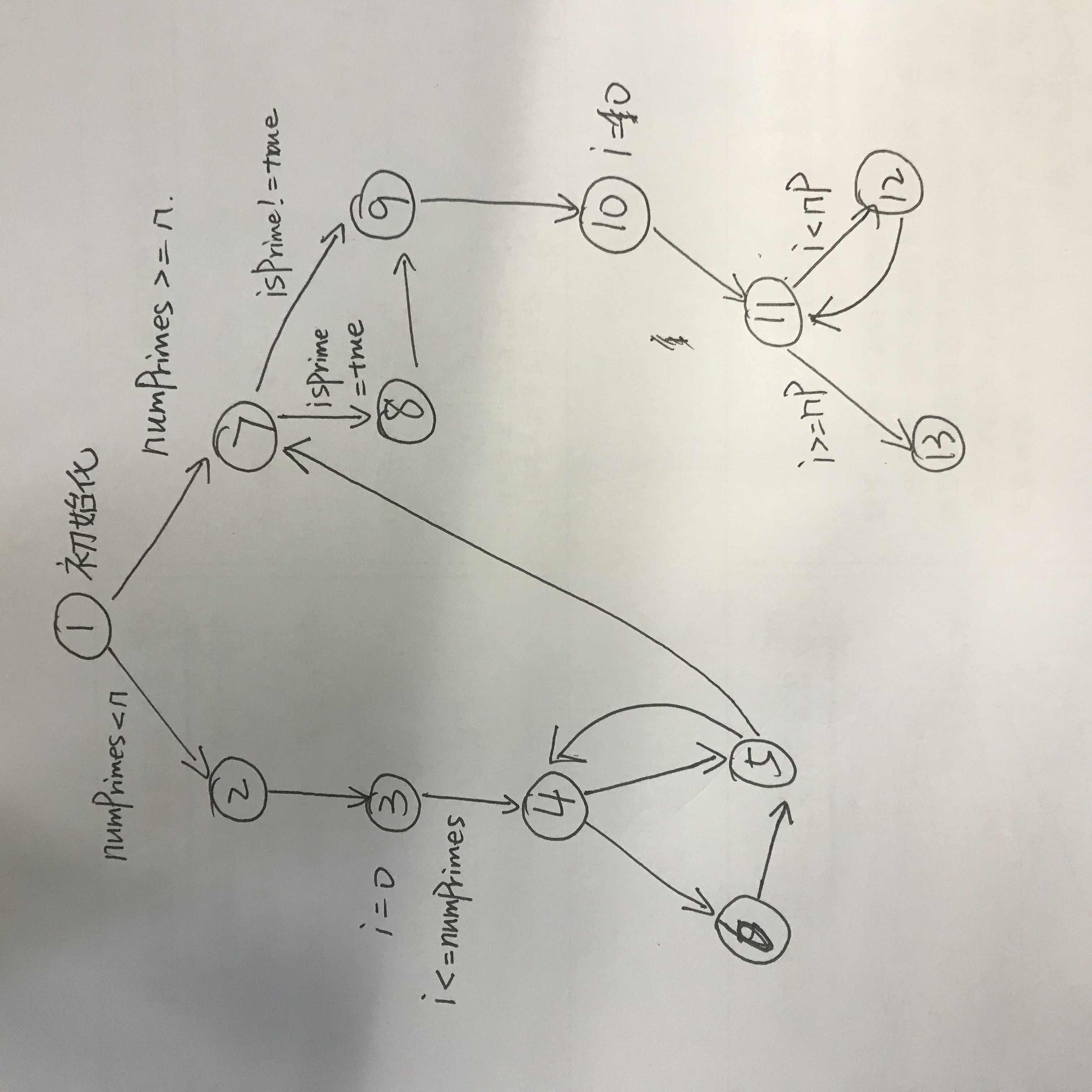
(b) Consider test cases t1 = (n = 3) and t2 = ( n = 5). Although these tour the same prime paths in printPrime(), they don't necessarily find the same faults.Design a simple fault that t2 would be more likely to discover than t1 would.
令数组界限为4,即将MAXPRIMES设置为4,这时n=5会发生数组越界的错误,n=3不会报错
(c) For printPrime(), find a test case such that the corresponding test path visits the edge that connects the beginning of the while statement
to the for statement without going through the body of the while loop.
n=1
(d) Enumerate the test requirements for node coverage, edge coverage,and prime path coverage for the path for printPrimes().
node coverage:[1,2,3,4,5,6,7,8,9,10,11,12,13]
edge coverage:[1,2], [2,3], [3,4], [4,5], [4,6], [5,4], [5,7], [6,5], [1,7], [7,8], [7,9], [8,9], [9,10], [10,11], [11,12], [12,11], [11,13]
edge pair coverage:[1,2,3], [2,3,4], [3,4,5], [3,4,6], [4,5,4], [4,6,5], [5,4,5], [5,4,6], [6,5,7], [4,5,7], [1,7,8], [1,7,9], [7,8,9], [7,9,10], [8,9,10], [9,10,11], [10,11,12], [10,11,13], [11,12,11], [12,11,12], [12,11,13]
prime path coverage:[1,2,3,4,5], [1,2,3,4,6,5,7,8,9,10,11,12], [1,2,3,4,6,5,7,8,9,10,11,13], [1,2,3,4,6,5,7,9,10,11,12], [1,2,3,4,5,7,8,9,10,11,13], [1,7,8,9,10,11,13], [1,7,9,10,11,13], [4,5,4], [5,4,5], [11,12,11], [12,11,12], [12,11,13]
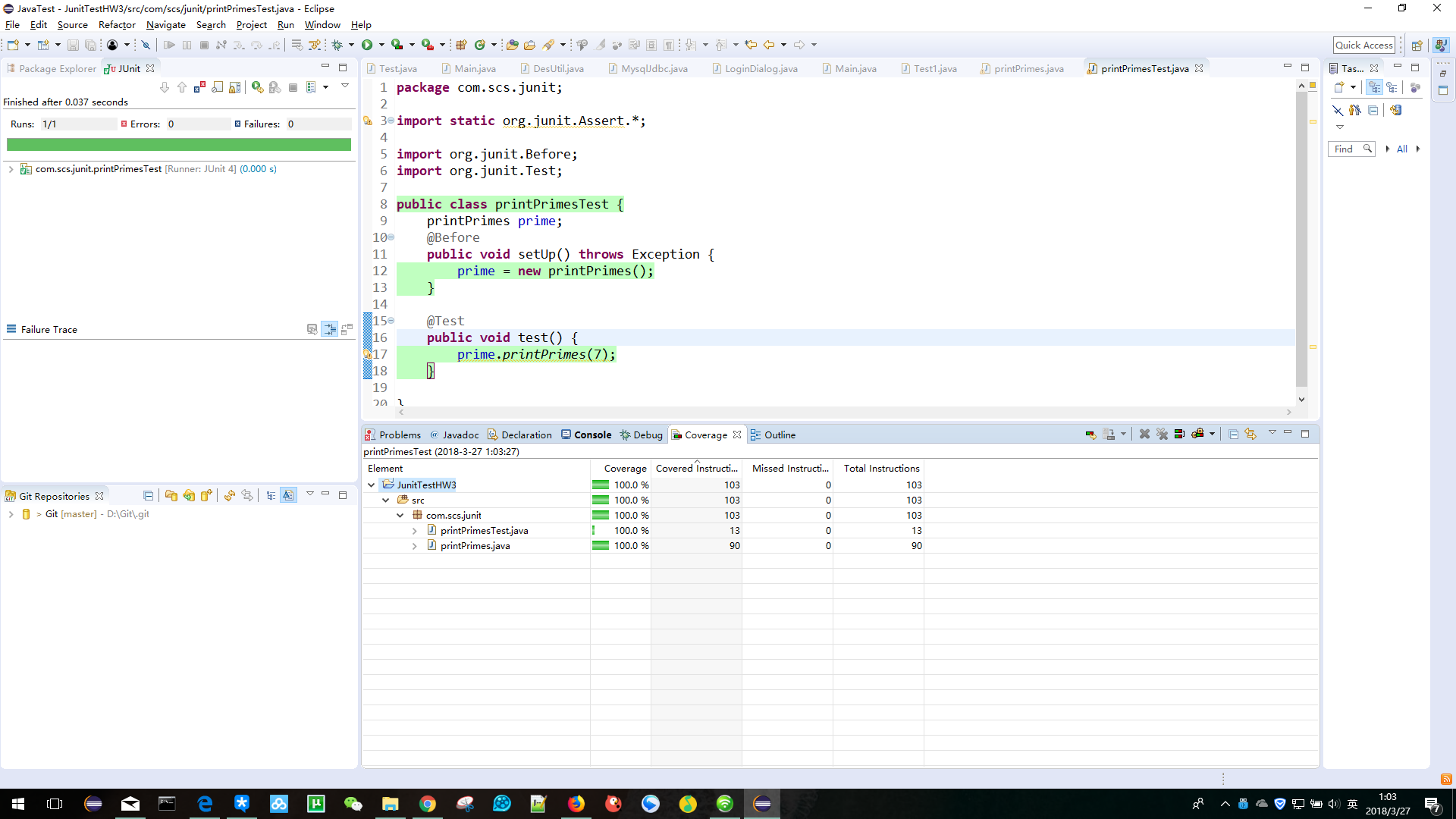
(e) 基于Junit及Eclemma(jacoco)实现一个主路径覆盖的测试
printPrimesTest.java
package com.scs.junit;

import static org.junit.Assert.*;

import org.junit.Before;
import org.junit.Test;

public class printPrimesTest {
    printPrimes prime;
    @Before
    public void setUp() throws Exception {
        prime = new printPrimes();
    }

    @Test
    public void test() {
        prime.printPrimes(7);
    }

}

 浙公网安备 33010602011771号