
实验6:开源控制器实践——RYU
实验6:开源控制器实践——RYU
一、实验目的
- 能够独立部署RYU控制器;
- 能够理解RYU控制器实现软件定义的集线器原理;
- 能够理解RYU控制器实现软件定义的交换机原理。
二、实验环境
Ubuntu 20.04 Desktop amd64
三、实验要求
(一)基本要求
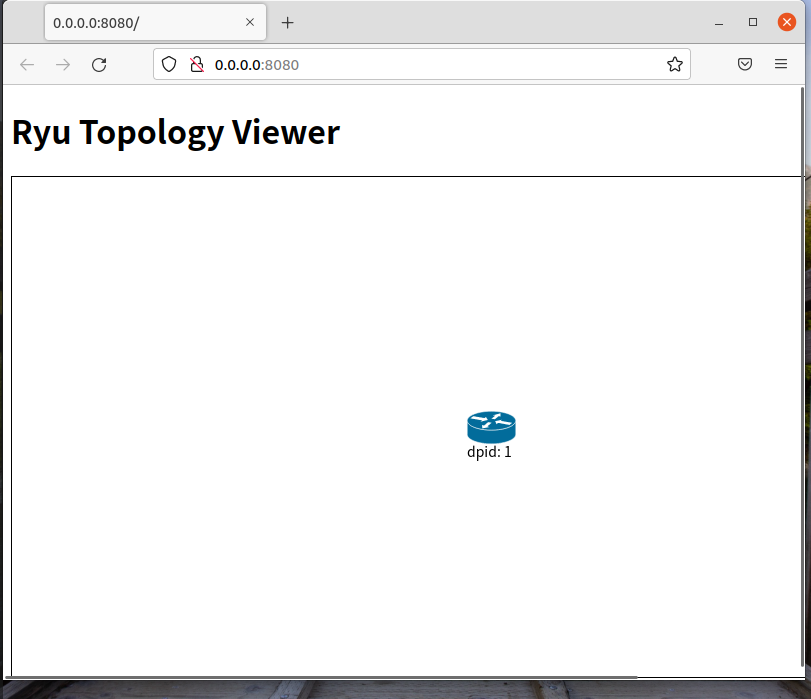
- 搭建下图所示SDN拓扑,协议使用Open Flow 1.0,并连接Ryu控制器,通过Ryu的图形界面查看网络拓扑。
![]()
- 阅读Ryu文档的The First Application一节,运行当中的L2Switch,h1 ping h2或h3,在目标主机使用 tcpdump 验证L2Switch,分析L2Switch和POX的Hub模块有何不同。
- 编程修改L2Switch.py,另存为L2xxxxxxxxx.py,使之和POX的Hub模块的变得一致?(xxxxxxxxx为学号)

(二)进阶要求
- 阅读Ryu关于simple_switch.py和simple_switch_1x.py的实现,以simple_switch_13.py为例,完成其代码的注释工作,并回答下列问题:
a) 代码当中的mac_to_port的作用是什么?
b) simple_switch和simple_switch_13在dpid的输出上有何不同?
c) 相比simple_switch,simple_switch_13增加的switch_feature_handler实现了什么功能?
d) simple_switch_13是如何实现流规则下发的?
e) switch_features_handler和_packet_in_handler两个事件在发送流规则的优先级上有何不同? - 编程实现和ODL实验的一样的硬超时功能。
(三)实验报告
- 基本要求需提交:回答基础要求2中有何不同,提交修改过的L2xxxxxxxxx.py代码和能够体现和验证修改的相关截图;
- 通过Ryu的图形界面查看网络拓扑
- L2Switch和POX的Hub模块异同点
相同之处:两个模块使用的是洪泛转发ICMP报文,所以无论h1 ping h2还是h3,都能收到数据包。
- 对h2和h3进行抓包,在目标主机中验证验证L2Switch
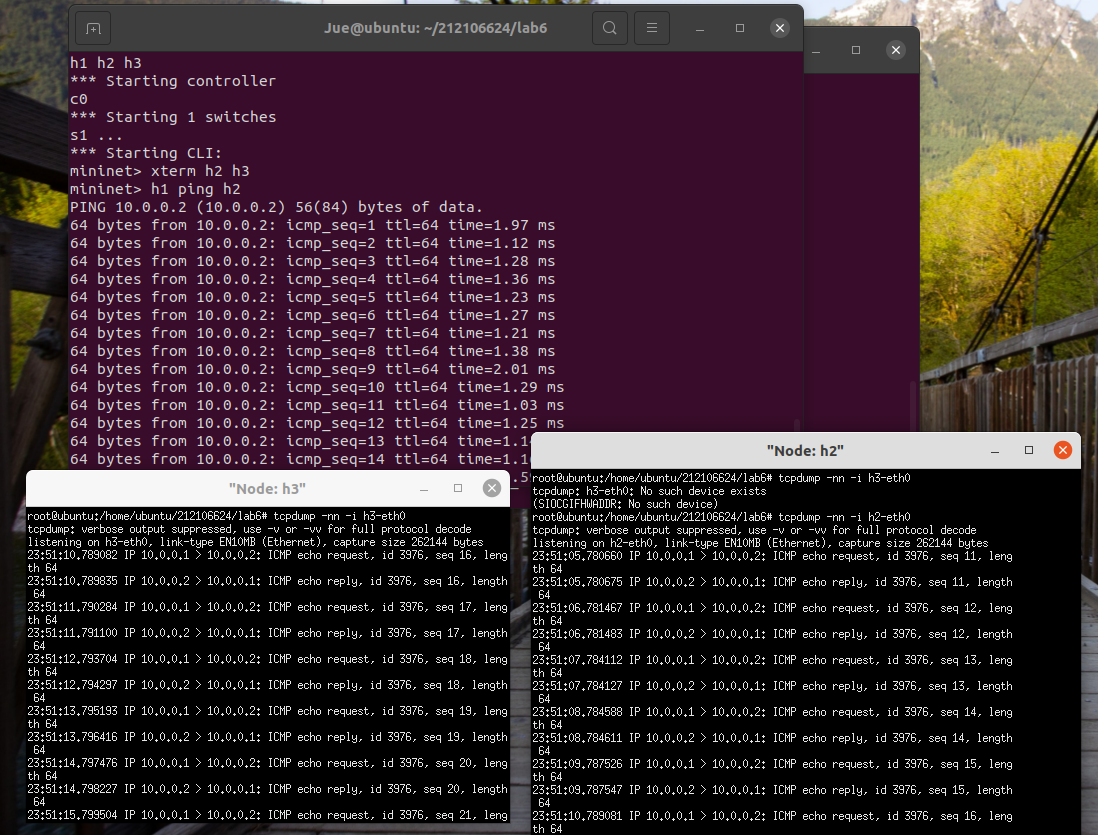
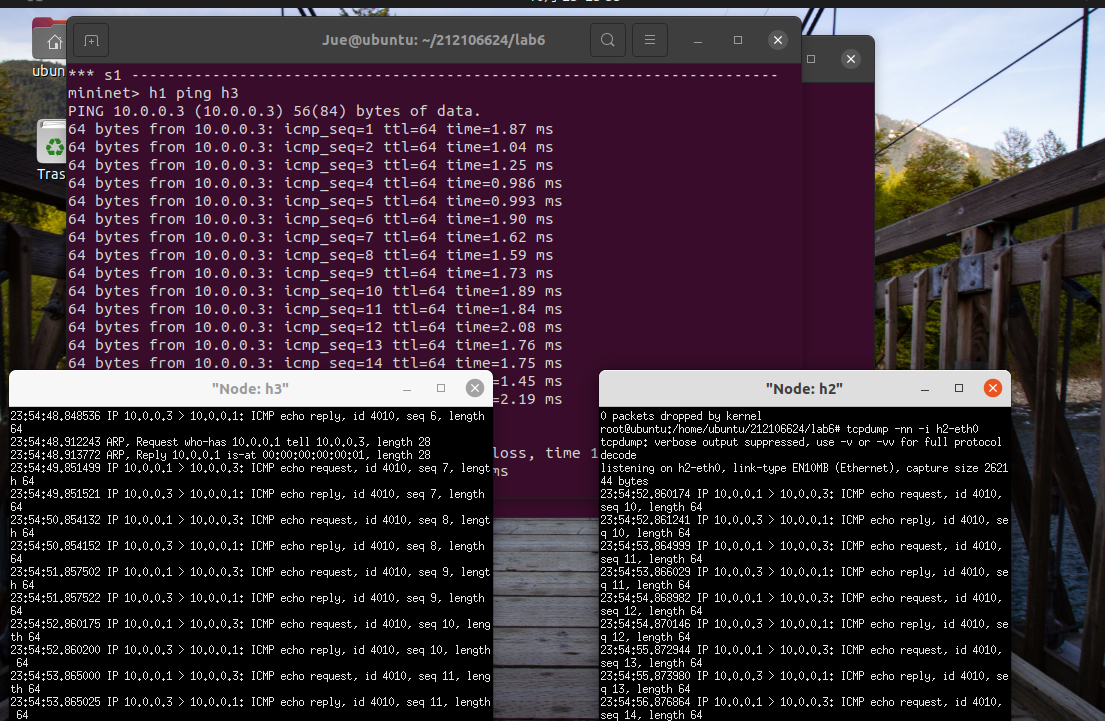
不同之处:L2Switch没有下发流表,如图所示

编程修改L2Switch.py
from ryu.base import app_manager
from ryu.ofproto import ofproto_v1_3
from ryu.controller import ofp_event
from ryu.controller.handler import MAIN_DISPATCHER, CONFIG_DISPATCHER
from ryu.controller.handler import set_ev_cls


class hub(app_manager.RyuApp):
    OFP_VERSIONS = [ofproto_v1_3.OFP_VERSION]

    def __init__(self, *args, **kwargs):
        super(hub, self).__init__(*args, **kwargs)

    @set_ev_cls(ofp_event.EventOFPSwitchFeatures, CONFIG_DISPATCHER)
    def switch_feathers_handler(self, ev):
        datapath = ev.msg.datapath
        ofproto = datapath.ofproto
        ofp_parser = datapath.ofproto_parser

        # install flow table-miss flow entry
        match = ofp_parser.OFPMatch()
        actions = [ofp_parser.OFPActionOutput(ofproto.OFPP_CONTROLLER, ofproto.OFPCML_NO_BUFFER)]
        # 1\OUTPUT PORT, 2\BUFF IN SWITCH?
        self.add_flow(datapath, 0, match, actions)

    def add_flow(self, datapath, priority, match, actions):
        # 1\ datapath for the switch, 2\priority for flow entry, 3\match field, 4\action for packet
        ofproto = datapath.ofproto
        ofp_parser = datapath.ofproto_parser
        # install flow
        inst = [ofp_parser.OFPInstructionActions(ofproto.OFPIT_APPLY_ACTIONS, actions)]
        mod = ofp_parser.OFPFlowMod(datapath=datapath, priority=priority, match=match, instructions=inst)
        datapath.send_msg(mod)

    @set_ev_cls(ofp_event.EventOFPPacketIn, MAIN_DISPATCHER)
    def packet_in_handler(self, ev):
        msg = ev.msg
        datapath = msg.datapath
        ofproto = datapath.ofproto
        ofp_parser = datapath.ofproto_parser
        in_port = msg.match['in_port']  # get in port of the packet

        # add a flow entry for the packet
        match = ofp_parser.OFPMatch()
        actions = [ofp_parser.OFPActionOutput(ofproto.OFPP_FLOOD)]
        self.add_flow(datapath, 1, match, actions)

        # to output the current packet. for install rules only output later packets
        out = ofp_parser.OFPPacketOut(datapath=datapath, buffer_id=msg.buffer_id, in_port=in_port, actions=actions)
        # buffer id: locate the buffered packet
        datapath.send_msg(out)
结果:
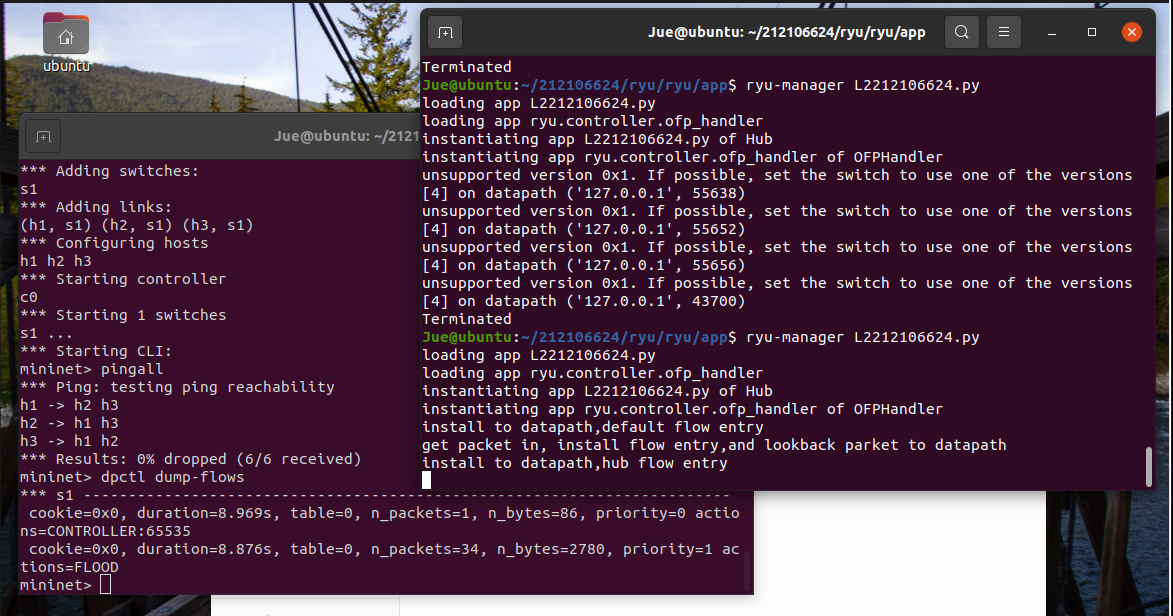
2.进阶要求为选做,有完成的同学请提交相关问题回答、代码和运行结果,交换机流表项截图,代码保存目录同要求2,有完成比未完成的上机分数更高。
- 阅读Ryu关于simple_switch.py和simple_switch_1x.py的实现,以simple_switch_13.py为例,完成其代码的注释工作,并回答下列问题:
# Copyright (C) 2011 Nippon Telegraph and Telephone Corporation.
#
# Licensed under the Apache License, Version 2.0 (the "License");
# you may not use this file except in compliance with the License.
# You may obtain a copy of the License at
#
#    http://www.apache.org/licenses/LICENSE-2.0
#
# Unless required by applicable law or agreed to in writing, software
# distributed under the License is distributed on an "AS IS" BASIS,
# WITHOUT WARRANTIES OR CONDITIONS OF ANY KIND, either express or
# implied.
# See the License for the specific language governing permissions and
# limitations under the License.

# 引入包
from ryu.base import app_manager
from ryu.controller import ofp_event
from ryu.controller.handler import CONFIG_DISPATCHER, MAIN_DISPATCHER
from ryu.controller.handler import set_ev_cls
from ryu.ofproto import ofproto_v1_3
from ryu.lib.packet import packet
from ryu.lib.packet import ethernet
from ryu.lib.packet import ether_types


class SimpleSwitch13(app_manager.RyuApp):   # 继承
    # 定义openflow版本
    OFP_VERSIONS = [ofproto_v1_3.OFP_VERSION]

    def __init__(self, *args, **kwargs):
        super(SimpleSwitch13, self).__init__(*args, **kwargs)
        self.mac_to_port = {}  # 用字典存储MAC地址表


    # 处理EventOFPSwitchFeatures事件
    @set_ev_cls(ofp_event.EventOFPSwitchFeatures, CONFIG_DISPATCHER)
    def switch_features_handler(self, ev):
        datapath = ev.msg.datapath  # datapath可认为是交换机n上发生的事
        ofproto = datapath.ofproto  # openflow协议的版本
        parser = datapath.ofproto_parser  # openflow协议的解析器

        # install table-miss flow entry
        #
        # We specify NO BUFFER to max_len of the output action due to
        # OVS bug. At this moment, if we specify a lesser number, e.g.,
        # 128, OVS will send Packet-In with invalid buffer_id and
        # truncated packet data. In that case, we cannot output packets
        # correctly.  The bug has been fixed in OVS v2.1.0.
        match = parser.OFPMatch()  # match:流表项匹配,OFPMatch():空的,为了匹配所有的封包
        # actions是为了转送到控制器端口,参数里是发往控制器端口,不进行缓存
        actions = [parser.OFPActionOutput(ofproto.OFPP_CONTROLLER,
                                          ofproto.OFPCML_NO_BUFFER)]
        self.add_flow(datapath, 0, match, actions)  # 添加流表

        def add_flow(self, datapath, priority, match, actions, buffer_id=None):
        # 获取交换机信息
        ofproto = datapath.ofproto
        parser = datapath.ofproto_parser

        # inst是instruction的缩写,第一个参数是马上执行动作,第二个参数是执行动作的对象
        inst = [parser.OFPInstructionActions(ofproto.OFPIT_APPLY_ACTIONS,
                                             actions)]
        # 判断是否存在buffer_id,并生成mod对象
        if buffer_id:
            mod = parser.OFPFlowMod(datapath=datapath, buffer_id=buffer_id,
                                    priority=priority, match=match,
                                    instructions=inst)
        else:
            mod = parser.OFPFlowMod(datapath=datapath, priority=priority,
                                    match=match, instructions=inst)
        datapath.send_msg(mod)   # 发送mod操作指令给交换机


    # 监听packet_in消息是否被触发,用来处理未知目的地的封包
    @set_ev_cls(ofp_event.EventOFPPacketIn, MAIN_DISPATCHER)
    def _packet_in_handler(self, ev):
        # If you hit this you might want to increase
        # the "miss_send_length" of your switch
        if ev.msg.msg_len < ev.msg.total_len:
            self.logger.debug("packet truncated: only %s of %s bytes",
                              ev.msg.msg_len, ev.msg.total_len)
        msg = ev.msg
        datapath = msg.datapath
        ofproto = datapath.ofproto
        parser = datapath.ofproto_parser
        in_port = msg.match['in_port']

        pkt = packet.Packet(msg.data)
        eth = pkt.get_protocols(ethernet.ethernet)[0]

        if eth.ethertype == ether_types.ETH_TYPE_LLDP:
            # ignore lldp packet
            # 忽略LLDP类型的数据包
            return
        dst = eth.dst    # 获取目的端口
        src = eth.src    # 获取源端口


        dpid = format(datapath.id, "d").zfill(16)     # MAC地址表和每个交换机之间的识别,用dpid确认
        self.mac_to_port.setdefault(dpid, {})

        # 打印日志信息
        self.logger.info("packet in %s %s %s %s", dpid, src, dst, in_port)
        # learn a mac address to avoid FLOOD next time.
        # 学习包的源地址,和交换机上的入端口绑定
        self.mac_to_port[dpid][src] = in_port

        if dst in self.mac_to_port[dpid]:   # 如果目标Mac地址已经被学习了,决定哪个从哪个端口发送数据包,否则泛洪
            out_port = self.mac_to_port[dpid][dst]
        else:
            out_port = ofproto.OFPP_FLOOD

        actions = [parser.OFPActionOutput(out_port)]

        # 下发流表避免下次触发 packet in 事件
        # install a flow to avoid packet_in next time
        if out_port != ofproto.OFPP_FLOOD:
            match = parser.OFPMatch(in_port=in_port, eth_dst=dst, eth_src=src)
            # verify if we have a valid buffer_id, if yes avoid to send both
            # flow_mod & packet_out
            if msg.buffer_id != ofproto.OFP_NO_BUFFER:
                self.add_flow(datapath, 1, match, actions, msg.buffer_id)
                return
            else:
                self.add_flow(datapath, 1, match, actions)
        data = None
        if msg.buffer_id == ofproto.OFP_NO_BUFFER:
            data = msg.data
        # 构造一个pack_out消息然后发送
        out = parser.OFPPacketOut(datapath=datapath, buffer_id=msg.buffer_id,
                                  in_port=in_port, actions=actions, data=data)
        datapath.send_msg(out)
a) 代码当中的mac_to_port的作用是什么?
mac_to_port的作用是保存mac地址到交换机端口的映射
b) simple_switch和simple_switch_13在dpid的输出上有何不同?
simple_switch直接输出dpid:dpid = datapath.id
simple_switch_13中dpid用0在dpid前填充至总长度为16:dpid = format(datapath.id, "d").zfill(16)
c) 相比simple_switch,simple_switch_13增加的switch_feature_handler实现了什么功能?
switch_features_handler函数是新增缺失流表项到流表中,当封包没有匹配到流表时,就触发packet_in
d) simple_switch_13是如何实现流规则下发的?
在接收到packetin事件后,首先获取包学习,交换机信息,以太网信息,协议信息等。若以太网类型是LLDP类型,则不予处理。如果不是,则获取源端口的目的端口和交换机id,先学习源地址对应的交换机的入端口,再查看是否已经学习目的mac地址,如果没有则进行洪泛转发。如果学习过该mac地址,则查看是否有buffer_id,如果有的话,则在添加流表信息时加上buffer_id,向交换机发送流表。
e) switch_features_handler和_packet_in_handler两个事件在发送流规则的优先级上有何不同?
switch_features_handler下发流表的优先级更高
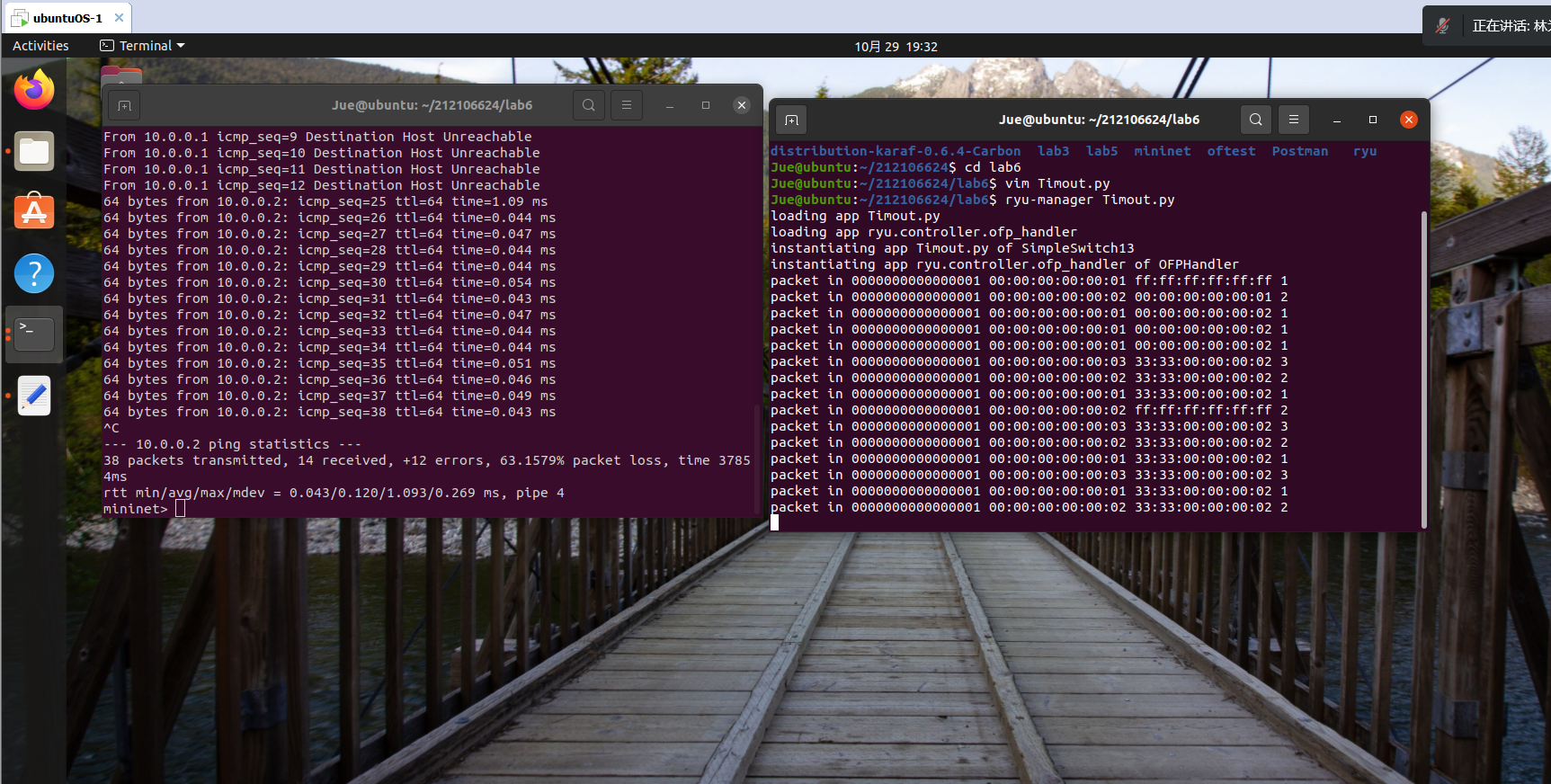
编程实现和ODL实验的一样的硬超时功能
# Copyright (C) 2011 Nippon Telegraph and Telephone Corporation.
#
# Licensed under the Apache License, Version 2.0 (the "License");
# you may not use this file except in compliance with the License.
# You may obtain a copy of the License at
#
#    http://www.apache.org/licenses/LICENSE-2.0
#
# Unless required by applicable law or agreed to in writing, software
# distributed under the License is distributed on an "AS IS" BASIS,
# WITHOUT WARRANTIES OR CONDITIONS OF ANY KIND, either express or
# implied.
# See the License for the specific language governing permissions and
# limitations under the License.

from ryu.base import app_manager
from ryu.controller import ofp_event
from ryu.controller.handler import CONFIG_DISPATCHER, MAIN_DISPATCHER
from ryu.controller.handler import set_ev_cls
from ryu.ofproto import ofproto_v1_3
from ryu.lib.packet import packet
from ryu.lib.packet import ethernet
from ryu.lib.packet import ether_types


class SimpleSwitch13(app_manager.RyuApp):
    OFP_VERSIONS = [ofproto_v1_3.OFP_VERSION]

    def __init__(self, *args, **kwargs):
        super(SimpleSwitch13, self).__init__(*args, **kwargs)
        self.mac_to_port = {}

    @set_ev_cls(ofp_event.EventOFPSwitchFeatures, CONFIG_DISPATCHER)
    def switch_features_handler(self, ev):
        datapath = ev.msg.datapath
        ofproto = datapath.ofproto
        parser = datapath.ofproto_parser

        # install table-miss flow entry
        #
        # We specify NO BUFFER to max_len of the output action due to
        # OVS bug. At this moment, if we specify a lesser number, e.g.,
        # 128, OVS will send Packet-In with invalid buffer_id and
        # truncated packet data. In that case, we cannot output packets
        # correctly.  The bug has been fixed in OVS v2.1.0.
        match = parser.OFPMatch()
        actions = [parser.OFPActionOutput(ofproto.OFPP_CONTROLLER,
                                          ofproto.OFPCML_NO_BUFFER)]
        self.add_flow(datapath, 0, match, actions)

    def add_flow(self, datapath, priority, match, actions, buffer_id=None, hard_timeout=0):
        ofproto = datapath.ofproto
        parser = datapath.ofproto_parser

        inst = [parser.OFPInstructionActions(ofproto.OFPIT_APPLY_ACTIONS,
                                             actions)]
        if buffer_id:
            mod = parser.OFPFlowMod(datapath=datapath, buffer_id=buffer_id,
                                    priority=priority, match=match,
                                    instructions=inst, hard_timeout=hard_timeout)
        else:
            mod = parser.OFPFlowMod(datapath=datapath, priority=priority,
                                    match=match, instructions=inst, hard_timeout=hard_timeout)
        datapath.send_msg(mod)

    @set_ev_cls(ofp_event.EventOFPPacketIn, MAIN_DISPATCHER)
    def _packet_in_handler(self, ev):
        # If you hit this you might want to increase
        # the "miss_send_length" of your switch
        if ev.msg.msg_len < ev.msg.total_len:
            self.logger.debug("packet truncated: only %s of %s bytes",
                              ev.msg.msg_len, ev.msg.total_len)
        msg = ev.msg
        datapath = msg.datapath
        ofproto = datapath.ofproto
        parser = datapath.ofproto_parser
        in_port = msg.match['in_port']

        pkt = packet.Packet(msg.data)
        eth = pkt.get_protocols(ethernet.ethernet)[0]

        if eth.ethertype == ether_types.ETH_TYPE_LLDP:
            # ignore lldp packet
            return
        dst = eth.dst
        src = eth.src

        dpid = format(datapath.id, "d").zfill(16)
        self.mac_to_port.setdefault(dpid, {})

        self.logger.info("packet in %s %s %s %s", dpid, src, dst, in_port)

        # learn a mac address to avoid FLOOD next time.
        self.mac_to_port[dpid][src] = in_port

        if dst in self.mac_to_port[dpid]:
            out_port = self.mac_to_port[dpid][dst]
        else:
            out_port = ofproto.OFPP_FLOOD

        actions = [parser.OFPActionOutput(out_port)]\

        actions_timeout=[]

        # install a flow to avoid packet_in next time
        if out_port != ofproto.OFPP_FLOOD:
            match = parser.OFPMatch(in_port=in_port, eth_dst=dst, eth_src=src)
            # verify if we have a valid buffer_id, if yes avoid to send both
            # flow_mod & packet_out
            hard_timeout=10
            if msg.buffer_id != ofproto.OFP_NO_BUFFER:
                self.add_flow(datapath, 2, match,actions_timeout, msg.buffer_id,hard_timeout=10)
                self.add_flow(datapath, 1, match, actions, msg.buffer_id)
                return
            else:
                self.add_flow(datapath, 2, match, actions_timeout, hard_timeout=10)
                self.add_flow(datapath, 1, match, actions)
        data = None
        if msg.buffer_id == ofproto.OFP_NO_BUFFER:
            data = msg.data

        out = parser.OFPPacketOut(datapath=datapath, buffer_id=msg.buffer_id,
                                  in_port=in_port, actions=actions, data=data)
        datapath.send_msg(out)
个人总结
本次实验学习了部署RYU控制器,理解RYU控制器实现软件定义的集线器和交换机的原理
做过了实验五后,在完成实验六的基础要求就比较得心应手,二者连接控制器以及验证的过程差别不大。通过本次实验我能够部署RYU控制器,顺利打开ryu的可视化图形界面,此外也进一步熟悉了之前tcpdump命令的用法,同时通过进阶要求对simple_switch_13有了一点了解。这次进阶要求的问题有很多,需要自己对于相关代码的理解要十分全面,主要还是由于对于英文文档阅读起来非常吃力;对于本次实验,最重要的还是了解到Hub和L2Switch的区别就在于下发流表是否可以查看,希望可以在之后的实验中能够更加深入地理解到它们的区别,有机会的话会加以使用。

 浙公网安备 33010602011771号