【代码粗读】Simultaneously Self-Attending to All Mentions for Full-Abstract Biological Relation Extraction
代码地址:https://github.com/patverga/bran
今天下载这篇论文的代码,着实把我惊住了,工程量庞大,脚本文件太多看花眼,而且代码使用python2 写的,和我python3环境不搭。
先记录下调试过程中的坑。
Setup Environment Variables
From this directory call: source set_environment.sh
Note: this will only set the paths for this session.
#!/usr/bin/env bash

export PYTHONPATH=$PYTHONPATH:`pwd`
export CDR_IE_ROOT=`pwd`
主要是通过'pwd'获得当前文件夹的目录。用shell中变量CDR_IE_ROOT保存
Processing Data
CDR
Process the CDR dataset${CDR_IE_ROOT}/bin/process_CDR/process_CDR.sh
Process the CDR dataset including additional weakly labeled data${CDR_IE_ROOT}/bin/process_CDR/process_CDR_extra_data.sh
These scripts will use byte-pair encoding (BPE) tokenization. There are also scripts to tokenize using the Genia tokenizer.
#!/usr/bin/env bash

#CDR_IE_ROOT = 'D:/python/wgy_jupyter/bran-master'
word_piece_vocab=data/cdr/word_piece_vocabs/just_train_2500/word_pieces.txt
input_dir=${CDR_IE_ROOT}/data/cdr
processed_dir=${input_dir}/processed/just_train_2500
proto_dir=${processed_dir}/protos
max_len=500000
# replace infrequent tokens with <UNK>
min_count=5


# process train, dev, and test data
mkdir -p ${processed_dir}
echo "Processing Training data"
python ${CDR_IE_ROOT}/src/processing/utils/process_CDR_data.py \
        --input_file ${input_dir}/CDR_TrainingSet.PubTator.txt.gz \
        --output_dir ${processed_dir} --output_file_suffix CDR_train.txt \
        --max_seq ${max_len} \
        --full_abstract True --word_piece_codes ${word_piece_vocab}
for f in CDR_dev CDR_train CDR_test; do
python ${CDR_IE_ROOT}/src/processing/utils/filter_hypernyms.py \
     -p ${processed_dir}/positive_0_${f}.txt \
     -n ${processed_dir}/negative_0_${f}.txt \
     -m data/2017MeshTree.txt \
     -o ${processed_dir}/negative_0_${f}_filtered.txt
done
拿训练集来举例:根据sh脚本文件的命令我们通过加载TraningSet.PubTator.txt.gz并与用分词工具BPE,得到关于训练集的命名实体训练集,正样本,负样本(过滤/未过滤)
word_pieces是一些切开分词的内容:
#version: 0.2
i n
t i
r e
t h
a n
e n
e r
e d</w>
o n
o f</w>
a t
th e</w>
r o
i n</w>
a ti
i t
an d</w>
a r
o n</w>
s t
s i
a l
a l</w>
o r
i c
a s
e c
d i
a c
en t
l o
in g</w>
t o</w>
生成的数据集文件目录:
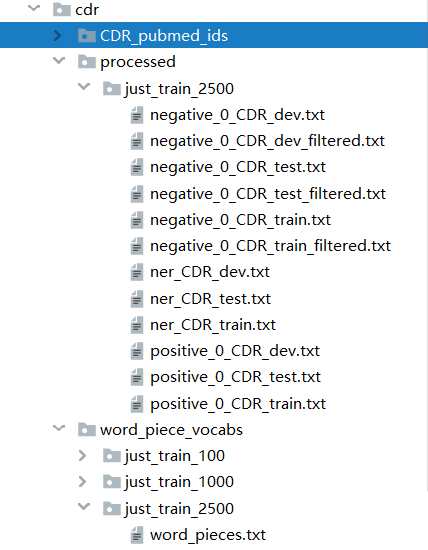
其中因为python2与python3的语法问题,Error: a bytes-like object is required, not 'str'
问题出在python3.5和Python2.7在套接字返回值解码上有区别:
python bytes和str两种类型可以通过函数encode()和decode()相互转换,
str→bytes:encode()方法。str通过encode()方法可以转换为bytes。
bytes→str:decode()方法。如果我们从网络或磁盘上读取了字节流,那么读到的数据就是bytes。要把bytes变为str,就需要用decode()方法。
解决方法:
将line.strip().split(",") 改为 line.decode().strip().split(",")【这分明和报错写的意思相反!】
也不知道为什么同一文件夹目录下
from word_piece_tokenizer import WordPieceTokenizer
语句导入同级别的包会标出红线报错,但是不影响使用,但在Pycharm中无法ctrl+鼠标索引;
from .word_piece_tokenizer import WordPieceTokenizer
这样同级别包下虽然不会红线报错,但代码无法运行,但在Pycharm中能够ctrl+鼠标索引.
代码使用Tensorflow 1.X写的所以没太看懂,只找到对应论文的模型部分看下作者如何实现的:
2.1 Inputs
 1     def get_token_embeddings(self, token_embeddings, position_embeddings, token_attention=None):
 2         selected_words = tf.nn.embedding_lookup(token_embeddings, self.text_batch)
 3         if self.project_inputs:
 4             params = {"inputs": selected_words, "filters": self.embed_dim, "kernel_size": 1,
 5                       "activation": tf.nn.relu, "use_bias": True}
 6             selected_words = tf.layers.conv1d(**params)
 7         if self.position_dim > 0:
 8             selected_e1_dists = tf.nn.embedding_lookup(position_embeddings, self.e1_dist_batch)
 9             selected_e2_dists = tf.nn.embedding_lookup(position_embeddings, self.e2_dist_batch)
10             token_embeds = tf.concat(axis=2, values=[selected_words, selected_e1_dists, selected_e2_dists])
11         else:
12             token_embeds = selected_words
13
14         if self.encode_position:
15             pad_mask = tf.expand_dims(tf.cast(tf.not_equal(self.text_batch, self.pad_idx), tf.float32), [2])
16             pos_encoding = pad_mask * tf.nn.embedding_lookup(self.pos_encoding, self.pos_encode_batch)
17             token_embeds = tf.add(token_embeds, pos_encoding)
18
19         dropped_embeddings = tf.nn.dropout(token_embeds, self.word_dropout_keep)
20         # keep pad tokens as 0 vectors
21         if self.filter_pad:
22             print('Filtering pad tokens')
23             dropped_embeddings = tf.multiply(dropped_embeddings,
24                                              tf.expand_dims(tf.cast(tf.not_equal(self.text_batch, self.pad_idx),
25                                                                     tf.float32), [2]))
26
27         return dropped_embeddings
2.2 Transformer
 1     def forward(self, input_feats, middle_dropout_keep_prob, hidden_dropout_keep_prob, batch_size, max_seq_len,
 2                 reuse, block_num=0):
 3         initial_in_dim =self.embed_dim if self.project_inputs else self.token_dim+(2*self.position_dim)
 4         input_feats *= (initial_in_dim ** 0.5)     #开根号
 5         self.attention_weights = []
 6         for i in range(self.block_repeats):     #B个transformer块
 7             with tf.variable_scope("num_blocks_{}".format(i)):
 8                 ### Multihead Attention
 9                 in_dim = self.embed_dim if i > 0 else initial_in_dim
10                 input_feats = self.multihead_attention(queries=input_feats,
11                                                   keys=input_feats,
12                                                   num_units=in_dim,
13                                                   num_heads=self.num_heads,
14                                                   dropout_rate=middle_dropout_keep_prob,
15                                                   causality=False,
16                                                   reuse=reuse)
17
18                 ### Feed Forward
19                 input_feats = self.feedforward(input_feats, num_units=[in_dim*self.ff_scale, in_dim], reuse=reuse)
20         return input_feats
2.2.1 Multi-head Attention
 1     def multihead_attention(self, queries,
 2                             keys,
 3                             num_units=None,
 4                             num_heads=8,
 5                             dropout_rate=0,
 6                             is_training=True,
 7                             causality=False,
 8                             scope="multihead_attention",
 9                             reuse=None):
10         '''
11         June 2017 by kyubyong park.
12         kbpark.linguist@gmail.com.
13         https://www.github.com/kyubyong/transformer
14         '''
15         '''Applies multihead attention.
16
17         Args:
18           queries: A 3d tensor with shape of [N, T_q, C_q].
19           keys: A 3d tensor with shape of [N, T_k, C_k].
20           num_units: A scalar. Attention size.
21           dropout_rate: A floating point number.
22           is_training: Boolean. Controller of mechanism for dropout.
23           causality: Boolean. If true, units that reference the future are masked.
24           num_heads: An int. Number of heads.
25           scope: Optional scope for `variable_scope`.
26           reuse: Boolean, whether to reuse the weights of a previous layer
27             by the same name.
28
29         Returns
30           A 3d tensor with shape of (N, T_q, C)
31         '''
32         with tf.variable_scope(scope, reuse=reuse):
33             # Set the fall back option for num_units
34             if num_units is None:
35                 num_units = queries.get_shape().as_list[-1]
36
37             # Linear projections
38             Q = tf.layers.dense(queries, num_units, activation=tf.nn.relu) # (N, T_q, C)
39             K = tf.layers.dense(keys, num_units, activation=tf.nn.relu) # (N, T_k, C)
40             V = tf.layers.dense(keys, num_units, activation=tf.nn.relu) # (N, T_k, C)
41
42             # Split and concat
43             Q_ = tf.concat(tf.split(Q, num_heads, axis=2), axis=0) # (h*N, T_q, C/h)
44             K_ = tf.concat(tf.split(K, num_heads, axis=2), axis=0) # (h*N, T_k, C/h)
45             V_ = tf.concat(tf.split(V, num_heads, axis=2), axis=0) # (h*N, T_k, C/h)
46
47             # Multiplication
48             outputs = tf.matmul(Q_, tf.transpose(K_, [0, 2, 1])) # (h*N, T_q, T_k)
49
50             # Scale
51             outputs = outputs / (K_.get_shape().as_list()[-1] ** 0.5)
52
53             # Key Masking
54             key_masks = tf.sign(tf.abs(tf.reduce_sum(keys, axis=-1))) # (N, T_k)
55             key_masks = tf.tile(key_masks, [num_heads, 1]) # (h*N, T_k)
56             key_masks = tf.tile(tf.expand_dims(key_masks, 1), [1, tf.shape(queries)[1], 1]) # (h*N, T_q, T_k)
57
58             paddings = tf.ones_like(outputs)*(-1e8)
59             outputs = tf.where(tf.equal(key_masks, 0), paddings, outputs) # (h*N, T_q, T_k)
60
61             # Activation
62             attention_weights = tf.nn.softmax(outputs) # (h*N, T_q, T_k)
63             # store the attention weights for analysis
64             batch_size = tf.shape(queries)[0]
65             seq_len = tf.shape(queries)[1]
66             save_attention = tf.reshape(attention_weights, [self.num_heads, batch_size, seq_len, seq_len])
67             save_attention = tf.transpose(save_attention, [1, 0, 2, 3])
68             self.attention_weights.append(save_attention)
69
70             # Query Masking
71             query_masks = tf.sign(tf.abs(tf.reduce_sum(queries, axis=-1))) # (N, T_q)
72             query_masks = tf.tile(query_masks, [num_heads, 1]) # (h*N, T_q)
73             query_masks = tf.tile(tf.expand_dims(query_masks, -1), [1, 1, tf.shape(keys)[1]]) # (h*N, T_q, T_k)
74             outputs = attention_weights * query_masks # broadcasting. (N, T_q, C)
75
76             # Dropouts
77             outputs = tf.nn.dropout(outputs, dropout_rate)
78
79             # Weighted sum
80             outputs = tf.matmul(outputs, V_) # ( h*N, T_q, C/h)
81
82             # Restore shape
83             outputs = tf.concat(tf.split(outputs, num_heads, axis=0), axis=-1 ) # (N, T_q, C)
84
85             # Residual connection
86             outputs += tf.nn.dropout(queries, dropout_rate)
87
88             # Normalize
89             outputs = self.normalize(outputs) # (N, T_q, C)
90
91         return outputs
2.2.2 Convolutions
 1     def feedforward(self, inputs,
 2                     num_units=[2048, 512],
 3                     scope="multihead_attention",
 4                     reuse=None):
 5
 6         '''Point-wise feed forward net.
 7
 8         Args:
 9           inputs: A 3d tensor with shape of [N, T, C].
10           num_units: A list of two integers.
11           scope: Optional scope for `variable_scope`.
12           reuse: Boolean, whether to reuse the weights of a previous layer
13             by the same name.
14
15         Returns:
16           A 3d tensor with the same shape and dtype as inputs
17         '''
18         with tf.variable_scope(scope, reuse=reuse):
19             outputs = inputs
20             layer_params = self.layer_str.split(',')
21             for i, l_params in enumerate(layer_params):
22                 width, dilation = [int(x) for x in l_params.split(':')]
23                 dim = num_units[1] if i == (len(layer_params)-1) else num_units[0]
24
25                 print('dimension: %d  width: %d  dilation: %d' % (dim, width, dilation))
26                 params = {"inputs": outputs, "filters": dim, "kernel_size": width,
27                           "activation": tf.nn.relu, "use_bias": True, "padding": "same", "dilation_rate": dilation}
28                 outputs = tf.layers.conv1d(**params)
29             # mask padding
30             outputs *= tf.expand_dims(tf.cast(tf.not_equal(self.text_batch, self.pad_idx), tf.float32), [2])
31             # Residual connection
32             inputs += outputs
33
34             # Normalize
35             outputs = self.normalize(outputs)
36
37         return outputs
2.3 Bi-affine Pairwise Scores
 1     def aggregate_tokens(self, encoded_tokens, batch_size, max_seq_len,
 2                          attention_vector, e1_dist_batch, e2_dist_batch, seq_lens,
 3                          middle_dropout_keep_prob, hidden_dropout_keep_prob, final_dropout_keep,
 4                          scope_name='text', reuse=False, aggregation='attention'):
 5
 6         reduction = tf.reduce_logsumexp
 7         # # aggregation='attention'
 8         with tf.variable_scope(scope_name, reuse=reuse):
 9             input_feats = encoded_tokens
10
11             e1_mask = tf.cast(tf.expand_dims(tf.equal(self.e1_dist_batch, self.entity_index), 2), tf.float32)
12             e2_mask = tf.cast(tf.expand_dims(tf.equal(self.e2_dist_batch, self.entity_index), 2), tf.float32)
13
14             # # b x s x (d*l)
15             e1 = tf.layers.dense(tf.layers.dense(input_feats, self.embed_dim, activation=tf.nn.relu), self.embed_dim)
16             e2 = tf.layers.dense(tf.layers.dense(input_feats, self.embed_dim, activation=tf.nn.relu), self.embed_dim)
17
18             e1 = tf.nn.dropout(e1, final_dropout_keep)
19             e2 = tf.nn.dropout(e2, final_dropout_keep)
20
21             # result = self.diagonal_bilinear(e1, e2, num_labels)
22             pairwise_scores = self.bilinear(e1, e2, self.num_labels)
23             # self.attention_weights = tf.split(self.bilinear_scores, self.num_labels, 2)[1]
24             self.pairwise_scores = tf.nn.softmax(pairwise_scores, dim=2)
25             result = tf.transpose(pairwise_scores, [0, 1, 3, 2])
26             # mask result
27             result += tf.expand_dims(self.ep_dist_batch, 3)
28             outputs = reduction(result, [1, 2])
29             print(outputs.get_shape())
30
31             return outputs
2.4 Entity Level Prediction
 1     def bilinear(self, inputs1, inputs2, output_size, add_bias2=True, add_bias1=True, add_bias=False,
 2                  initializer=None, scope=None, moving_params=None):
 3         """"""
 4         with tf.variable_scope(scope or 'Bilinear'):
 5             # Reformat the inputs
 6             ndims = len(inputs1.get_shape().as_list())
 7             inputs1_shape = tf.shape(inputs1)
 8             inputs1_bucket_size = inputs1_shape[ndims-2]
 9             inputs1_size = inputs1.get_shape().as_list()[-1]
10
11             inputs2_shape = tf.shape(inputs2)
12             inputs2_bucket_size = inputs2_shape[ndims-2]
13             inputs2_size = inputs2.get_shape().as_list()[-1]
14             output_shape = []
15             batch_size = 1
16             for i in range(ndims-2):
17                 batch_size *= inputs1_shape[i]
18                 output_shape.append(inputs1_shape[i])
19             output_shape.append(inputs1_bucket_size)
20             output_shape.append(output_size)
21             output_shape.append(inputs2_bucket_size)
22             inputs1 = tf.reshape(inputs1, [batch_size, inputs1_bucket_size, inputs1_size])
23             inputs2 = tf.reshape(inputs2, [batch_size, inputs2_bucket_size, inputs2_size])
24             if add_bias1:
25                 inputs1 = tf.concat([inputs1, tf.ones([batch_size, inputs1_bucket_size, 1])], 2)
26             if add_bias2:
27                 inputs2 = tf.concat([inputs2, tf.ones([batch_size, inputs2_bucket_size, 1])], 2)
28
29             # Get the matrix
30             if initializer is None and moving_params is None:
31                 mat = orthonormal_initializer(inputs1_size+add_bias1, inputs2_size+add_bias2)[:,None,:]
32                 mat = np.concatenate([mat]*output_size, axis=1)
33                 initializer = tf.constant_initializer(mat)
34             weights = tf.get_variable('Weights', [inputs1_size+add_bias1, output_size, inputs2_size+add_bias2], initializer=initializer)
35             if moving_params is not None:
36                 weights = moving_params.average(weights)
37             else:
38                 tf.add_to_collection('Weights', weights)
39
40             # Do the multiplications
41             # (bn x d) (d x rd) -> (bn x rd)
42             lin = tf.matmul(tf.reshape(inputs1, [-1, inputs1_size+add_bias1]),
43                             tf.reshape(weights, [inputs1_size+add_bias1, -1]))
44             # (b x nr x d) (b x n x d)T -> (b x nr x n)
45             bilin = tf.matmul(tf.reshape(lin, [batch_size, inputs1_bucket_size*output_size, inputs2_size+add_bias2]),
46                                     inputs2, adjoint_b=True)
47             # (bn x r x n)
48             bilin = tf.reshape(bilin, [-1, output_size, inputs2_bucket_size])
49             # (b x n x r x n)
50             bilin = tf.reshape(bilin, output_shape)
51
52             # Get the bias
53             if add_bias:
54                 bias = tf.get_variable('Biases', [output_size], initializer=tf.zeros_initializer)
55                 if moving_params is not None:
56                     bias = moving_params.average(bias)
57                 bilin += tf.expand_dims(bias, 1)
58
59             return bilin
由aggregate_tokens()得到的实体对score结果传入下列第19行代码:
 1     def embed_text_from_tokens(self, selected_col_embeddings, attention_vector, e1_dist_batch, e2_dist_batch, seq_lens,
 2                                middle_dropout_keep_prob, hidden_dropout_keep_prob, final_dropout_keep,
 3                                scope_name='text', reuse=False, aggregation='piecewise', return_tokens=False):
 4         batch_size = tf.shape(selected_col_embeddings)[0]
 5         max_seq_len = tf.shape(selected_col_embeddings)[1]
 6
 7         output = []
 8         last_output = selected_col_embeddings
 9         if not reuse:
10             print('___aggregation type:  %s filter %d  block repeats: %d___'
11                   % (aggregation, self.filter_width, self.block_repeats))
12         for i in range(1):
13             block_reuse = (reuse if i == 0 else True)
14             encoded_tokens = self.forward(last_output, middle_dropout_keep_prob,
15                                           hidden_dropout_keep_prob, batch_size, max_seq_len, block_reuse, i)
16             if return_tokens:
17                 output.append(encoded_tokens)
18             else:
19                 encoded_seq = self.aggregate_tokens(encoded_tokens, batch_size, max_seq_len,
20                                                     attention_vector, e1_dist_batch, e2_dist_batch, seq_lens,
21                                                     middle_dropout_keep_prob, hidden_dropout_keep_prob, final_dropout_keep,
22                                                     scope_name=scope_name, reuse=block_reuse, aggregation=aggregation)
23                 output.append(encoded_seq)
24             last_output = encoded_tokens
25         return output
由aggregate_tokens()得到的结果传入下列第12行代码:
 1     def embed_text(self, token_embeddings, position_embeddings, attention_vector,   #最终结果
 2                    scope_name='text', reuse=False, aggregation='attention', no_dropout=False,
 3                    return_tokens=False, token_attention=None,):
 4         selected_col_embeddings = self.get_token_embeddings(token_embeddings, position_embeddings, token_attention)
 5         if no_dropout:
 6             middle_dropout_keep_prob, hidden_dropout_keep_prob, final_dropout_keep = 1.0, 1.0, 1.0
 7         else:
 8             middle_dropout_keep_prob = self.middle_dropout_keep_prob
 9             hidden_dropout_keep_prob = self.hidden_dropout_keep_prob
10             final_dropout_keep = self.final_dropout_keep
11
12         output = self.embed_text_from_tokens(
13                 selected_col_embeddings, attention_vector,
14                 self.e1_dist_batch, self.e2_dist_batch, self.seq_len_batch,
15                 middle_dropout_keep_prob, hidden_dropout_keep_prob, final_dropout_keep,
16                 scope_name, reuse, aggregation, return_tokens=return_tokens)
17         return output
使用embed_text()的预测结果与标签做梯度下降优化模型:
1 encoded_text_list = self.text_encoder.embed_text(self.token_embeddings, self.position_embeddings,
2                                                              self.attention_vector, token_attention=token_attention)
3
4 self.loss = self.calculate_loss(encoded_text_list, predictions_list, self.label_batch,
5                                             FLAGS.l2_weight, FLAGS.dropout_loss_weight, no_drop_output_list)


 浙公网安备 33010602011771号