

换根dp
看到网上的方法多多少少比较复杂,所以决定写一下。
首先对于一道换根dp题应该是先要会不换根版本的。
然后可以按照欧拉序(括号序)换根。对于欧拉序中相邻的两个节点必有一条边把它们相连,所以换根的时候只需要从新统计 \(1\) 个子树的信息。
觉得自己的语言表达能力太烂,还是上题目比较好。
求一个点的应该很好做,考虑 \(f_u\) 表示点 \(u\) 的子树中的答案,\(sz_u\) 为 \(u\)的子树大小,有转移方程:
\[f_u=\sum_{v \in ch}(f_v+sz_v)
\]
考虑如何进行换根。
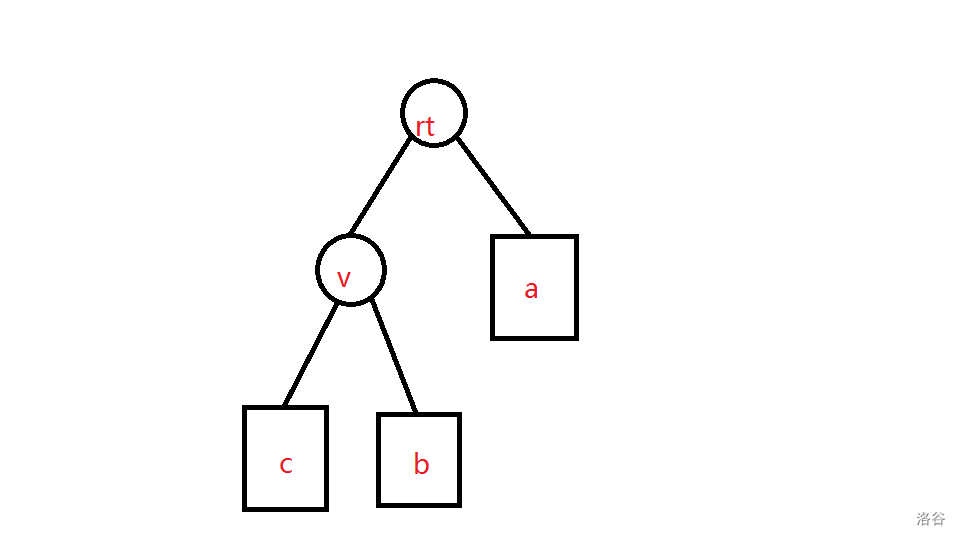
假如把 \(v\) 换成新的根,结果如下
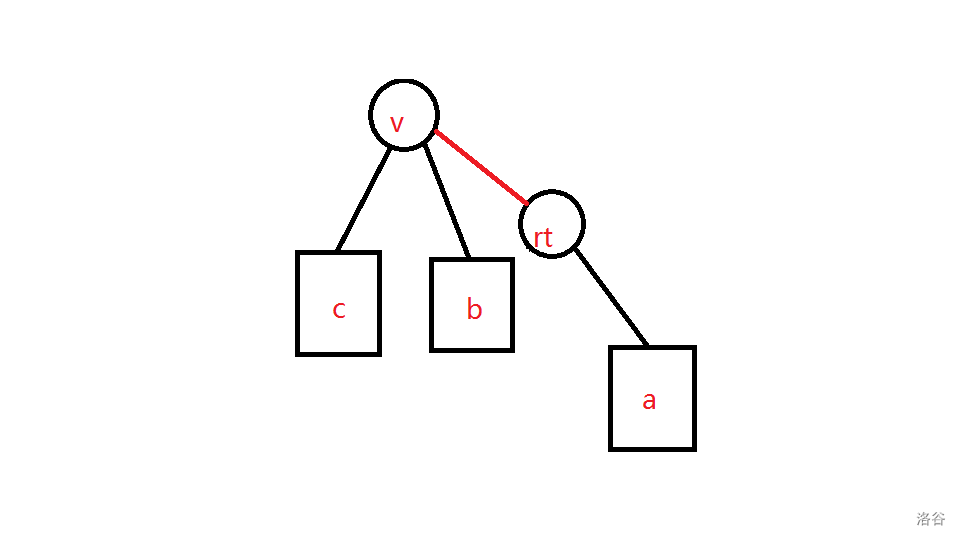
可以发现,只有 \(rt\) 与 \(v\) 的信息改变了,所以将 \(rt\) 减去 \(v\) 的贡献,\(v\)
加上 \(rt\) 的贡献即可。
code:
#include<vector>
#include<iostream>
using namespace std;

#define ll long long

const int MX=2e6+7;

vector<int > g[MX];
ll sz[MX],f[MX],ans=0;
int n,x,y,pos=0;

int read(){
	int x=0,ch=getchar();
	while(!(ch>=48&&ch<=57))ch=getchar();
	while(ch>=48&&ch<=57)x=x*10+ch-48,ch=getchar();
	return x;
}

void write(int x){
	if(x>9)write(x/10);
	putchar(x%10+48);
}

void dp(int x,int fa){
	sz[x]=f[x]=0;
	for(int i=0;i<g[x].size();i++){
		int to=g[x][i];
		if(to==fa)continue;
		dp(to,x);
		sz[x]+=sz[to];
		f[x]+=f[to]+sz[to];
	}
	sz[x]++;
}

void chg_rt(int rt,int newrt){
	f[rt]-=f[newrt]+sz[newrt];
	sz[rt]-=sz[newrt];
	f[newrt]+=f[rt]+sz[rt];
	sz[newrt]+=sz[rt];
	if(f[newrt]>ans){
		ans=f[newrt];
		pos=newrt;
	}
}

void dfs(int x,int fa){
	for(int i=0;i<g[x].size();i++){
		int to=g[x][i];
		if(to==fa)continue;
		chg_rt(x,to);
		dfs(to,x);
		chg_rt(to,x);
	}
}

int main(){
	ios::sync_with_stdio(false);
	n=read();
	for(int i=1;i<n;i++){
		x=read();
		y=read();
		g[x].push_back(y);
		g[y].push_back(x);
	}
	dp(1,1);
	dfs(1,1);
	write(pos);
	return 0;
}
直接换根dp,不写了。

 浙公网安备 33010602011771号