
面向对象、查看socketserver源代码执行过程、反射 、异常处理、单例模式
面向对象基础
1、面向对象不是所有情况都适用
2、面向对象编程
- 定义类
class 类名:
def 方法1(self,bb)
pass - 根据类创建对象
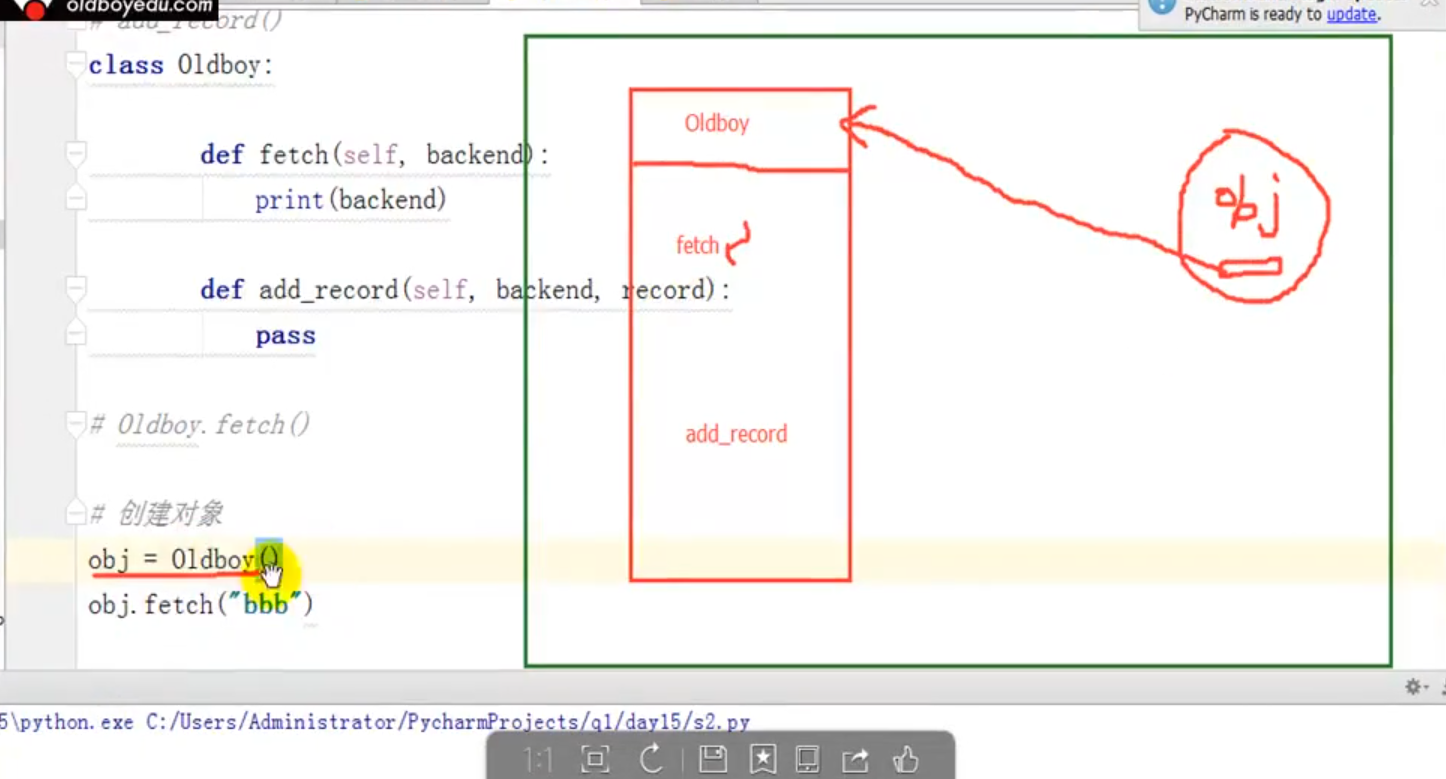
适用对象去执行类中方法
 1 class oldboy: #创建类oldboy
 2     def fetch (self, backend):  #定义方法
 3         print()
 4
 5     def add_record (self, backend, record):#定义方法
 6         pass
 7
 8 obj = oldboy() #根据类创建对象
 9 obj.fetch() #使用对象去执行类中的方法
10 obj.add_record()
封装
 1 class oldboy: #创建类oldboy
 2     def fetch (self):  #定义方法
 3         print(self.backend )
 4
 5     def add_record (self, record):#定义方法
 6         print(self.backend )
 7
 8 obj1 = oldboy() #根据类创建对象
 9 obj1.backend = "www.Freechen.com" #封装到obj1
10 obj1.fetch()
11
12 obj2 = oldboy() #根据类创建对象
13 obj2.backend = "www.oldboy.com" #封装到obj2
14 obj2.fetch()
构造方法: __init__
类+括号 ----》 自动执行类中的 __init__方法:创建了一个类
在__init__方法中执行具体的封装的操作
__init__ 有一个特殊的名字:构造方法
初始化
__del__ 解释器销毁对象的时候自动调用,特殊名称:析构方法。
========================结果==========================
封装:
使用场景:当同一类型的方法具有相同参数时,直接封装到对象即可。
使用场景:当类当做模板,创建多个对象,(对象内封装的数据可以不一样)
class foo:
    def __init__(self): #构造方法
        print("init")

obj = foo() #默认执行__init__方法


class foo:
    def __init__(self,bk): #构造方法
        self.name = "alex" #封装
        self.favor = bk  #封装

obj1 = foo("xx") #默认执行__init__方法
r = obj1.name
r2 = obj1.favor
print(r,r2)
class oldboy: #创建类oldboy
    def __init__(self,backend):
        self.name = backend #普通字段

    def fetch (self):  #定义方法
        print(self.backend )

    def add_record (self, record):#定义方法
        print(self.backend )

obj1 = oldboy("alex") #根据类创建对象
ret = obj1.name
print(ret)
继承:
1、派生类可以继承基类中所有的功能
2、派生类和基类同时存在相同的方法时,优先找派生类。
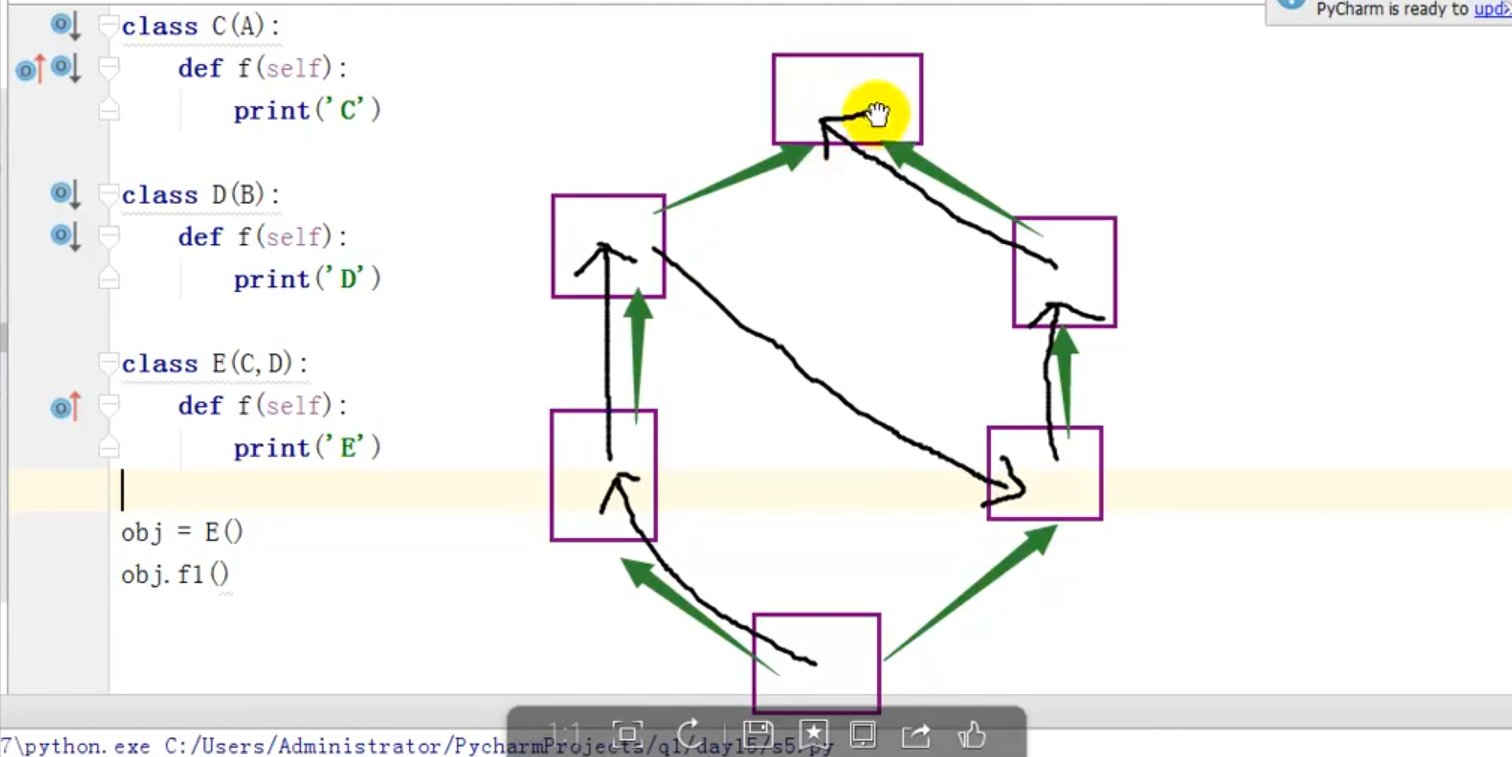
3、可继承多个类。优先级是:自己----左边----右边
 1 class Animals:
 2     def  chi(self):
 3         print(self.name + "吃")
 4
 5     def he(self):
 6         print(self.name+"喝")
 7
 8 class Dog(Animals): #继承Animals,Dog是Animals的子类,也叫派生类。Animals 是Dog的父类,也叫基类。
 9     def __init__(self, name):
10         self.name = name
11
12     def jiao(self):
13         print(self.name + "汪")
14 alex = Dog("李杰")
15 alex.chi()
16 alex.he()
17 alex.jiao()
多继承优先级:python3.5
多态:
多种形态
面向对象有三大特性:封装、继承、多态。python支持多继承,其他语言不可以。
接口:Python不存在接口
一、面向对象进阶
成员
通过类访问的有:静态字段
通过对象访问:普通字段,类的方法。
成员修饰符
出了自己谁也不好使
私有
面向对象一些常用特殊方法 __init__ __call__ __delitm__ __dict__ __iter__
___metaclass__ __new__
二、异常处理
try :
xxx
except Execption as e :
print(e)
try :
xxx
except Execption as e :
xxx
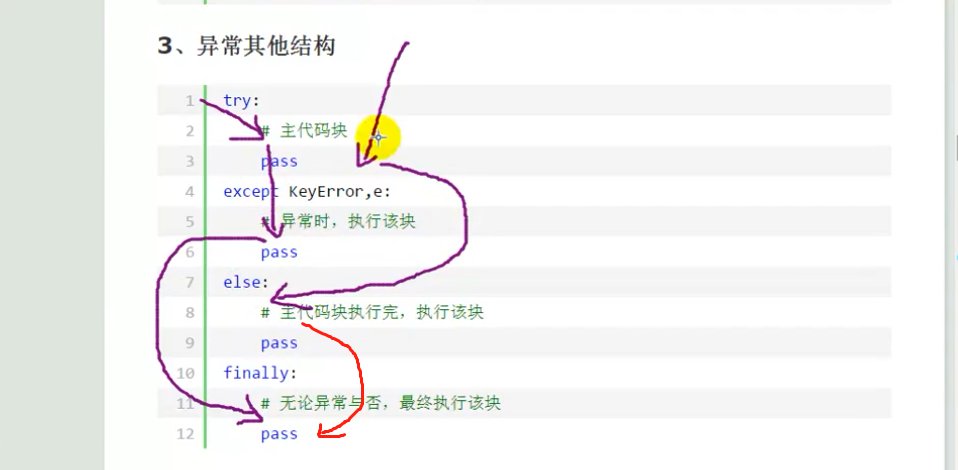
else:
xxx
finally:
xxx
三、单例模式
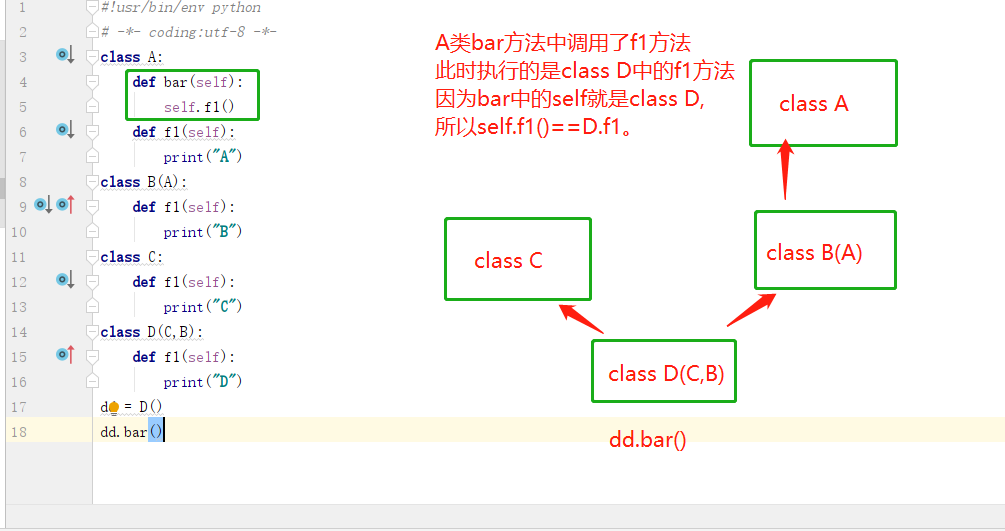
继承:
 1 class A:
 2     def bar(self):
 3         self.f1()
 4     def f1(self):
 5         print("A")
 6 class B(A):
 7     def f1(self):
 8         print("B")
 9 class C:
10     def f1(self):
11         print("C")
12 class D(C,B):
13     def f1(self):
14         print("D")
15 dd = D()
16 dd.bar()
派生类执行基类的构造方法:》
 1 class Annimal:
 2     def __init__(self):
 3         print("Aninimal的构造方法")
 4         self.ty = "动物"
 5
 6 class Cat(Annimal):
 7     def __init__(self):
 8         print("Cat的构造方法")
 9         self.n = "猫"
10         #执行父类的构造的两种方法,推荐使用super
11         super (Cat, self).__init__()  #第一种方法
12         Annimal.__init__(self) #第二种方法
13 c = Cat()
14 print(c.__dict__)
查看socketserver源代码执行过程
以字符串的形式去对象、模块中操作成员。
 1 #反射
 2 #以字符串的形式去对象、模块中操作成员。
 3 #反射:类,只能找类里的成员。
 4 #反射:对象,即可找对象,也可以找类的成员。
 5 class Foo:
 6     def __init__(self,name):
 7         self.name = name
 8     def show(self):
 9         print("show")
10 obj = Foo("free")
11 #对象中找
12 r = hasattr(obj,"name")
13 print(r)
14 r = hasattr(obj,"show")
15 print(r)
16 r = hasattr(obj,"show")
17 print(r)
利用反射导入模块、查找类、创建对象、查找对象中的字段
静态字段,在类中:将对象中存在多份一样的内容,放在类中,即静态字段
 1 class Provice:
 2     #静态字段,在类中:将对象中存在多份一样的内容,放在类中,即静态字段
 3     country = "China"
 4     def __init__(self,name):
 5         #普通字段,在对象中
 6         self.name = name
 7     #普通方法,类中
 8     def show(self):
 9         print("show")
10 hebei = Provice("河北")
11 henan = Provice("河南")
静态字段、静态方法,用类来调用
 1 class Provice:
 2     #静态字段,在类中:将对象中存在多份一样的内容,放在类中,即静态字段
 3     country = "China"
 4     def __init__(self,name):
 5         #普通字段,在对象中
 6         self.name = name
 7     #普通方法,类中
 8     def show(self):
 9         print("show")
10     #静态方法
11     @staticmethod
12     def xo():
13         print("xo")
14
15 print (Provice.country)
16 Provice.xo()
类方法:
 1 class Provice:
 2     #静态字段,在类中:将对象中存在多份一样的内容,放在类中,即静态字段
 3     country = "China"
 4     def __init__(self,name):
 5         #普通字段,在对象中
 6         self.name = name
 7     #普通方法,类中
 8     def show(self):
 9         print("show")
10     #类方法,必须有一个参数,
11     @classmethod
12     def xxoo(cls):
13         print("xxoo")
14     #静态方法
15     @staticmethod
16     def xo():
17         print("xo")
18
19 Provice.xo()
20 Provice.xxoo()
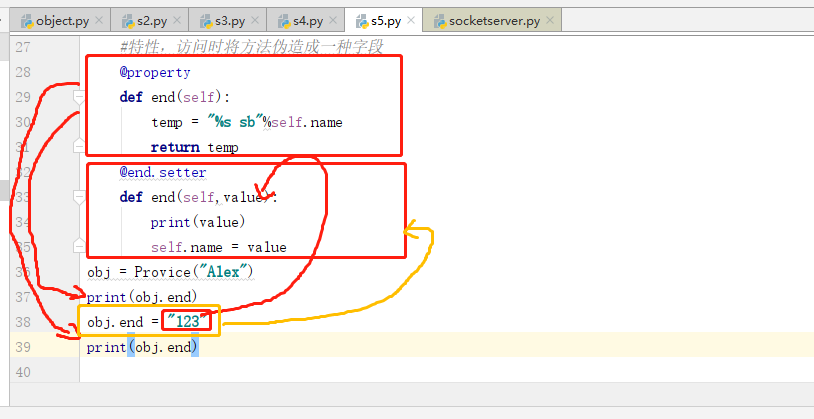
类的特性:
#特性,访问时将方法伪造成一种字段
class Provice:

    @property
    def end(self):
        temp = "%s sb"%self.name
        return temp

obj = Provice("Free")
print( obj.end)
给特性方法,设置值
 1 class Provice:
 2     #静态字段,在类中:将对象中存在多份一样的内容,放在类中,即静态字段
 3     country = "China"
 4     def __init__(self,name):
 5         #普通字段,在对象中
 6         self.name = name
 7     #普通方法,类中
 8     def show(self):
 9         print("show")
10     #类方法,必须有一个参数,
11     @classmethod
12     def xxoo(cls):
13         print("xxoo")
14     #静态方法
15     @staticmethod
16     def xo():
17         print("xo")
18     def start(self):
19         temp = "%s sb"%self.name
20         return temp
21     #特性,访问时将方法伪造成一种字段
22     @property
23     def end(self):
24         temp = "%s sb"%self.name
25         return temp
26     @end.setter
27     def end(self,value):
28         print(value)
29         self.name = value
30 obj = Provice("Alex")
31 print(obj.end)
32 obj.end = "123"
33 print(obj.end)
#__成员修饰符,只有内部成员才可以访问它,私有的只有自己可以访问,子类也不可以访问。
 1 class Foo:
 2     xo = "xo"
 3     __ox = "ox" #__成员修饰符,只有内部成员才可以访问它
 4
 5     def f1(self):
 6         print("F1")
 7         print(Foo.__ox) #内部访问私有静态字段
 8 obj = Foo()
 9 print(Foo.xo)
10 # print(Foo.__ox)
11 obj.f1()
成员修饰符:公有、私有
__call__
1 class Foo:
2     def __init__(self):
3         print("init")
4
5     def __call__(self, *args, **kwargs):
6         print("call")
7 r = Foo()
8 r()#调用__call__
9 Foo()()#调用__call__
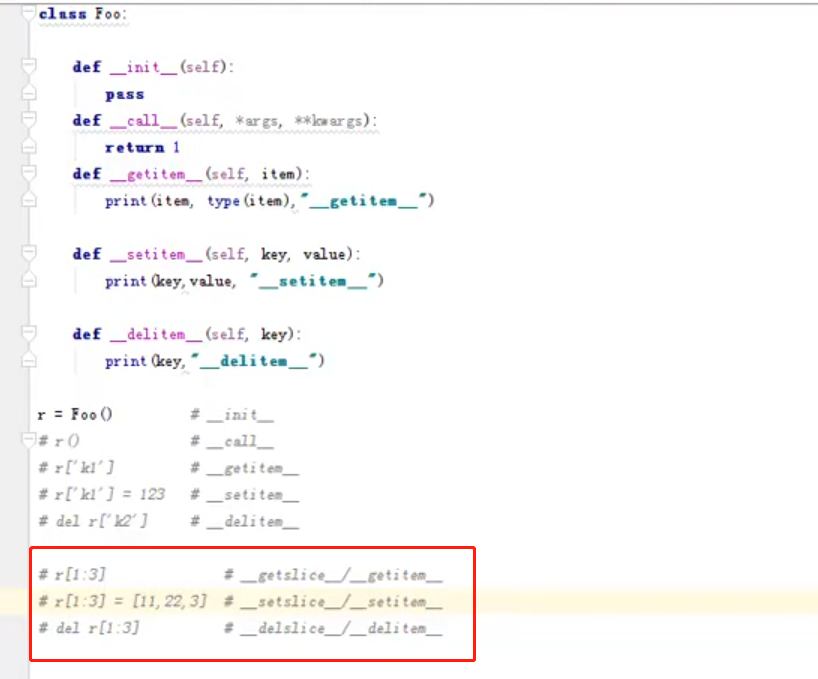
__getitem__方法
 1 class Foo:
 2     def __init__(self):
 3         print("init")
 4
 5     def __call__(self, *args, **kwargs):
 6         print("call")
 7
 8     def  __getitem__(self, item):
 9         print(item)
10 r = Foo()
11 r()#调用__call__
12 Foo()()#调用__call__
13 r["k1"]  #中括号执行__getitem__方法。
r = Foo()       #执行__init__方法
r()             #执行__call__方法
r["k1"]         #执行__getitem__方法
r["k1"] =123    #执行__setitem__方法
del r["k2"]     #执行__delitm__方法
 1 class Foo:
 2     '''
 3         我是类的注释
 4     '''
 5     def __init__(self):
 6         print("init")
 7
 8     def __call__(self, *args, **kwargs):
 9         print("call")
10
11     def  __getitem__(self, item):
12         print(item)
13 obj = Foo()
14 print(obj.__dict__)
15 print(Foo.__dict__)
基本异常处理:
1 inp = input("Please:")
2 try:
3     num = int(inp)
4     print(num)
5 except  Exception as e:
6     print("数据类型有误")
1 inp = input("Please:")
2 try:
3     num = int(inp)
4     print(num)
5 except ValueError as e: #捕捉值错误,捕捉到之后停止执行,没有捕捉到,继续往下执行。
6     print("值错误")
7 except  Exception as e: #捕捉所有的错误
8     print("数据类型有误")
主动触发异常
1 try:
2     print("123")
3     raise Exception("出错了") # 主动触发异常
4 except Exception as e:
5     print(e)
其他异常结构
![]()
__str__方法
1 class Foo:
2     def __init__(self,arg):
3         self.xo = arg
4
5     def __str__(self):
6         return self.xo
7
8 obj = Foo('出错了……')
9 print(obj)
断言
assert 1==1 assert 条件。条件成立往下执行,条件不成立报错。
单例模式
GoF设计模式
大话设计模式
设计模式一:单例模式:只有一个实例:静态方法+静态字段。
所有的实例中封装的内容相同时,用单例模式。
====================应用========================
创建Web站点并应用单例模式
 1 #python 2.7
 2
 3 from wsgiref.simple_server import make_server
 4
 5 def RunServer(environ,start_response):
 6     start_response(status='200 OK', headers=[('Content-Type', 'text/html')])
 7     url = environ['PATH_INFO']
 8
 9
10     return "Oldboy1"
11
12
13 if __name__ == '__main__':
14     httpd = make_server('',8000,RunServer)
15     print ("Serving HTTP on prot 8000....")
16     httpd.serve_forever()

 浙公网安备 33010602011771号