
tiny4412 基础(七)移植command
先看效果图
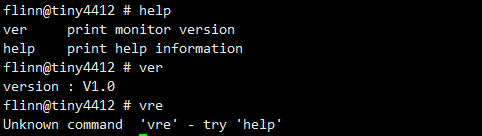

这个图是在裸机下跑的,移植了u-boot的command, 新的u-boot改成cli(命令行接口)
使用起来非常方便:
static int do_version (struct cmd_tbl_s *cmd_tbl_t, int argc, int type, char * const argv[])
{
	puts("version : V1.0 \r\n");
	return 0;
}

REGISTER_CMD(
	ver,
	1,
	ARG_TYPE_NONE,
	do_version,
	"print monitor version"
);
在任意文件里面都可以添加命令。
REGISTER_CMD宏即
#define REGISTER_CMD(name,maxargs,type,handler,usage) \
	const cmd_tbl_t cmd_##name __attribute__ ((section (".cli_cmd"))) =  {#name, maxargs, type, handler, usage}
也即REGISTER_CMD宏定义的命令最终都会链接到“.cli_cmd”段里面,在链接脚本里面:
SECTIONS
{
        . = 0x02023400;

        .text : {
                src/head.o
                * (.text)
        }

        .data : {
                * (.data)
        }

        __cli_cmd_start = .;
        .cli_cmd : {
                *(.cli_cmd)
        }
        __cli_cmd_end = .;

        bss_start = .;
        .bss : {
                * (.bss)
        }

        bss_end  = .;
}
可以看到.cli_cmd字段。
上面简单描述了效果即简单解析。
目录结构
.
├── basic.lds
├── common
├── HAL
│   ├── uart.c
│   └── uart.h
├── include
│   ├── system_clock.h
│   └── tiny4412.h
├── Makefile
├── src
│   ├── command.c
│   ├── command.h
│   ├── head.S
│   ├── main.c
│   └── system_clock.c
└── tools
    ├── bl2.bin
    ├── E4412_N.bl1.bin
    ├── E4412_tzsw.bin
    ├── Makefile
    ├── mkbl2
    ├── sd_fuse.sh
    └── V310-EVT1-mkbl2.c
其中basic.lds就是链接脚本,内容在上面以及贴出来了。
Makefile
CC      = /home/flinn/tools/4.5.1/bin/arm-none-linux-gnueabi-gcc
LD      = /home/flinn/tools/4.5.1/bin/arm-none-linux-gnueabi-ld
AR      = /home/flinn/tools/4.5.1/bin/arm-none-linux-gnueabi-ar
OBJCOPY = /home/flinn/tools/4.5.1/bin/arm-none-linux-gnueabi-objcopy
OBJDUMP = /home/flinn/tools/4.5.1/bin/arm-none-linux-gnueabi-objdump


CFLAGS          := -Wall -O2 -nostdlib -fno-builtin \
                -I./include \
                -I./HAL \
                -I./common \
                -I./src \
                -lgcc -L/home/flinn/tools/4.5.1/arm-none-linux-gnueabi/lib

OBJS := src/head.o src/main.o src/system_clock.o HAL/uart.o src/command.o

VER = 1.0
TARGET = tiny4412_$(VER).bin

$(TARGET): $(OBJS)
        ${LD} -Tbasic.lds -o $(TARGET)_elf $^
        ${OBJCOPY} -O binary -S $(TARGET)_elf $@
        ${OBJDUMP} -D -m arm $(TARGET)_elf > $(TARGET).dis


%.o:%.c
        ${CC}  $(CFLAGS) -c -o $@ $<

%.o:%.S
        ${CC}  $(CFLAGS) -c -o $@ $<

clean:
        rm -f $(TARGET) $(TARGET)_elf $(TARGET).dis *.o *.bin $(OBJS)
main
main很简单:
include "tiny4412.h"
#include "system_clock.h"
#include "uart.h"
#include "command.h"


int main(void)
{
        int i = 0;

        system_clock_init();

        uart_init();
        command_init();


        puts("\r\nstart...\r\n");

        while (1)
        {
                command_loop();
        }

        return 0;
}
其中需要初始化串口。
command_init()和command_loop()两个实现都在src/command.c里面
以上代码没有实现itoa,strlen, printf , vsprintf等标准库函数,并运行在tiny4412裸机上,对于其他平台,比如fpga,stm32, msp430, 51等平台,一般IDE支持标准库函数,移植起来更方便。熟悉u-boot移植的人来说,cli接口是必不可少的调试神器。
所有代码由以下方式获取:
git clone git@github.com:fanglinn/tiny4412.git
最后还是补充一下:
如果你想使用以上框架,需要做如下几点:
1.在Makefile里面修改你的编译器gcc路径

2.实现uart底层读写函数,必须实现putc, puts, getc, tstc四个函数,分别表示发送字符,发送字符串, 获
  取一个字符, 监测是否有数据来

3.插入SD卡,使用sudo fdisk -l来识别,比如/dev/sdc

4.进入tools目录,执行sudo ./sd_fuse /dev/sdc 即可
最后还是贴上代码,以便自己后面使用:
src/command.c