
[MIT 6.S081] Lab: Xv6 and Unix utilities
Lab: Xv6 and Unix utilities
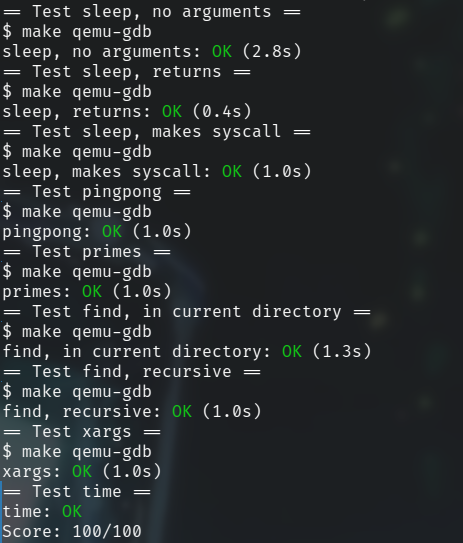
Grade
sleep
sleep 格式如下
sleep 5
这边需要使用 kernal/stat.h 中的 sleep 系统调用,并将参数转化为传入。
#include "kernel/types.h"
#include "kernel/stat.h"
#include "user/user.h"

int main(int argc, char* argv[]) {
    if (argc != 2) {
        printf("usage: sleep digit");
        exit(1);
    }

    int is_digit = 1, sec = 0;
    for (const char* s = argv[1]; *s; s ++) {
        if (*s >= '0' && *s <= '9') {
            sec = sec * 10 + *s - '0';
        } else {
            is_digit = 0;
            break;
        }
    }

    if (!is_digit) {
        printf("argv must be int");
        exit(1);
    }

    sleep(sec);
    exit(0);
}
pingpong
pingpong 需要父进程和子进程之间具有交流信息的能力,也就是使用一对管道。对于父进程,先向子进程传输一个字节的信息,然后等待子进程返回一个字节的信息后 ,输出 pong 。对于子进程来说,需要先接收信息,然后输出 ping ,再将信息传输回去。要记住的是,及时关闭各个进程的通道读端和写端,也就是及时释放资源。
#include "kernel/types.h"
#include "user/user.h"

int main() {
    const char* msg = "a";
    char buf[2] = {};

    int pipe_p_to_c[2], pipe_c_to_p[2];

    // 0:= read fd
    // 1:= write fd
    pipe(pipe_p_to_c);
    pipe(pipe_c_to_p);

    // == 0 := ch p
    if (fork() == 0) {
        close(pipe_p_to_c[0]);
        close(pipe_c_to_p[1]);

        read(pipe_p_to_c[0], buf, 1);
        printf("%d: received ping\n", getpid());
        write(pipe_c_to_p[1], msg, 1);

        close(pipe_p_to_c[1]);
        close(pipe_c_to_p[0]);
    } else {
        close(pipe_c_to_p[0]);
        close(pipe_p_to_c[1]);

        write(pipe_p_to_c[1], msg, 1);
        wait(0);
        read(pipe_c_to_p[0], buf, 1);
        printf("%d: received pong\n", getpid());

        close(pipe_c_to_p[1]);
        close(pipe_p_to_c[0]);
    }

    exit(0);
}
primes
这一步就比较困难。
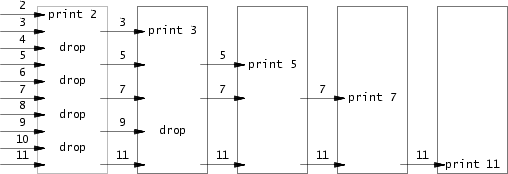
首先 primes 的要求是:在每个进程中输出还未筛出的第一个素数,并在这个进程中进行一轮筛法,将剩下的数使用 pipe 传递给下一个进程。
std::vector<int> pri;
bool is_not_pri[N];

void GetPrime() {
    is_not_pro[0] = is_not_pri[1] = true;
    for (int i = 2; i < N; i ++) {
		if (is_not_pri[i])
            continue;
        pri.emplace_back(i);
        for (int j = i * 2; j < N; j += i) {
			is_not_pri[j] = true;
        }
    }
}
也就是说,每个进程相当于是 continue 之后的步骤。由于数字范围比较小,可以直接将目前得到的素数作为基准,用这个素数筛去其倍数即可。
需要注意的是,在这里特别要留意资源释放的问题。每次开启 pipe ,就必须要释放掉所可能不需要的 fd 。同时,父进程需要保留到所有子进程结束后才可退出,这时候就需要 wait() 了。
#include "kernel/types.h"
#include "kernel/stat.h"
#include "user/user.h"

__attribute__((noreturn))
void dfs(int rd) {
    int n;
    if (read(rd, &n, 4) == 0) {
        exit(0);
    }
    printf("prime %d\n", n);

    int p[2];
    pipe(p);

    if (fork() == 0) {
        close(p[0]);
        int m;
        while (read(rd, &m, 4)) {
            if (m % n) {
                write(p[1], &m, 4);
            }
        }
        close(rd);
        close(p[1]);
    } else {
        close(p[1]);
        dfs(p[0]);
    }

    wait(0);
    exit(0);
}

int main() {
    int p[2];
    pipe(p);

    for (int i = 2; i <= 35; i ++) {
        write(p[1], &i, 4);
    }
    close(p[1]);
    dfs(p[0]);

    wait(0);
    exit(0);
}
find
这块可以直接参考 ls 的实现,观察 ls 是如何遍历目录的,find 只是多了需要比较名字的步骤。
#include "kernel/types.h"
#include "kernel/stat.h"
#include "user/user.h"
#include "kernel/fs.h"
#include <float.h>

char* get_filename(char* path) {
    static char buf[DIRSIZ + 1] = {};

    char* p;
    for (p = path + strlen(path); p >= path && *p != '/'; p --);
    p ++;

    if (strlen(p) >= DIRSIZ) {
        return p;
    }
    memmove(buf, p, strlen(p));
    memset(buf + strlen(p), ' ', DIRSIZ - strlen(p));

    return buf;
}

void find(char *path, char *tar) {
    char buf[512];
    int fd;
    struct stat st;

    if ((fd = open(path, 0)) < 0) {
        fprintf(2, "find: cannot open %s\n", path);
        return;
    }
    if (fstat(fd, &st) < 0) {
        fprintf(2, "find: cannot stat %s\n", path);
        close(fd);
        return;
    }

    switch (st.type) {
        case T_DEVICE:
        case T_FILE:
            if (strcmp(tar, get_filename(path)) == 0) {
                printf("%s\n", path);
            }
            break;

        case T_DIR:
            if (strlen(path) + 1 + DIRSIZ + 1 > sizeof(buf)) {
                printf("find: path too long\n");
                break;
            }
            strcpy(buf, path);

            char* p = buf + strlen(buf);
            *p ++ = '/';

            struct dirent de;
            while(read(fd, &de, sizeof(de)) == sizeof(de)) {
                if (de.inum == 0) {
                    continue;
                }

                memmove(p, de.name, DIRSIZ);
                p[DIRSIZ] = 0;
                if (stat(buf, &st) < 0) {
                    printf("find: cannot stat %s\n", buf);
                    continue;
                }

                char* name = de.name;

                if (st.type != T_DIR) {
                    // goto TAR_FILE;
                    if (strcmp(tar, name) == 0) {
                        printf("%s\n", buf);
                    }
                    continue;
                }

                if (strcmp(name, ".") && strcmp(name, "..")) {
                    find(buf, tar);
                }
            }

            break;
        default:
            break;
    }

    close(fd);
    return;
}

int main(int argc, char* argv[]) {
    if (argc != 3) {
        fprintf(2, "useage: find path/to/dir file_name\n");
    } else {
        find(argv[1], argv[2]);
    }
    exit(0);
}
xargs
xargs 真正执行的就是其第一个参数中的命令,只要从标准输入流中读入前面命令的输出,然后将这个输出作为真正执行的命令的参数,调用 exec 即可。
#include "kernel/types.h"
#include "kernel/param.h"
#include "user/user.h"

int main(int argc, char* argv[]) {
    char* xargv[MAXARG] = {};
    for (int i = 1; i < argc; i ++)
        xargv[i - 1] = argv[i];

    char buf[512] = {};
    while (gets(buf, 512)) {
        int len = strlen(buf);
        if (len == 0)
            break;
        if (buf[len - 1] == '\n')
            buf[len - 1] = '\0';

        xargv[argc - 1] = buf;
        if (fork() == 0) {
            exec(argv[1], xargv);
        } else {
            wait(0);
        }
    }

    exit(0);
}

 浙公网安备 33010602011771号