
1+Spring源码解析之注解驱动容器
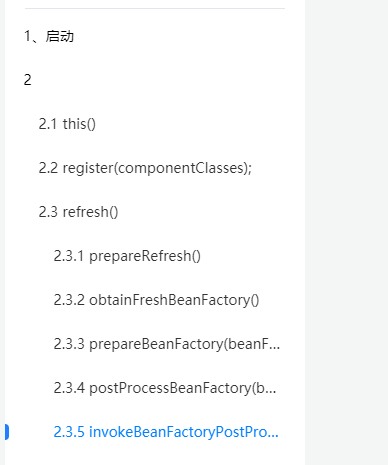
1、启动
new AnnotationConfigApplicationContext(LifecycleSourceConfiguration.class);
复制代码
2
public AnnotationConfigApplicationContext(Class<?>... componentClasses) {
   this();
   register(componentClasses);
   refresh();
}
复制代码
2.1 this()
初始化AnnotatedBeanDefinitionReader 和 ClassPathBeanDefinitionScanner
ConfigurationClassPostProcessor是用于处理注解类的后置处理器,
某种程度上也算是一个 bdReader,所以它的 bd 也在这一步被注册到 bdMap,
另外还有AutowiredAnnotationBeanPostProcessor 和 CommonAnnotationBeanPostProcessor
另外值得注意的是,初始化读取器和扫描器之前会调用父类 GenericApplicationContext的构造方法来初始化内部容器:this.beanFactory = new DefaultListableBeanFactory();
复制代码
2.2 register(componentClasses);
这一步完成后,会将传入的注解类的 bd 注册到 bdMap中,并且注解类的元信息也会被解析出来,封装为一个 StandardAnnotationMetadata。
复制代码
2.3 refresh()
synchronized (this.startupShutdownMonitor) {
   // Prepare this context for refreshing.
   //2.3.1
   prepareRefresh();

   // Tell the subclass to refresh the internal bean factory.
   //2.3.2
   ConfigurableListableBeanFactory beanFactory = obtainFreshBeanFactory();

   // Prepare the bean factory for use in this context.
   //2.3.3
   prepareBeanFactory(beanFactory);

   try {
      // Allows post-processing of the bean factory in context subclasses.
      //2.3.4
      postProcessBeanFactory(beanFactory);

      // Invoke factory processors registered as beans in the context.
      //2.3.5
      invokeBeanFactoryPostProcessors(beanFactory);

      // Register bean processors that intercept bean creation.
      //2.3.6
      registerBeanPostProcessors(beanFactory);

      // Initialize message source for this context.
      //2.3.7
      initMessageSource();

      // Initialize event multicaster for this context.
      //2.3.8
      initApplicationEventMulticaster();

      // Initialize other special beans in specific context subclasses.
      //2.3.9
      onRefresh();

      // Check for listener beans and register them.
      //2.3.10
      registerListeners();

      // Instantiate all remaining (non-lazy-init) singletons.
      //2.3.11
      finishBeanFactoryInitialization(beanFactory);

      // Last step: publish corresponding event.
      //2.3.12
      finishRefresh();
   }
}
复制代码
2.3.1 prepareRefresh()
// Initialize any placeholder property sources in the context environment.
//空实现。留给子类的扩展点
//@PropertySource 是在
//ConfigurationClassParser#processPropertySource中处理的
//会将 properties文件中的属性解析出来,add 进 environment 中。
initPropertySources();

// Validate that all properties marked as required are resolvable:
// see ConfigurablePropertyResolver#setRequiredProperties
getEnvironment().validateRequiredProperties();

// Store pre-refresh ApplicationListeners...
if (this.earlyApplicationListeners == null) {
   this.earlyApplicationListeners = new LinkedHashSet<>(this.applicationListeners);
}
复制代码
2.3.2 obtainFreshBeanFactory()
啥也没做。不同于 ClassPathXmlApplicationContext会在这一步 loadBeanDefinitions
复制代码
2.3.3 prepareBeanFactory(beanFactory);
/**
 * Configure the factory's standard context characteristics,
 * such as the context's ClassLoader and post-processors.
 * @param beanFactory the BeanFactory to configure
 */
protected void prepareBeanFactory(ConfigurableListableBeanFactory beanFactory) {
   // Tell the internal bean factory to use the context's class loader etc.
   beanFactory.setBeanClassLoader(getClassLoader());
   beanFactory.setBeanExpressionResolver(new StandardBeanExpressionResolver(beanFactory.getBeanClassLoader()));
   beanFactory.addPropertyEditorRegistrar(new ResourceEditorRegistrar(this, getEnvironment()));

   // Configure the bean factory with context callbacks.
   // 配置一个可回调注入 ApplicationContext 的 BeanPostProcessor
   beanFactory.addBeanPostProcessor(new ApplicationContextAwareProcessor(this));
   beanFactory.ignoreDependencyInterface(EnvironmentAware.class);
   beanFactory.ignoreDependencyInterface(EmbeddedValueResolverAware.class);
   beanFactory.ignoreDependencyInterface(ResourceLoaderAware.class);
   beanFactory.ignoreDependencyInterface(ApplicationEventPublisherAware.class);
   beanFactory.ignoreDependencyInterface(MessageSourceAware.class);
   beanFactory.ignoreDependencyInterface(ApplicationContextAware.class);

   // BeanFactory interface not registered as resolvable type in a plain factory.
   // MessageSource registered (and found for autowiring) as a bean.
   beanFactory.registerResolvableDependency(BeanFactory.class, beanFactory);
   beanFactory.registerResolvableDependency(ResourceLoader.class, this);
   beanFactory.registerResolvableDependency(ApplicationEventPublisher.class, this);
   beanFactory.registerResolvableDependency(ApplicationContext.class, this);

   // Register early post-processor for detecting inner beans as ApplicationListeners.
   beanFactory.addBeanPostProcessor(new ApplicationListenerDetector(this));

   // Detect a LoadTimeWeaver and prepare for weaving, if found.
   if (beanFactory.containsBean(LOAD_TIME_WEAVER_BEAN_NAME)) {
      beanFactory.addBeanPostProcessor(new LoadTimeWeaverAwareProcessor(beanFactory));
      // Set a temporary ClassLoader for type matching.
      beanFactory.setTempClassLoader(new ContextTypeMatchClassLoader(beanFactory.getBeanClassLoader()));
   }

   // Register default environment beans.
   //environment 初始化。注册了默认的运行时环境、系统配置属性、系统环境的信息
   if (!beanFactory.containsLocalBean(ENVIRONMENT_BEAN_NAME)) {
      beanFactory.registerSingleton(ENVIRONMENT_BEAN_NAME, getEnvironment());
   }
   if (!beanFactory.containsLocalBean(SYSTEM_PROPERTIES_BEAN_NAME)) {
      beanFactory.registerSingleton(SYSTEM_PROPERTIES_BEAN_NAME, getEnvironment().getSystemProperties());
   }
   if (!beanFactory.containsLocalBean(SYSTEM_ENVIRONMENT_BEAN_NAME)) {
      beanFactory.registerSingleton(SYSTEM_ENVIRONMENT_BEAN_NAME, getEnvironment().getSystemEnvironment());
   }
}
复制代码
2.3.4 postProcessBeanFactory(beanFactory);
2.3.5 invokeBeanFactoryPostProcessors(beanFactory)
public static void invokeBeanFactoryPostProcessors(
      ConfigurableListableBeanFactory beanFactory,
      List<BeanFactoryPostProcessor> beanFactoryPostProcessors) {

   // Invoke BeanDefinitionRegistryPostProcessors first, if any.
   Set<String> processedBeans = new HashSet<>();

   if (beanFactory instanceof BeanDefinitionRegistry) {
      BeanDefinitionRegistry registry = (BeanDefinitionRegistry) beanFactory;
      List<BeanFactoryPostProcessor> regularPostProcessors = new ArrayList<>();
      List<BeanDefinitionRegistryPostProcessor> registryProcessors = new ArrayList<>();

      for (BeanFactoryPostProcessor postProcessor : beanFactoryPostProcessors) {
         if (postProcessor instanceof BeanDefinitionRegistryPostProcessor) {
            BeanDefinitionRegistryPostProcessor registryProcessor =
                  (BeanDefinitionRegistryPostProcessor) postProcessor;
            registryProcessor.postProcessBeanDefinitionRegistry(registry);
            registryProcessors.add(registryProcessor);
         }
         else {
            regularPostProcessors.add(postProcessor);
         }
      }

      // Do not initialize FactoryBeans here: We need to leave all regular beans
      // uninitialized to let the bean factory post-processors apply to them!
      // Separate between BeanDefinitionRegistryPostProcessors that implement
      // PriorityOrdered, Ordered, and the rest.
      List<BeanDefinitionRegistryPostProcessor> currentRegistryProcessors = new ArrayList<>();

      // First, invoke the BeanDefinitionRegistryPostProcessors that implement PriorityOrdered.
      /**
      这儿可以拿到 ConfigurationClassPostProcessor 专门用于解析配置类 XxxConfiguration
      该类用于 `@Configuration` 类的扫描加载处理。
      使用`<context:annotation-config />` 或 `<context:component-scan />` 时默认注册。
      */
      String[] postProcessorNames = beanFactory.
            getBeanNamesForType(BeanDefinitionRegistryPostProcessor.class, true, false);

      for (String ppName : postProcessorNames) {
         if (beanFactory.isTypeMatch(ppName, PriorityOrdered.class)) {
            //实例化 ConfigurationClassPostProcessor
            currentRegistryProcessors.add(beanFactory.getBean(ppName, BeanDefinitionRegistryPostProcessor.class));
            processedBeans.add(ppName);
         }
      }
      sortPostProcessors(currentRegistryProcessors, beanFactory);
      registryProcessors.addAll(currentRegistryProcessors);
      /**
      调用 ConfigurationClassPostProcessor#postProcessBeanDefinitionRegistry()
      Derive further bean definitions from the configuration classes in the registry.
      解析配置类,然后根据配置类的引导来扫描Bean,将其 BeanDefinition 注入 bdMap 中。
      大概要处理的内容:
      // Process any @PropertySource annotations
      // Process any @ComponentScan annotations
      // Process any @Import annotations
      // Process any @ImportResource annotations
      // Process individual @Bean methods
      // Process superclass, if any
      */
      invokeBeanDefinitionRegistryPostProcessors(currentRegistryProcessors, registry);
      currentRegistryProcessors.clear();

      // Next, invoke the BeanDefinitionRegistryPostProcessors that implement Ordered.
      postProcessorNames = beanFactory.getBeanNamesForType(BeanDefinitionRegistryPostProcessor.class, true, false);
      for (String ppName : postProcessorNames) {
         if (!processedBeans.contains(ppName) && beanFactory.isTypeMatch(ppName, Ordered.class)) {
            currentRegistryProcessors.add(beanFactory.getBean(ppName, BeanDefinitionRegistryPostProcessor.class));
            processedBeans.add(ppName);
         }
      }
      sortPostProcessors(currentRegistryProcessors, beanFactory);
      registryProcessors.addAll(currentRegistryProcessors);
      invokeBeanDefinitionRegistryPostProcessors(currentRegistryProcessors, registry);
      currentRegistryProcessors.clear();

      // Finally, invoke all other BeanDefinitionRegistryPostProcessors
      // until no further ones appear.
      boolean reiterate = true;
      while (reiterate) {
         reiterate = false;
         postProcessorNames = beanFactory.getBeanNamesForType(BeanDefinitionRegistryPostProcessor.class, true, false);
         for (String ppName : postProcessorNames) {
            if (!processedBeans.contains(ppName)) {
               currentRegistryProcessors.add(beanFactory.getBean(ppName, BeanDefinitionRegistryPostProcessor.class));
               processedBeans.add(ppName);
               reiterate = true;
            }
         }
         sortPostProcessors(currentRegistryProcessors, beanFactory);
         registryProcessors.addAll(currentRegistryProcessors);
         invokeBeanDefinitionRegistryPostProcessors(currentRegistryProcessors, registry);
         currentRegistryProcessors.clear();
      }

      // Now, invoke the postProcessBeanFactory callback of all processors handled so far.
      invokeBeanFactoryPostProcessors(registryProcessors, beanFactory);
      invokeBeanFactoryPostProcessors(regularPostProcessors, beanFactory);
   } else {
      // Invoke factory processors registered with the context instance.
      invokeBeanFactoryPostProcessors(beanFactoryPostProcessors, beanFactory);
   }

   // Do not initialize FactoryBeans here: We need to leave all regular beans
   // uninitialized to let the bean factory post-processors apply to them!
   String[] postProcessorNames =
         beanFactory.getBeanNamesForType(BeanFactoryPostProcessor.class, true, false);

   // Separate between BeanFactoryPostProcessors that implement PriorityOrdered,
   // Ordered, and the rest.
   List<BeanFactoryPostProcessor> priorityOrderedPostProcessors = new ArrayList<>();
   List<String> orderedPostProcessorNames = new ArrayList<>();
   List<String> nonOrderedPostProcessorNames = new ArrayList<>();
   for (String ppName : postProcessorNames) {
      if (processedBeans.contains(ppName)) {
         // skip - already processed in first phase above
      }
      else if (beanFactory.isTypeMatch(ppName, PriorityOrdered.class)) {
         priorityOrderedPostProcessors.add(beanFactory.getBean(ppName, BeanFactoryPostProcessor.class));
      }
      else if (beanFactory.isTypeMatch(ppName, Ordered.class)) {
         orderedPostProcessorNames.add(ppName);
      }
      else {
         nonOrderedPostProcessorNames.add(ppName);
      }
   }

   // First, invoke the BeanFactoryPostProcessors that implement PriorityOrdered.
   sortPostProcessors(priorityOrderedPostProcessors, beanFactory);
   invokeBeanFactoryPostProcessors(priorityOrderedPostProcessors, beanFactory);

   // Next, invoke the BeanFactoryPostProcessors that implement Ordered.
   List<BeanFactoryPostProcessor> orderedPostProcessors = new ArrayList<>(orderedPostProcessorNames.size());
   for (String postProcessorName : orderedPostProcessorNames) {
      orderedPostProcessors.add(beanFactory.getBean(postProcessorName, BeanFactoryPostProcessor.class));
   }
   sortPostProcessors(orderedPostProcessors, beanFactory);
   invokeBeanFactoryPostProcessors(orderedPostProcessors, beanFactory);

   // Finally, invoke all other BeanFactoryPostProcessors.
   List<BeanFactoryPostProcessor> nonOrderedPostProcessors = new ArrayList<>(nonOrderedPostProcessorNames.size());
   for (String postProcessorName : nonOrderedPostProcessorNames) {
      nonOrderedPostProcessors.add(beanFactory.getBean(postProcessorName, BeanFactoryPostProcessor.class));
   }
   invokeBeanFactoryPostProcessors(nonOrderedPostProcessors, beanFactory);

   // Clear cached merged bean definitions since the post-processors might have
   // modified the original metadata, e.g. replacing placeholders in values...
   beanFactory.clearMetadataCache();
}
复制代码
2.3.5.1 processConfigBeanDefinitions(beanDefinitionRegistry)
/**
 * Build and validate a configuration model based on the registry of
 * {@link Configuration} classes.
 */
public void processConfigBeanDefinitions(BeanDefinitionRegistry registry) {
   List<BeanDefinitionHolder> configCandidates = new ArrayList<>();
   //拿到所有容器中所有 bd
   String[] candidateNames = registry.getBeanDefinitionNames();
   //确定配置类和组件
   /**
   这里面需要关注 `ConfigurationClassUtils` 的一个方法:
    `checkConfigurationClassCandidate`:检查一个类是否为配置类
   */
   for (String beanName : candidateNames) {
      BeanDefinition beanDef = registry.getBeanDefinition(beanName);
      if (beanDef.getAttribute(ConfigurationClassUtils.CONFIGURATION_CLASS_ATTRIBUTE) != null) {
         if (logger.isDebugEnabled()) {
            logger.debug("Bean definition has already been processed as a configuration class: " + beanDef);
         }
      }
      else if (ConfigurationClassUtils.checkConfigurationClassCandidate(beanDef, this.metadataReaderFactory)) {
         configCandidates.add(new BeanDefinitionHolder(beanDef, beanName));
      }
   }

   // Return immediately if no @Configuration classes were found
   if (configCandidates.isEmpty()) {
      return;
   }

   // Sort by previously determined @Order value, if applicable
   configCandidates.sort((bd1, bd2) -> {
      int i1 = ConfigurationClassUtils.getOrder(bd1.getBeanDefinition());
      int i2 = ConfigurationClassUtils.getOrder(bd2.getBeanDefinition());
      return Integer.compare(i1, i2);
   });

   // Detect any custom bean name generation strategy supplied
   // through the enclosing application context
   // 加载获取BeanNameGenerator
   SingletonBeanRegistry sbr = null;
   if (registry instanceof SingletonBeanRegistry) {
      sbr = (SingletonBeanRegistry) registry;
      if (!this.localBeanNameGeneratorSet) {
         BeanNameGenerator generator = (BeanNameGenerator) sbr.getSingleton(
               AnnotationConfigUtils.CONFIGURATION_BEAN_NAME_GENERATOR);
         if (generator != null) {
            this.componentScanBeanNameGenerator = generator;
            this.importBeanNameGenerator = generator;
         }
      }
   }

   if (this.environment == null) {
      this.environment = new StandardEnvironment();
   }
   // 加载所有配置类
   // Parse each @Configuration class
   ConfigurationClassParser parser = new ConfigurationClassParser(
         this.metadataReaderFactory, this.problemReporter, this.environment,
         this.resourceLoader, this.componentScanBeanNameGenerator, registry);

   Set<BeanDefinitionHolder> candidates = new LinkedHashSet<>(configCandidates);
   Set<ConfigurationClass> alreadyParsed = new HashSet<>(configCandidates.size());
   do {
      // 解析配置类
      parser.parse(candidates);
      parser.validate();

      Set<ConfigurationClass> configClasses = new LinkedHashSet<>(parser.getConfigurationClasses());
      configClasses.removeAll(alreadyParsed);

      // Read the model and create bean definitions based on its content
      if (this.reader == null) {
         this.reader = new ConfigurationClassBeanDefinitionReader(
               registry, this.sourceExtractor, this.resourceLoader, this.environment,
               this.importBeanNameGenerator, parser.getImportRegistry());
      }
      // 解析配置类中的内容
      this.reader.loadBeanDefinitions(configClasses);
      alreadyParsed.addAll(configClasses);

      candidates.clear();
      // 加载配置类中的被 @Bean 标注的组件
      if (registry.getBeanDefinitionCount() > candidateNames.length) {
         String[] newCandidateNames = registry.getBeanDefinitionNames();
         Set<String> oldCandidateNames = new HashSet<>(Arrays.asList(candidateNames));
         Set<String> alreadyParsedClasses = new HashSet<>();
         for (ConfigurationClass configurationClass : alreadyParsed) {
            alreadyParsedClasses.add(configurationClass.getMetadata().getClassName());
         }
         for (String candidateName : newCandidateNames) {
            if (!oldCandidateNames.contains(candidateName)) {
               BeanDefinition bd = registry.getBeanDefinition(candidateName);
               if (ConfigurationClassUtils.checkConfigurationClassCandidate(bd, this.metadataReaderFactory) &&
                     !alreadyParsedClasses.contains(bd.getBeanClassName())) {
                  candidates.add(new BeanDefinitionHolder(bd, candidateName));
               }
            }
         }
         candidateNames = newCandidateNames;
      }
   }
   while (!candidates.isEmpty());

   // Register the ImportRegistry as a bean in order to support ImportAware @Configuration classes
   if (sbr != null && !sbr.containsSingleton(IMPORT_REGISTRY_BEAN_NAME)) {
      sbr.registerSingleton(IMPORT_REGISTRY_BEAN_NAME, parser.getImportRegistry());
   }

   if (this.metadataReaderFactory instanceof CachingMetadataReaderFactory) {
      // Clear cache in externally provided MetadataReaderFactory; this is a no-op
      // for a shared cache since it'll be cleared by the ApplicationContext.
      ((CachingMetadataReaderFactory) this.metadataReaderFactory).clearCache();
   }
}
复制代码
2.3.5.1.1 parser.parse(candidates)--解析配置类
/**
 * Apply processing and build a complete {@link ConfigurationClass} by reading the
 * annotations, members and methods from the source class. This method can be called
 * multiple times as relevant sources are discovered.

 从源码注释中已经看出,它来解析 `@PropertySource` 、`@ComponentScan` 、`@Import` 、`@ImportResource` 、`@Bean` 等注解,并整理成一个 `ConfigClass` 。
由此可知,在这一步,一个配置类的所有信息就已经被解析完成了。

 * @param configClass the configuration class being build
 * @param sourceClass a source class
 * @return the superclass, or {@code null} if none found or previously processed
 */
@Nullable
protected final SourceClass doProcessConfigurationClass(
      ConfigurationClass configClass, SourceClass sourceClass, Predicate<String> filter)
      throws IOException {

   if (configClass.getMetadata().isAnnotated(Component.class.getName())) {
      // Recursively process any member (nested) classes first
      processMemberClasses(configClass, sourceClass, filter);
   }

   // Process any @PropertySource annotations
   for (AnnotationAttributes propertySource : AnnotationConfigUtils.attributesForRepeatable(
         sourceClass.getMetadata(), PropertySources.class,
         org.springframework.context.annotation.PropertySource.class)) {
      if (this.environment instanceof ConfigurableEnvironment) {
         processPropertySource(propertySource);
      }
      else {
         logger.info("Ignoring @PropertySource annotation on [" + sourceClass.getMetadata().getClassName() +
               "]. Reason: Environment must implement ConfigurableEnvironment");
      }
   }

   // Process any @ComponentScan annotations
   Set<AnnotationAttributes> componentScans = AnnotationConfigUtils.attributesForRepeatable(
         sourceClass.getMetadata(), ComponentScans.class, ComponentScan.class);
   if (!componentScans.isEmpty() &&
         !this.conditionEvaluator.shouldSkip(sourceClass.getMetadata(), ConfigurationPhase.REGISTER_BEAN)) {
      for (AnnotationAttributes componentScan : componentScans) {
         // The config class is annotated with @ComponentScan -> perform the scan immediately
         Set<BeanDefinitionHolder> scannedBeanDefinitions =
               this.componentScanParser.parse(componentScan, sourceClass.getMetadata().getClassName());
         // Check the set of scanned definitions for any further config classes and parse recursively if needed
         for (BeanDefinitionHolder holder : scannedBeanDefinitions) {
            BeanDefinition bdCand = holder.getBeanDefinition().getOriginatingBeanDefinition();
            if (bdCand == null) {
               bdCand = holder.getBeanDefinition();
            }
            if (ConfigurationClassUtils.checkConfigurationClassCandidate(bdCand, this.metadataReaderFactory)) {
               parse(bdCand.getBeanClassName(), holder.getBeanName());
            }
         }
      }
   }

   // Process any @Import annotations
   processImports(configClass, sourceClass, getImports(sourceClass), filter, true);

   // Process any @ImportResource annotations
   AnnotationAttributes importResource =
         AnnotationConfigUtils.attributesFor(sourceClass.getMetadata(), ImportResource.class);
   if (importResource != null) {
      String[] resources = importResource.getStringArray("locations");
      Class<? extends BeanDefinitionReader> readerClass = importResource.getClass("reader");
      for (String resource : resources) {
         String resolvedResource = this.environment.resolveRequiredPlaceholders(resource);
         configClass.addImportedResource(resolvedResource, readerClass);
      }
   }

   // Process individual @Bean methods
   Set<MethodMetadata> beanMethods = retrieveBeanMethodMetadata(sourceClass);
   for (MethodMetadata methodMetadata : beanMethods) {
      configClass.addBeanMethod(new BeanMethod(methodMetadata, configClass));
   }

   // Process default methods on interfaces
   processInterfaces(configClass, sourceClass);

   // Process superclass, if any
   if (sourceClass.getMetadata().hasSuperClass()) {
      String superclass = sourceClass.getMetadata().getSuperClassName();
      if (superclass != null && !superclass.startsWith("java") &&
            !this.knownSuperclasses.containsKey(superclass)) {
         this.knownSuperclasses.put(superclass, configClass);
         // Superclass found, return its annotation metadata and recurse
         return sourceClass.getSuperClass();
      }
   }

   // No superclass -> processing is complete
   return null;
}
复制代码
ComponentScanAnnotationParser.parse--解析ComponentScan
public Set<BeanDefinitionHolder> parse(AnnotationAttributes componentScan, final String declaringClass) {
   //实例化一个 扫描类路径 BD 的扫描器(提供注册器,全局环境,资源加载器)
   ClassPathBeanDefinitionScanner scanner = new ClassPathBeanDefinitionScanner(this.registry,
         componentScan.getBoolean("useDefaultFilters"), this.environment, this.resourceLoader);

   Class<? extends BeanNameGenerator> generatorClass = componentScan.getClass("nameGenerator");
   boolean useInheritedGenerator = (BeanNameGenerator.class == generatorClass);
   //扫描器添加名称生成器(BeanGenerator)
   scanner.setBeanNameGenerator(useInheritedGenerator ? this.beanNameGenerator :
         BeanUtils.instantiateClass(generatorClass));

   ScopedProxyMode scopedProxyMode = componentScan.getEnum("scopedProxy");
   if (scopedProxyMode != ScopedProxyMode.DEFAULT) {
      scanner.setScopedProxyMode(scopedProxyMode);
   }
   else {
      // 元数据解析器
      Class<? extends ScopeMetadataResolver> resolverClass = componentScan.getClass("scopeResolver");
      scanner.setScopeMetadataResolver(BeanUtils.instantiateClass(resolverClass));
   }
   // 扫描器的资源匹配模式
   scanner.setResourcePattern(componentScan.getString("resourcePattern"));

   for (AnnotationAttributes filter : componentScan.getAnnotationArray("includeFilters")) {
      for (TypeFilter typeFilter : typeFiltersFor(filter)) {
         scanner.addIncludeFilter(typeFilter);
      }
   }
   // 为扫描器添加过滤器(注解上的过滤器)
   for (AnnotationAttributes filter : componentScan.getAnnotationArray("excludeFilters")) {
      for (TypeFilter typeFilter : typeFiltersFor(filter)) {
         scanner.addExcludeFilter(typeFilter);
      }
   }

   boolean lazyInit = componentScan.getBoolean("lazyInit");
   if (lazyInit) {
      scanner.getBeanDefinitionDefaults().setLazyInit(true);
   }

   // 解析出要扫描的目标包
   Set<String> basePackages = new LinkedHashSet<>();
   String[] basePackagesArray = componentScan.getStringArray("basePackages");
   for (String pkg : basePackagesArray) {
      String[] tokenized = StringUtils.tokenizeToStringArray(this.environment.resolvePlaceholders(pkg),
            ConfigurableApplicationContext.CONFIG_LOCATION_DELIMITERS);
      Collections.addAll(basePackages, tokenized);
   }
   for (Class<?> clazz : componentScan.getClassArray("basePackageClasses")) {
      basePackages.add(ClassUtils.getPackageName(clazz));
   }
   if (basePackages.isEmpty()) {
      basePackages.add(ClassUtils.getPackageName(declaringClass));
   }
   // 为扫描器添加过滤器
   scanner.addExcludeFilter(new AbstractTypeHierarchyTraversingFilter(false, false) {
      @Override
      protected boolean matchClassName(String className) {
         return declaringClass.equals(className);
      }
   });
   // 原来包扫描的触发时机在这里
   return scanner.doScan(StringUtils.toStringArray(basePackages));
}
复制代码
2.3.5.1.2 loadBeanDefinitions
public void loadBeanDefinitions(Set<ConfigurationClass> configurationModel) {
   TrackedConditionEvaluator trackedConditionEvaluator = new TrackedConditionEvaluator();
   for (ConfigurationClass configClass : configurationModel) {
      loadBeanDefinitionsForConfigurationClass(configClass, trackedConditionEvaluator);
   }
}
复制代码
/**
* Read a particular {@link ConfigurationClass}, registering bean definitions
* for the class itself and all of its {@link Bean} methods.
由于在之前已经解析过这个 `configClass` 了,所以在这里可以很容易的解析出这里面的 `@Import` 、
标注了 `@Bean` 的方法、`@ImportResource` 等,并进行相应处理
*/
private void loadBeanDefinitionsForConfigurationClass(
ConfigurationClass configClass, TrackedConditionEvaluator trackedConditionEvaluator) {
if (trackedConditionEvaluator.shouldSkip(configClass)) {
String beanName = configClass.getBeanName();
if (StringUtils.hasLength(beanName) && this.registry.containsBeanDefinition(beanName)) {
this.registry.removeBeanDefinition(beanName);
}
this.importRegistry.removeImportingClass(configClass.getMetadata().getClassName());
return;
}
if (configClass.isImported()) {
registerBeanDefinitionForImportedConfigurationClass(configClass);
}
for (BeanMethod beanMethod : configClass.getBeanMethods()) {
loadBeanDefinitionsForBeanMethod(beanMethod);
}
loadBeanDefinitionsFromImportedResources(configClass.getImportedResources());
loadBeanDefinitionsFromRegistrars(configClass.getImportBeanDefinitionRegistrars());
}
复制代码loadBeanDefinitionsForBeanMethod(beanMethod)
/**
 * Read the given {@link BeanMethod}, registering bean definitions
 * with the BeanDefinitionRegistry based on its contents.
 */
@SuppressWarnings("deprecation")  // for RequiredAnnotationBeanPostProcessor.SKIP_REQUIRED_CHECK_ATTRIBUTE
private void loadBeanDefinitionsForBeanMethod(BeanMethod beanMethod) {
   ConfigurationClass configClass = beanMethod.getConfigurationClass();
   MethodMetadata metadata = beanMethod.getMetadata();
   String methodName = metadata.getMethodName();

   // Do we need to mark the bean as skipped by its condition?
   if (this.conditionEvaluator.shouldSkip(metadata, ConfigurationPhase.REGISTER_BEAN)) {
      configClass.skippedBeanMethods.add(methodName);
      return;
   }
   if (configClass.skippedBeanMethods.contains(methodName)) {
      return;
   }

   AnnotationAttributes bean = AnnotationConfigUtils.attributesFor(metadata, Bean.class);
   Assert.state(bean != null, "No @Bean annotation attributes");

   // Consider name and any aliases
   List<String> names = new ArrayList<>(Arrays.asList(bean.getStringArray("name")));
   String beanName = (!names.isEmpty() ? names.remove(0) : methodName);

   // Register aliases even when overridden
   for (String alias : names) {
      this.registry.registerAlias(beanName, alias);
   }

   // Has this effectively been overridden before (e.g. via XML)?
   if (isOverriddenByExistingDefinition(beanMethod, beanName)) {
      if (beanName.equals(beanMethod.getConfigurationClass().getBeanName())) {
         throw new BeanDefinitionStoreException(beanMethod.getConfigurationClass().getResource().getDescription(),
               beanName, "Bean name derived from @Bean method '" + beanMethod.getMetadata().getMethodName() +
               "' *****es with bean name for containing configuration class; please make those names unique!");
      }
      return;
   }

   ConfigurationClassBeanDefinition beanDef = new ConfigurationClassBeanDefinition(configClass, metadata);
   beanDef.setSource(this.sourceExtractor.extractSource(metadata, configClass.getResource()));

   if (metadata.isStatic()) {
      // static @Bean method
      if (configClass.getMetadata() instanceof StandardAnnotationMetadata) {
         beanDef.setBeanClass(((StandardAnnotationMetadata) configClass.getMetadata()).getIntrospectedClass());
      }
      else {
         beanDef.setBeanClassName(configClass.getMetadata().getClassName());
      }
      beanDef.setUniqueFactoryMethodName(methodName);
   }
   else {
      // instance @Bean method
      beanDef.setFactoryBeanName(configClass.getBeanName());
      beanDef.setUniqueFactoryMethodName(methodName);
   }

   if (metadata instanceof StandardMethodMetadata) {
      beanDef.setResolvedFactoryMethod(((StandardMethodMetadata) metadata).getIntrospectedMethod());
   }

   beanDef.setAutowireMode(AbstractBeanDefinition.AUTOWIRE_CONSTRUCTOR);
   beanDef.setAttribute(org.springframework.beans.factory.annotation.RequiredAnnotationBeanPostProcessor.
         SKIP_REQUIRED_CHECK_ATTRIBUTE, Boolean.TRUE);

   AnnotationConfigUtils.processCommonDefinitionAnnotations(beanDef, metadata);

   Autowire autowire = bean.getEnum("autowire");
   if (autowire.isAutowire()) {
      beanDef.setAutowireMode(autowire.value());
   }

   boolean autowireCandidate = bean.getBoolean("autowireCandidate");
   if (!autowireCandidate) {
      beanDef.setAutowireCandidate(false);
   }

   String initMethodName = bean.getString("initMethod");
   if (StringUtils.hasText(initMethodName)) {
      beanDef.setInitMethodName(initMethodName);
   }

   String destroyMethodName = bean.getString("destroyMethod");
   beanDef.setDestroyMethodName(destroyMethodName);

   // Consider scoping
   ScopedProxyMode proxyMode = ScopedProxyMode.NO;
   AnnotationAttributes attributes = AnnotationConfigUtils.attributesFor(metadata, Scope.class);
   if (attributes != null) {
      beanDef.setScope(attributes.getString("value"));
      proxyMode = attributes.getEnum("proxyMode");
      if (proxyMode == ScopedProxyMode.DEFAULT) {
         proxyMode = ScopedProxyMode.NO;
      }
   }

   // Replace the original bean definition with the target one, if necessary
   BeanDefinition beanDefToRegister = beanDef;
   if (proxyMode != ScopedProxyMode.NO) {
      BeanDefinitionHolder proxyDef = ScopedProxyCreator.createScopedProxy(
            new BeanDefinitionHolder(beanDef, beanName), this.registry,
            proxyMode == ScopedProxyMode.TARGET_CLASS);
      beanDefToRegister = new ConfigurationClassBeanDefinition(
            (RootBeanDefinition) proxyDef.getBeanDefinition(), configClass, metadata);
   }

   if (logger.isTraceEnabled()) {
      logger.trace(String.format("Registering bean definition for @Bean method %s.%s()",
            configClass.getMetadata().getClassName(), beanName));
   }
   this.registry.registerBeanDefinition(beanName, beanDefToRegister);
}
正在找工作,欢迎发 JD 到我邮箱,坐标上海浦东新区。

 浙公网安备 33010602011771号