
一、单元测试(Junit单元测试框架)
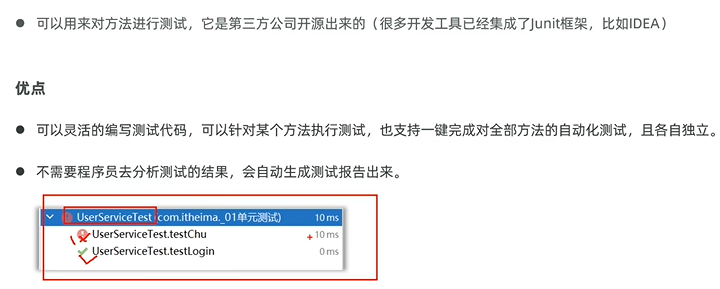
针对最小的功能单元:方法,编写测试代码对其进行正确性测试
1、优点:
2、操作步骤
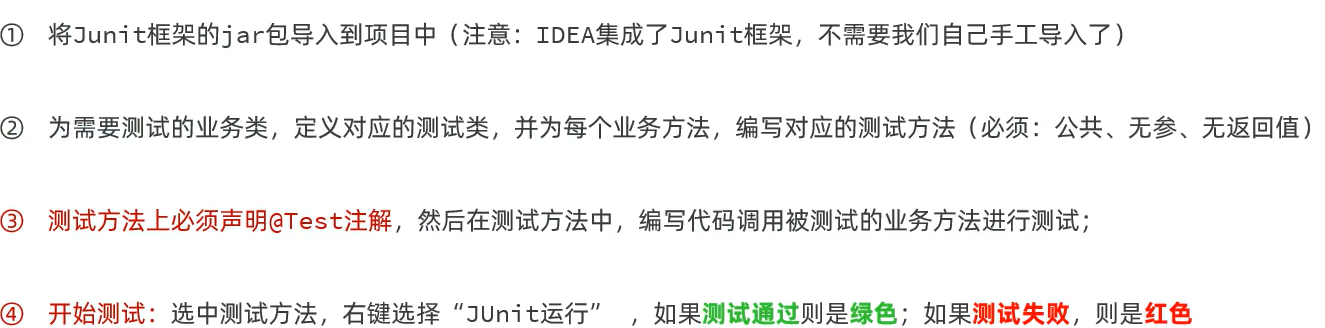
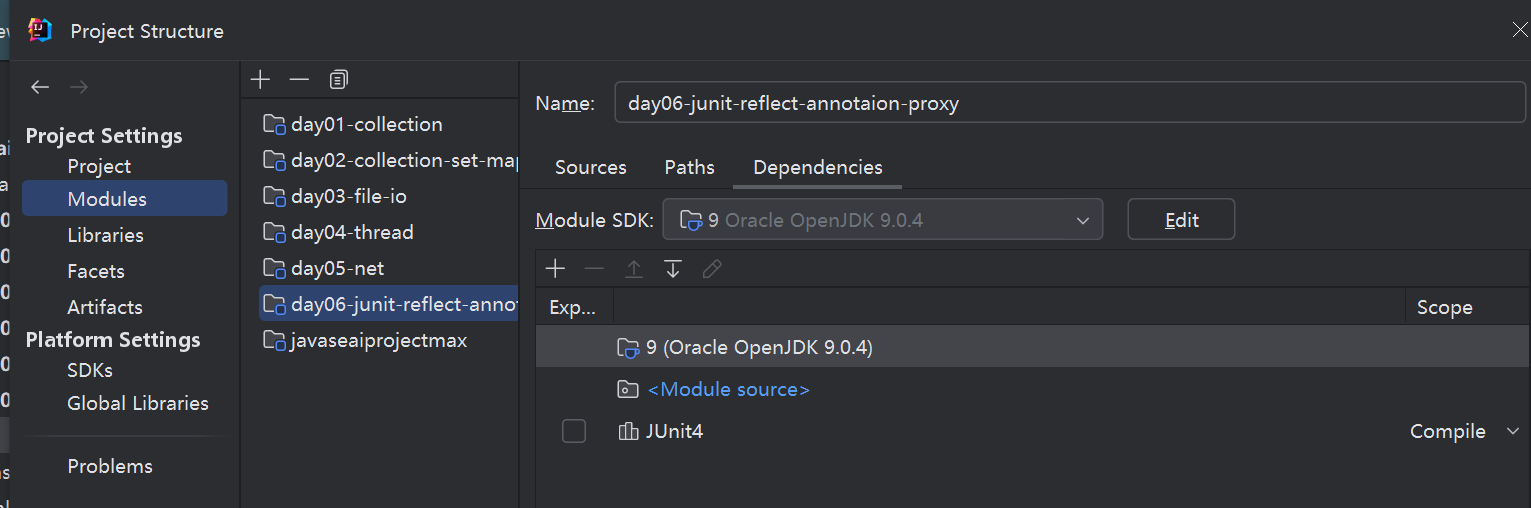
注意:导包JUnit4后,重启idea,右键才显示 运行单元测试方法
package com.ithema.junit;

/**
 * 字符串工具类类
 */
public class StringUtil {
    public static void printNumber(String name) {
        if(name==null){return;}
        System.out.println("名字长度是" + name.length());
    }

    /**
     * 获取字符串最大索引
     */
    public static int getMaxIndex(String data) {
        if (data == null|| data.isEmpty()) return -1;
        return data.length()-1;
    }
}
package com.ithema.junit;

import org.junit.Assert;
import org.junit.Test;

/**
 * 测试类
 */
public class StringUtilTest {
    // 测试方法必须是公共的,不能有参数,不能有返回值
    //测试方法上面必须加上@Test注解


    @Test
    public void testPrintNumber() {
        StringUtil.printNumber("hello world");
        StringUtil.printNumber(null);
    }

    @Test
    public void testGetMaxIndex() {
        int maxIndex = StringUtil.getMaxIndex("hel");
        int maxIndex2 = StringUtil.getMaxIndex("");
        int maxIndex3 = StringUtil.getMaxIndex(null);
        //做断言:断言是否和预期结果一样
        Assert.assertEquals("本轮测试失败,业务获取最大索引有问题,请检查", 2, maxIndex);
        Assert.assertEquals("本轮测试失败,业务获取最大索引有问题,请检查", -1, maxIndex2);
        Assert.assertEquals("本轮测试失败,业务获取最大索引有问题,请检查", -1, maxIndex3);

    }
}
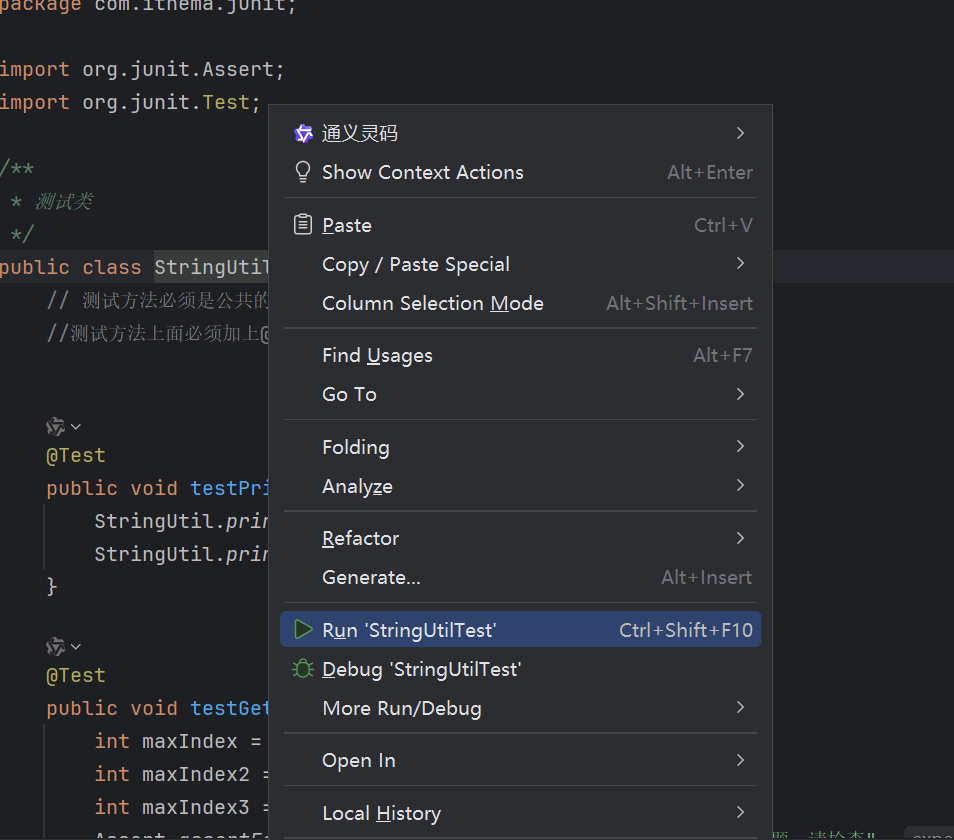
选中方法某处或者类(全部的方法都会运行)
二、反射Reflection
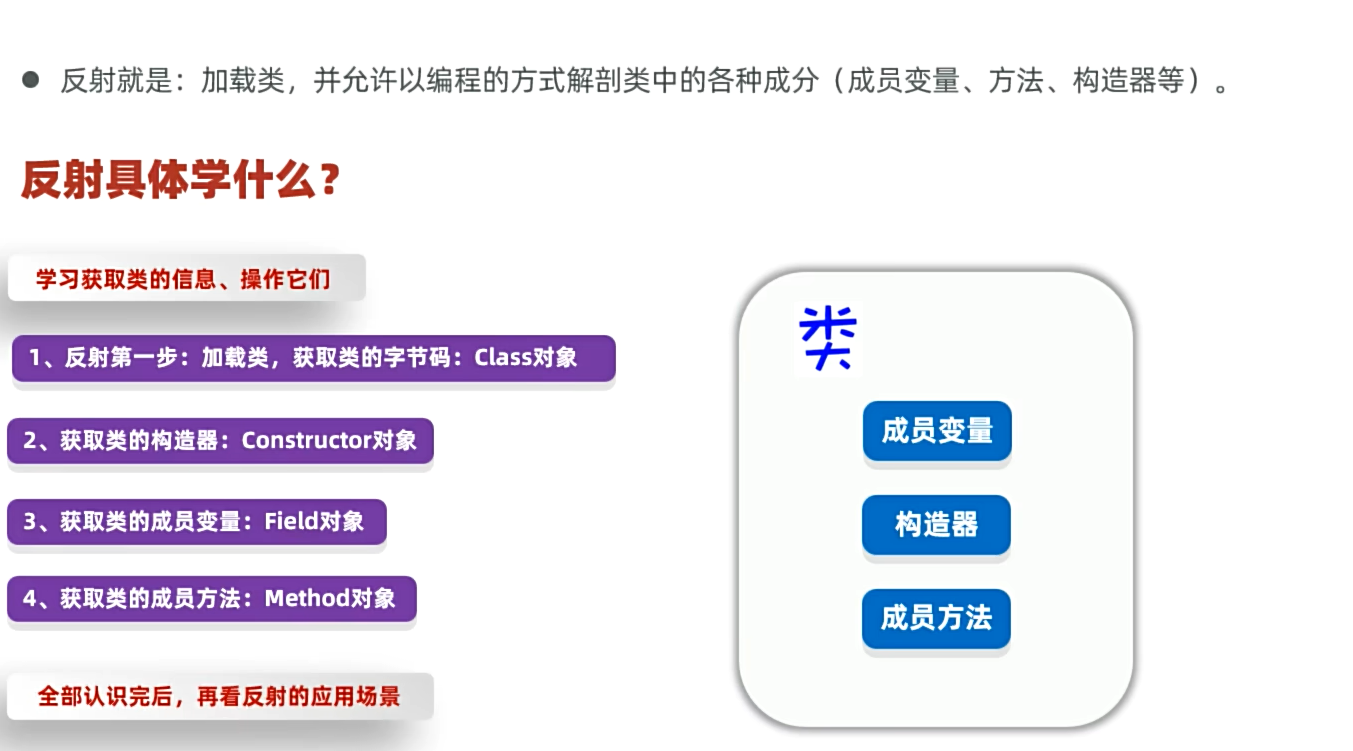
1、认识反射获取类
反射类就是加载类,并允许以编程的方式解剖类中的各种成分(成员变量,方法,构造器等)
(1)获取Class对象的三种方式
- Class c1=类名.Class
- 调用Class提供方法:public static Class forName(String package); Class.forName("com.xx……")
- Object提供的方法:public Class getClass(); Class c3=对象.getClass
package com.ithema.reflect;

public class ReflectDemo1 {
    public static void main(String[] args) throws ClassNotFoundException {
        //反射第一步,获取类的Class对象(获取类本身)
        //1、获取类本身 类名.class
        Class c1 = Student.class;
        //2、获取类本身 对象.getClass()
        Student s = new Student();
        Class c2 = s.getClass();
        //3、Class.forName()

        Class c3 = Class.forName("com.ithema.reflect.Student");
        System.out.println(c1==c2);//true
        System.out.println(c1==c3); //true 同一份类文件

    }
}
2、获取类中的成分进行操作
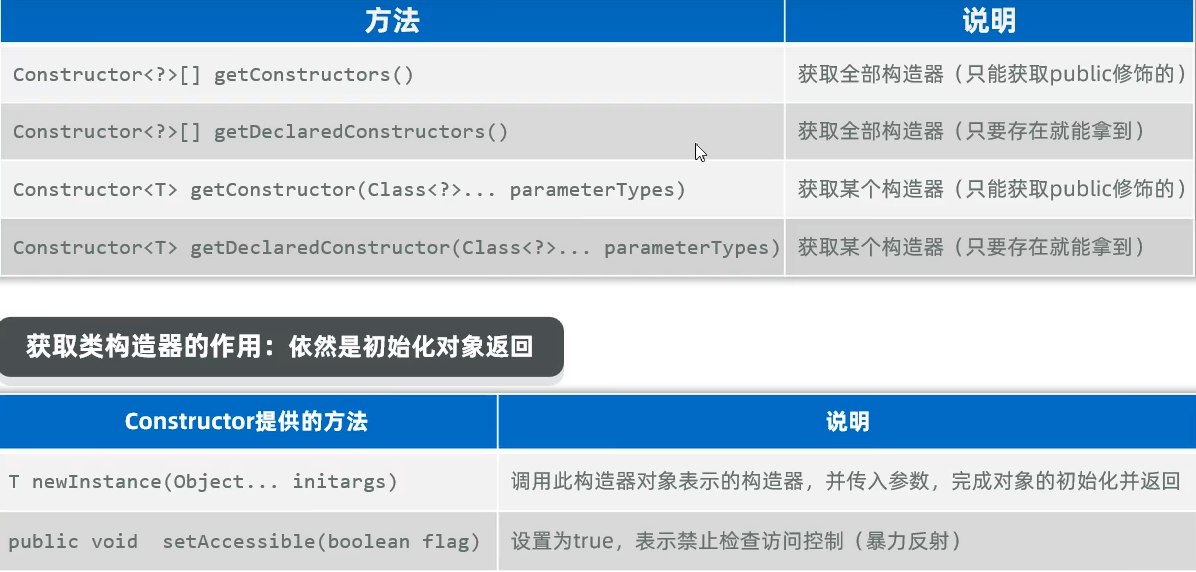
(1)Class提供从类中获取构造器的方法
一般用Declared的
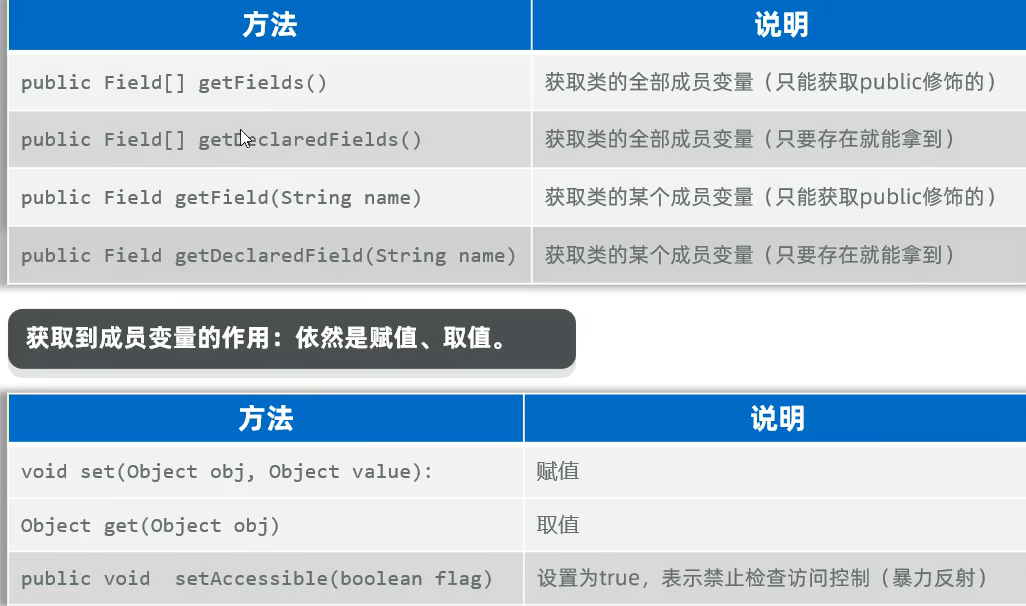
(2)获取类的成员变量
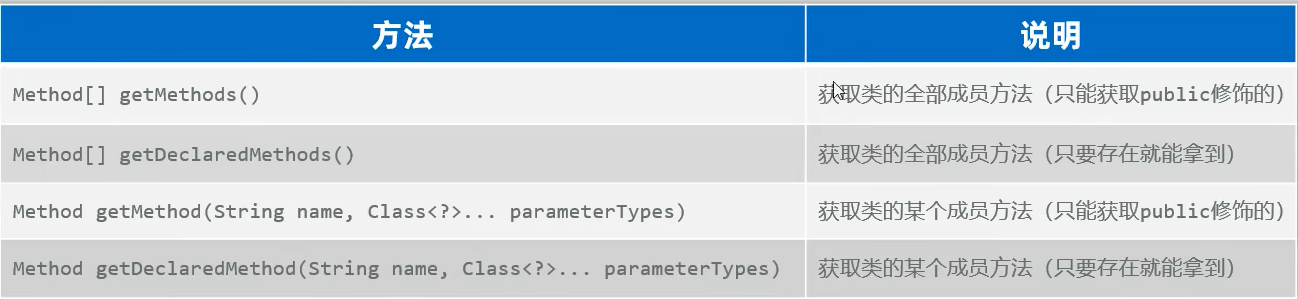
(3)获取类的方法
package com.ithema.reflect;

public class Dog {
    public String getName() {
        return name;
    }

    public void setName(String name) {
        this.name = name;
    }

    public int getAge() {
        return age;
    }

    public void setAge(int age) {
        this.age = age;
    }

    public String getHobby() {
        return hobby;
    }

    public void setHobby(String hobby) {
        this.hobby = hobby;
    }

    private String name;
    private int age;
    private String hobby;

    public Dog(String name, int age, String hobby) {
        this.name = name;
        this.age = age;
        this.hobby = hobby;
        System.out.println("三个参数的有参构造");
    }

    private Dog() {
        System.out.println("无参构造");
    }

    public Dog(String name, int age) {
        this.name = name;
        this.age = age;
        System.out.println("两个参数的有参构造");
    }

    private void eat() {
        System.out.println("无参的吃");
    }

    public String eat(String name) {
        System.out.println("爱吃" + name);
        return "谢谢,旺旺";
    }

    @Override
    public String toString() {
        return "Dog{" +
                "name='" + name + '\'' +
                ", age=" + age +
                ", Hobby='" + hobby + '\'' +
                '}';
    }
}
package com.ithema.reflect;

import org.junit.Test;

import java.lang.reflect.Constructor;
import java.lang.reflect.Field;
import java.lang.reflect.InvocationTargetException;
import java.lang.reflect.Method;

public class ReflectDemo2 {
    @Test
    public void getClassInfo() {
        //获取类的信息

        //1、获取Class对象
        Class c1 = Student.class;
        System.out.println(c1.getName());//类名的全类名 com.ithema.reflect.Student
        System.out.println(c1.getSimpleName());//类型Student
    }

    //获取类的构造器对象并对其操作
    @Test
    public void constructorInfo() throws Exception {

        //1、获取Class对象
        Class c = Dog.class;
        //2、获取构造器对象
        Constructor[] cons = c.getDeclaredConstructors();
        System.out.println("所有的构造器:");
        for (Constructor cr : cons) {
            System.out.println(c.getName() + "参数数量" + cr.getParameterCount());
        }
        //3、获取单个构造器
        Constructor con1 = c.getDeclaredConstructor(String.class, int.class, String.class);//有参构造器
        System.out.println("单个构造器:" + con1.getName() + con1.getParameterCount());

        Constructor con2 = c.getDeclaredConstructor();//无参构造器
        System.out.println("无参构造器:" + con2.getName() + con2.getParameterCount());
        //4、获取构造器的作用依然是创建对象
        Dog d1 = (Dog) con1.newInstance("小王", 18, "游泳");
        System.out.println(d1);
        con2.setAccessible(true);//暴力反射:可以访问私有的属性、方法、构造器
        Dog d2 = (Dog) con2.newInstance();
        System.out.println(d2);

    }


    //获取类的成员变量对象并对其操作
    @Test
    public void getFieldInfo() throws Exception {
        //1、获取Class对象
        Class c = Dog.class;

        Constructor cr = c.getDeclaredConstructor();
        cr.setAccessible(true);
        Dog dog = (Dog) cr.newInstance();

        //2、获取类的成员变量对象
        Field[] fileds = c.getDeclaredFields();
        for (Field field : fileds) {
            System.out.println(field.getName() + " " + field.getType());
        }

        //3、获取单个成员变量对象
        Field field = c.getDeclaredField("age");
        Field field1 = c.getDeclaredField("hobby");
        System.out.println(field.getName() + "(" + field.getType() + ")");
        System.out.println(field.getName() + "(" + field1.getType() + ")");

        //4、获取成员变量的目的是依旧是取值和赋值
        field.setAccessible(true);//暴力反射,绕过访问权限直接访问
        field.set(dog, 18);
        field1.setAccessible(true);
        field1.set(dog,"社交");
        System.out.println(dog);

    }

    @Test
    public void getMethodInfo() throws Exception {
        //1、获取Class对象
        Class c = Dog.class;

        //获取类的构造器对象并实例化
        Constructor cr = c.getDeclaredConstructor(String.class, int.class);
        Dog dog = (Dog) cr.newInstance("小王", 18);

        //2、获取成员方法对象
        Method[] methods = c.getDeclaredMethods();
        for (Method method : methods) {
            System.out.println(method.getName() + "返回类型 " + method.getReturnType());
        }

        //3、获取单个方法对象
        Method m1 = c.getDeclaredMethod("eat", String.class);//获取有参的eat方法
        Method m2 = c.getDeclaredMethod("eat");//获取的是无参的eat
        System.out.println(m1.getName() + "(" + m1.getParameterCount() + ")");
        System.out.println(m2.getName() + "(" + m2.getParameterCount() + ")");

        //4、获取方法对象的目的是调用方法
        String result = (String) m1.invoke(dog, "肉骨头");
        System.out.println(result);
        m2.setAccessible(true);//暴力反射
        Object result2 = m2.invoke(dog);
        System.out.println(result2);
    }
}
3、作用、应用场景
(1)反射的作用:
- 可以获取类的全部成分进行操作
- 可以破坏封装性(私有的暴力反射)
- 可以绕过泛型的约束(编译后泛型约束就没有了)
最重要的用途是:适合做java的框架,基本上,主流的框架都会基于反射设计一些通用的功能
package com.ithema.reflect;

import java.lang.reflect.Method;
import java.util.ArrayList;
import java.util.List;

public class ReflectDemo3 {
    public static void main(String[] args) throws Exception {
        //反射的基本作用
        //1、类的全部成分的获取
        //2、破坏封装性
        //3、可以绕过泛型约束
        List<String>list =new ArrayList<>();
        list.add("hello");
        list.add("world");
        Class c=list.getClass();
        Method add = c.getMethod("add", Object.class);
        add.invoke(list,100);
        add.invoke(list,true);
        System.out.println(list);// [hello, world, 100, true]
    }
}
//综合
package com.ithema.reflect;

import org.apache.commons.io.IOUtils;

import java.io.*;
import java.lang.reflect.Field;

public class SaveObjectFrame {
    //保存任意对象的静态方法
    public static void saveObject(Object obj) throws Exception{
        OutputStream os = new FileOutputStream("day06-junit-reflect-annotaion-proxy\\src\\obj.txt",true);
        PrintStream ps = new PrintStream(os);
            //1、获取Class对象
            Class c = obj.getClass();
            ps.println("******************"+c.getSimpleName()+"********************");

            //2、获取Class对象的所有字段
            Field[] fields = c.getDeclaredFields();
            //3、遍历所有字段
            for (Field field : fields) {
                field.setAccessible(true);
                //获取字段的名称和字段的值
                ps.println(field.getName() + "=" + field.get(obj) );
            }
           ps.close();

    }
}
package com.ithema.reflect;

public class ReflectDemo4 {
    //反射的应用场景:框架的通用技术
    public static void main(String[] args) throws Exception {
        Dog dog = new Dog("小黑黑", 2, "吃肉骨头");
        SaveObjectFrame.saveObject( dog);
        Student student = new Student( "小王", 18, "打游戏");
        SaveObjectFrame.saveObject( student);
        Teacher teacher = new Teacher( "张老师", 49, "跳舞、下棋", 5000.0, "四年三班", '男', "12345678901");
        SaveObjectFrame.saveObject( teacher);
    }

}
三、注解
1、概述、自定义注解
(1)概述
是java的特殊标记,比如@Test @Override等,作用是让其他程序根据注解信息来决定怎么执行该程序。
注解可以用在类上、构造器上、方法上、成员变量上、参数上等位置
(2)自定义注解
public @interface 注解名{
public 属性类型 属性名() default 默认值
}
特殊属性名:value
如果注解中只有一个属性,且是value属性,使用注解时,value名称可以不写
(3)注解的原理
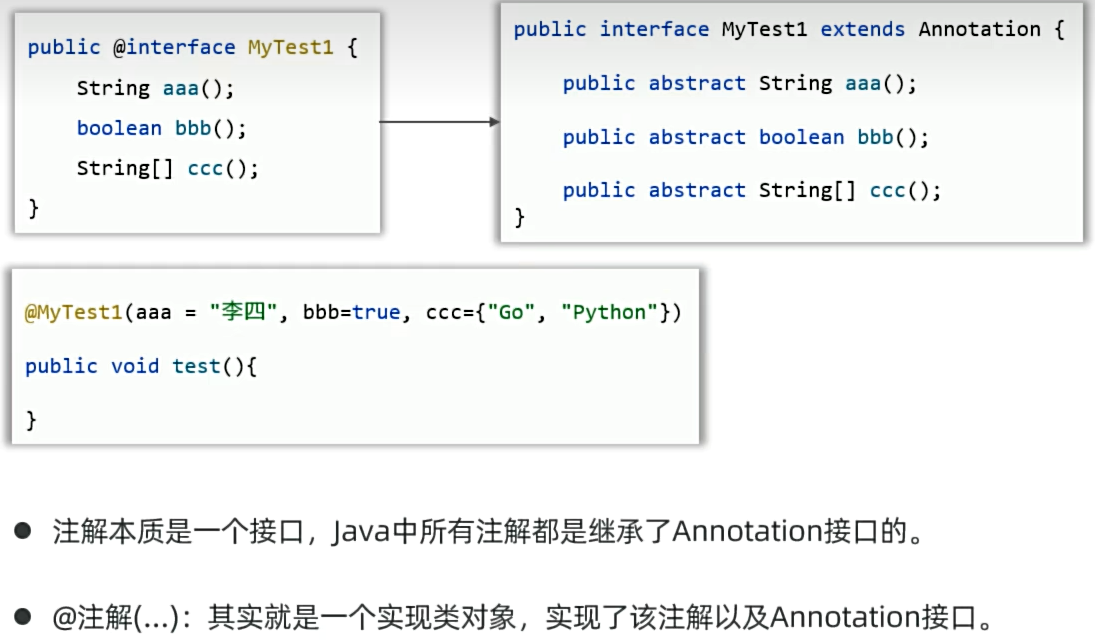
package com.ithema.annotaion;

public @interface Mybook {
    String name();//默认public
    int age() default 18;
    String sex() default "男";
    String []address();

}
package com.ithema.annotaion;

public @interface A {
    String value();//特殊属性value,在使用时,如果只有一个value属性,可以省略value
   // String hobby();这个时候value不能省
    String hobby() default "小王";//value可省
}
package com.ithema.annotaion;
@Mybook( name = "赵颖", age = 18, sex = "女", address = {"北京", "上海"})
@A("del")
public class AnnotationDemo1 {

    public static void main(@A("k") String[] args) {

    }
}
2、元注解
(1)指的是注解注解的注解(vnn)(放在注解上的注解)
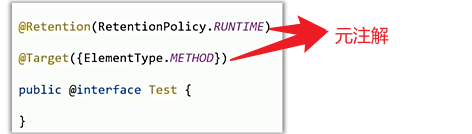
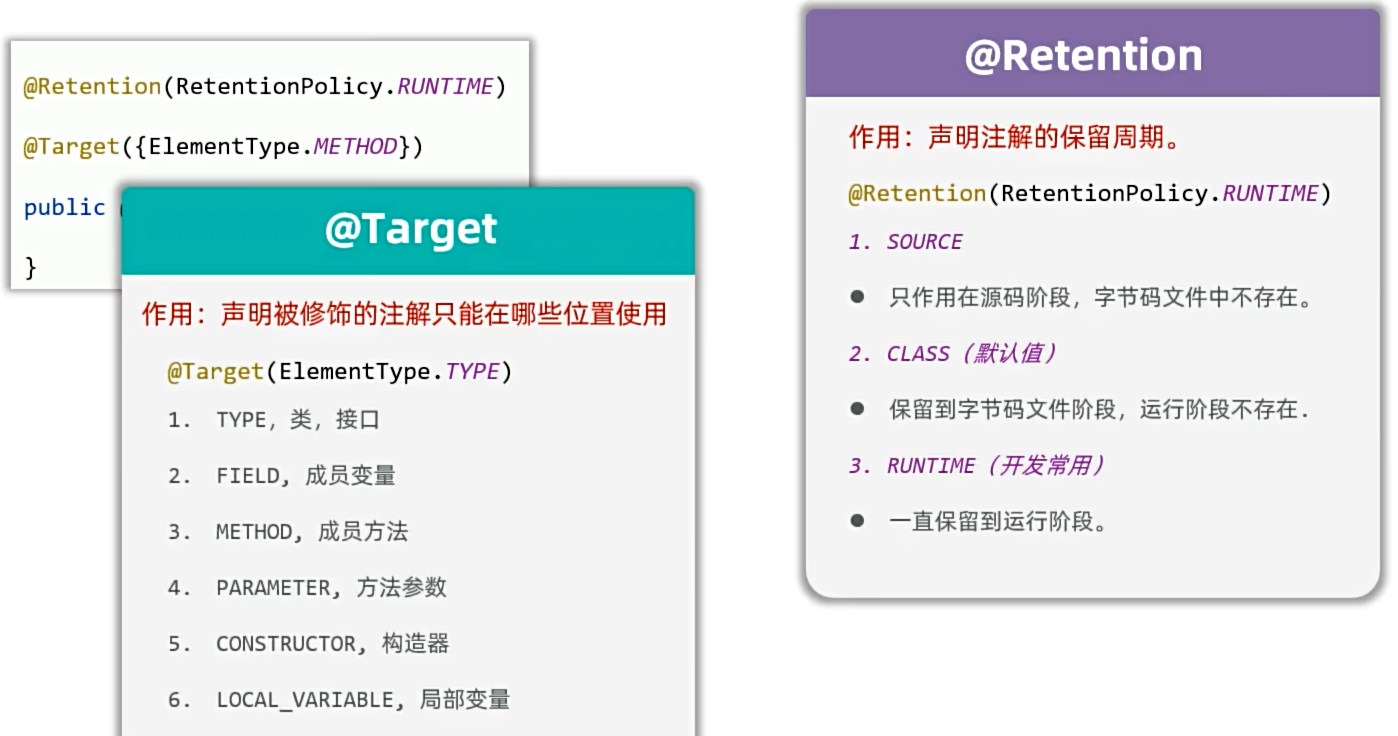
(2)元注解:@Target @Retention 如下:
@Target声明被修饰的注解只能在哪些位置使用
@Retention声明注解的保留周期
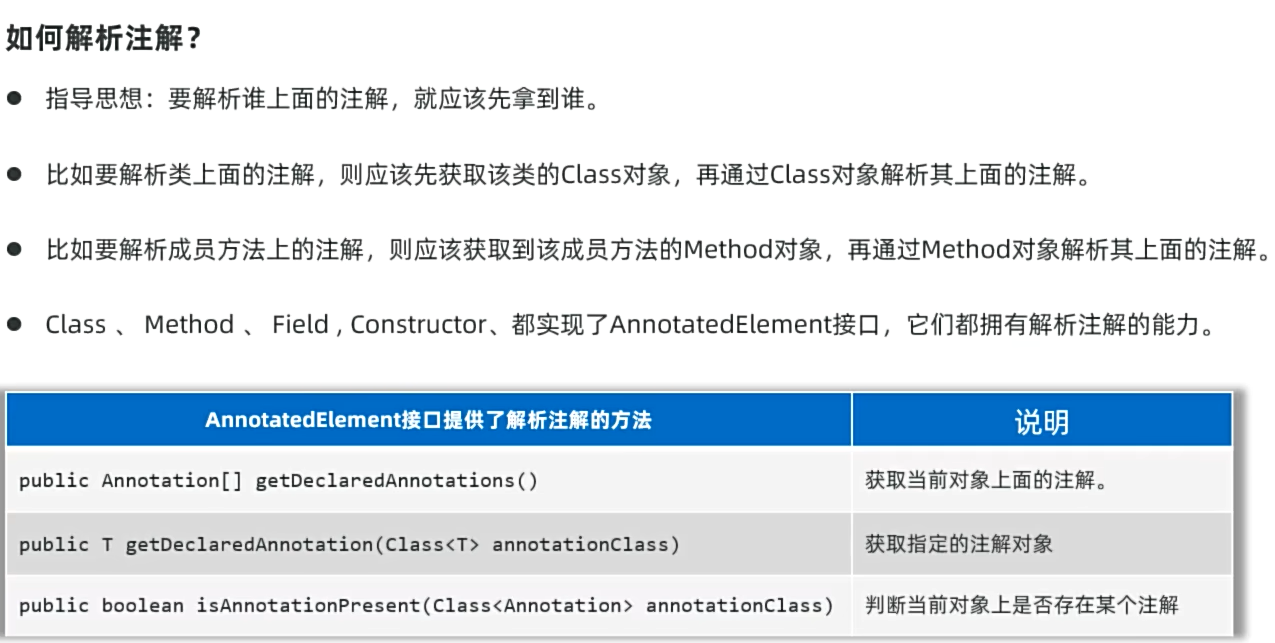
3、注解的解析
就是判断类上、方法上、成员变量上是否存在注解,并把注解里的内容给解析出来
package com.ithema.annotaion;

import java.lang.annotation.ElementType;
import java.lang.annotation.Retention;
import java.lang.annotation.RetentionPolicy;
import java.lang.annotation.Target;

@Retention(RetentionPolicy.RUNTIME)
@Target({ElementType.METHOD,ElementType.TYPE})
public @interface Mytest2 {
    String value();
    double price() default 100;
    String[] city();
}
package com.ithema.annotaion;
@Mytest2(value = "华晨宇", price = 400.0, city = {"成都","北京"})
public class Demo {
    @Mytest2(value = "张靓颖", price = 100.0, city = { "上海","北京"})
    public  void test(){
        System.out.println("test");
    }
    @Mytest2(value = "周深", price = 300.0, city = { "深圳","长沙","沈阳"})
    public  void test1(String name){
        System.out.println("test1");
    }
}
package com.ithema.annotaion;

import org.junit.Test;

import java.lang.annotation.Annotation;
import java.lang.reflect.Method;
import java.util.Arrays;

public class AnnotationDemo3 {
    @Test
    public void parsClass() throws Exception {
        //解析Demo类中的全部注解
        Class c = Demo.class;
        // 判断这个类对象上是否存在某个注解
        if (c.isAnnotationPresent(Mytest2.class)) {
            //获取指定的注解对象
            Mytest2 annotation = (Mytest2) c.getAnnotation(Mytest2.class);
            System.out.println(annotation.value());
            System.out.println(annotation.price());
            System.out.println(Arrays.toString(annotation.city()));

        }

    }

    @Test
    public void parsMethod() throws Exception {
        Class c = Demo.class;
        Method[] m=c.getDeclaredMethods();
        for (Method method : m) {
            if(method.isAnnotationPresent(Mytest2.class))
            {
                System.out.println(method.getName());
                Mytest2 annotation = method.getAnnotation(Mytest2.class);
                System.out.println(annotation.value());
                System.out.println(annotation.price());
                System.out.println(Arrays.toString(annotation.city()));
                 System.out.println("--------------------------------");
            }
        }
    }
}
4、作用、应用场景
让其他程序根据注解信息来决定怎么执行该程序
使用注解开发建议的JUnit框架
package com.ithema.annotaion;

import java.lang.annotation.ElementType;
import java.lang.annotation.Retention;
import java.lang.annotation.RetentionPolicy;
import java.lang.annotation.Target;

@Target(ElementType.METHOD)
@Retention(RetentionPolicy.RUNTIME)
public @interface Mytest {
    int count() default 1;

}
package com.ithema.annotaion;

import java.lang.reflect.Method;

public class AnotationDemo4 {

    public static void main(String[] args) throws Exception {
        //搞清楚注解的应用场景,模拟JUnit框架
        //获取类对象
        //获取所有方法
        //遍历所有方法,判断方法上是否有Test注解,有就执行,没有就不执行
        Class c = AnotationDemo4.class;
        Method[] methods = c.getDeclaredMethods();
//        Object o = c.getConstructor().newInstance();
//        Constructor constructor = c.getConstructor();
//        AnotationDemo4 obj = (AnotationDemo4) constructor.newInstance();
        AnotationDemo4 obj = new AnotationDemo4();
        for (Method m : methods) {
            if (m.isAnnotationPresent(Mytest.class)) {
                Mytest declaredAnnotation = m.getDeclaredAnnotation(Mytest.class);
                int value = declaredAnnotation.count();
                for (int i = 0; i < value; i++) {
                    m.invoke(obj);
                }


            }
        }
    }

    //测试方法 public 无参无返回值
    @Mytest
    public void test1() {
        System.out.println("test1执行了");
    }

    public void test2() {
        System.out.println("test2执行了");
    }

    @Mytest(count = 3)//执行3次
    public void test3() {
        System.out.println("test3执行了");
    }

    public void test4() {
        System.out.println("test4执行了");
    }
}
四、动态代理
1、需要代理的原因
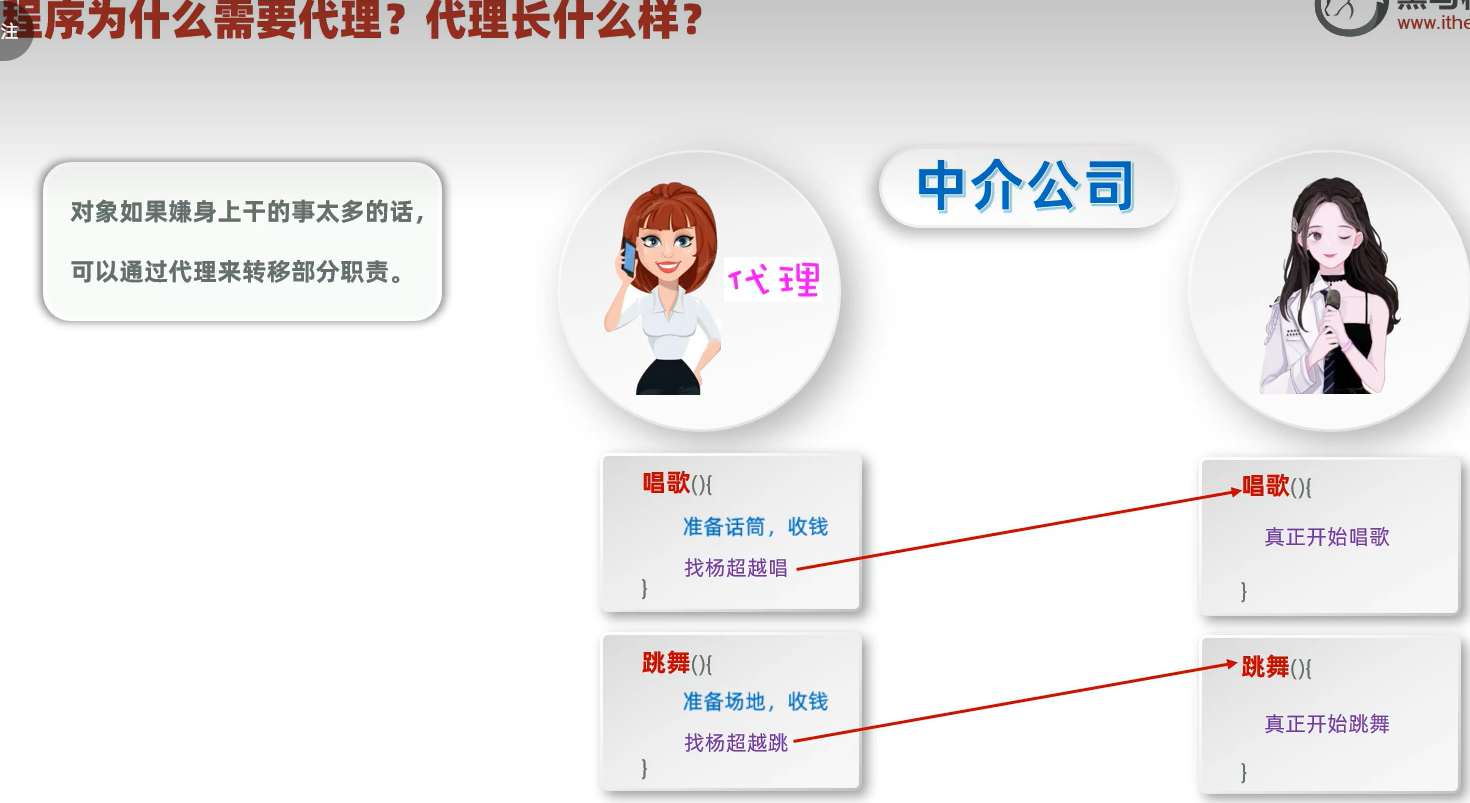
(1)创建代理
java.lang.reflect.Proxy类:提供了为对象产生代理对象的方法:
public static Object newProxy

package com.ithema.proxy;
//明星服务接口
public interface StarService {
    void sing(String name);
    String dance();
}
package com.ithema.proxy;

import lombok.AllArgsConstructor;
import lombok.Data;
import lombok.NoArgsConstructor;

@Data
@AllArgsConstructor
@NoArgsConstructor
public class Star implements StarService {
    private String name;

    @Override
    public void sing(String name) {
        System.out.println(this.name + "在唱"+ name);
    }

    @Override
    public String dance() {
        System.out.println(this.name + "在跳pop");
        return "谢谢";
    }
}
package com.ithema.proxy;

import java.lang.reflect.InvocationHandler;
import java.lang.reflect.Method;
import java.lang.reflect.Proxy;

//代理工具类,中介公司,专门负责创建代理对象并返回
public class ProxyUtils {
    //创建代理对象并返回
    public static StarService createProxy(Star star) {
        /**
         * 参数一:用于执行用哪个类加载器去加载生成的代理类。哪个类的都行
         * 参数二:用于指定代理类需要实现的接口:明星类实现了哪些接口,代理类就实现哪些接口
         * 参数三:用于指定代理类需要如何去代理(代理要做的事)
         */
        return (StarService) Proxy.newProxyInstance(ProxyUtils.class.getClassLoader(),
                star.getClass().getInterfaces(), new InvocationHandler() {
                    @Override
                    public Object invoke(Object proxy, Method method, Object[] args) throws Throwable {
                        //声明代理对象要干的事情
                        //参数一:proxy接收到代理对象本身(暂时用不到)
                        //参数二:method表示正在被代理的方法
                        //参数三:args表示正在被代理方法的参数
                        if("sing".equals(method.getName()))
                        {
                            System.out.println("准备话筒,收钱20w");
                        }else  if("dance".equals(method.getName())){
                            System.out.println("准备场地,收钱100w");
                        }
                        //真正干活(把真正的明星对象叫来正式干活)
                        //找真正的明星对象来执行被代理的方法
                      return  method.invoke(star, args);
                    }
                });

    }
}
package com.ithema.proxy;

public class Test {
    public static void main(String[] args) {
        //1、创建明星类Star
        Star star = new Star("杨超越");
        //为明星创建一个专属的代理对象
        StarService proxy = ProxyUtils.createProxy(star);
        proxy.sing("月亮之上");
        System.out.println(proxy.dance());

    }
}
2、解决实际问题,掌握代理的好处
例如统计每个方法的耗时(AOP切面思想,上下一样,中间不一样)
package com.ithema.proxy2;

public interface UserService {
    void loginUser(String name, String pwd) throws  Exception;

    void deleteUsers() throws Exception;

    String[] SelectUsers() throws Exception;
}
    package com.ithema.proxy2;

    import lombok.AllArgsConstructor;
    import lombok.Data;
    import lombok.NoArgsConstructor;

    @Data
    @AllArgsConstructor

    public class UserServiceImp implements UserService    {


        @Override
        public void loginUser(String name, String pwd) throws Exception {
            System.out.println("用户"+name+"登录成功");
            Thread.sleep(200);
        }

        @Override
        public void deleteUsers()  throws Exception{
            System.out.println("删除1000哥用户成功");
            Thread.sleep(500);
        }

        @Override
        public String[] SelectUsers() throws Exception{
            System.out.println("查询到3名用户");
            String[]users={"王一博","肖战","杨夏"};
            Thread.sleep(100);
            return users;
        }
    }
package com.ithema.proxy2;

import java.lang.reflect.InvocationHandler;
import java.lang.reflect.Method;
import java.lang.reflect.Proxy;
import java.util.logging.Handler;

//代理工具类,中介公司,专门负责创建代理对象并返回
public class ProxyUtils {
    public static <T>T createProxy(T user) {
        return (T) Proxy.newProxyInstance(ProxyUtils.class.getClassLoader(),
                user.getClass().getInterfaces(),
                new InvocationHandler() {
                    @Override
                    public Object invoke(Object proxy, Method method, Object[] args) throws Throwable {
                        long start = System.currentTimeMillis();
                        Object obj = method.invoke(user, args);
                        long end = System.currentTimeMillis();
                        System.out.println(method.getName()+"耗时:" + (end - start) / 1000.0 + "s");
                        return obj;
                    }
                });

    }
}
package com.ithema.proxy2;

import java.util.Arrays;

public class Test {
    public static void main(String[] args) throws Exception {
    //使用动态代理解决实际问题,并掌握使用代码的好处
    //统计每个方法的
        UserService proxy = ProxyUtils.createProxy(new UserServiceImp());
        proxy.loginUser("admin","123456");
        proxy.deleteUsers();
        System.out.println(Arrays.toString(proxy.SelectUsers()));
    }
}

 浙公网安备 33010602011771号