
步骤1:同上
步骤2:建立目录
cd workdir/linux/application/10-comm/
mkdir fifo
cd fifo
步骤3:复制
cp /mnt/hgfs/share/2.\ Linux 系统部分/13.\ Linux系统有名管道通信实验/实验代码/write_fifo.c ./ -a
cp /mnt/hgfs/share/2.\ Linux 系统部分/13.\ Linux系统有名管道通信实验/实验代码/read_fifo.c ./ -a
cp /mnt/hgfs/share/2.\ Linux 系统部分/13.\ Linux系统有名管道通信实验/实验代码/create_fifo.c ./ -a
步骤4:执行
gcc create_fifo.c -o create_fifo
./create_fifo test
gcc read_fifo.c -o read_fifo

gcc write_fifo.c -o write_fifo
./read_fifo test
步骤5:重新打开一个新终端
进入该目录
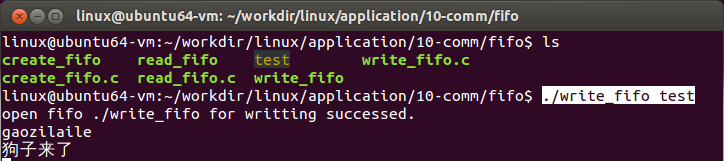
./write_fifo test
输入任意字符
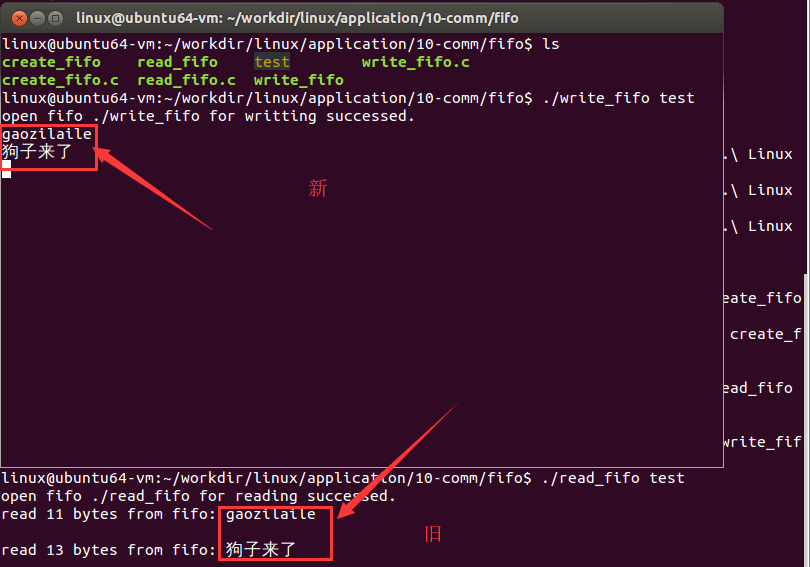
在旧的终端可以接受到信息
附:程序源码
create_fifo.c
 1 #include <stdio.h>
 2 #include <stdlib.h>
 3 #include <sys/stat.h>
 4 #include <string.h>
 5 #include <errno.h>
 6
 7 int main(int argc, char **argv)
 8 {
 9     if (argc < 2)
10     {
11         fprintf(stdout, "Usage: %s <filename>\n", argv[0]);
12         exit(1);
13     }
14
15     //int mkfifo(const char *path, mode_t mode);
16     if (mkfifo(argv[1], 0644) < 0)
17     {
18         fprintf(stderr, "mkfifo() failed: %s\n", strerror(errno));
19         exit(1);
20     }
21
22     return 0;
23 }
read_fifo.c
 1 #include <stdio.h>
 2 #include <stdlib.h>
 3 #include <unistd.h>
 4 #include <sys/stat.h>
 5 #include <fcntl.h>
 6 #include <string.h>
 7 #include <errno.h>
 8
 9 #define BUFFER_SIZE    1024
10
11 int main(int argc, char **argv)
12 {
13     int fd;
14
15     if (argc < 2)
16     {
17         fprintf(stdout, "Usage: %s <filename>\n", argv[0]);
18         exit(1);
19     }
20
21     //int open(const char *path, int oflag, ...);
22     if ((fd = open(argv[1], O_RDONLY)) < 0)
23     {
24         fprintf(stderr, "open fifo %s for reading failed: %s\n", argv[1], strerror(errno));
25         exit(1);
26     }
27
28     fprintf(stdout, "open fifo %s for reading successed.\n", argv[0]);
29     char buffer[BUFFER_SIZE];
30     ssize_t n;
31
32     while (1)
33     {
34 again:
35         //ssize_t read(int fd, void *buf, size_t count);
36         if ((n = read(fd, buffer, BUFFER_SIZE)) < 0)
37         {
38             if (errno == EINTR)
39             {
40                 goto again;
41             }
42             else
43             {
44                 fprintf(stderr, "read failed on %s: %s\n", argv[1], strerror(errno));
45                 exit(1);
46             }
47         }
48         else if (n == 0)
49         {
50             fprintf(stderr, "peer closed fifo.\n");
51             break;
52         }
53         else
54         {
55             buffer[n] = '\0';
56             fprintf(stdout, "read %d bytes from fifo: %s\n", n, buffer);
57         }
58     }
59     return 0;
60 }
write_fifo.c
 1 #include <stdio.h>
 2 #include <stdlib.h>
 3 #include <unistd.h>
 4 #include <sys/stat.h>
 5 #include <fcntl.h>
 6 #include <signal.h>
 7 #include <string.h>
 8 #include <errno.h>
 9
10 #define BUFFER_SIZE    1024
11
12 void signal_handler(int s);
13
14 int main(int argc, char **argv)
15 {
16     int fd;
17
18     if (argc < 2)
19     {
20         fprintf(stdout, "Usage: %s <filename>\n", argv[0]);
21         exit(1);
22     }
23
24     signal(SIGPIPE, signal_handler);
25
26     //int open(const char *path, int oflag, ...);
27     if ((fd = open(argv[1], O_WRONLY)) < 0)
28     {
29         fprintf(stderr, "open fifo %s for writting failed: %s\n", argv[1], strerror(errno));
30         exit(1);
31     }
32
33     fprintf(stdout, "open fifo %s for writting successed.\n", argv[0]);
34
35     char buffer[BUFFER_SIZE];
36     ssize_t n;
37
38     //char *fgets(char *s, int size, FILE * stream);
39     while (fgets(buffer, BUFFER_SIZE, stdin))
40     {
41 again:
42         //ssize_t write(int fd, const void *buf, size_t count);
43         if ((n = write(fd, buffer, strlen(buffer))) < 0)
44         {
45             if (errno == EINTR)
46             {
47                 goto again;
48             }
49             else
50             {
51                 fprintf(stderr, "write() failed on fifo: %s\n", strerror(errno));
52                 break;
53             }
54         }  // end if
55     }  // end while
56
57     return 0;
58 }
59
60 void signal_handler(int signo)
61 {
62     fprintf(stdout, "Caught signal %d\n", signo);
63 }

 浙公网安备 33010602011771号