


实验五
task1
源代码
publisher.hpp
#pragma once

#include <string>

// 发行/出版物类:Publisher (抽象类)
class Publisher {
public:
    Publisher(const std::string &name_ = "");            // 构造函数
    virtual ~Publisher() = default;

public:
    virtual void publish() const = 0;                 // 纯虚函数,作为接口继承
    virtual void use() const = 0;                     // 纯虚函数,作为接口继承

protected:
    std::string name;    // 发行/出版物名称
};

// 图书类: Book
class Book: public Publisher {
public:
    Book(const std::string &name_ = "", const std::string &author_ = "");  // 构造函数

public:
    void publish() const override;        // 接口
    void use() const override;            // 接口

private:
    std::string author;          // 作者
};

// 电影类: Film
class Film: public Publisher {
public:
    Film(const std::string &name_ = "", const std::string &director_ = "");   // 构造函数

public:
    void publish() const override;    // 接口
    void use() const override;        // 接口

private:
    std::string director;        // 导演
};


// 音乐类:Music
class Music: public Publisher {
public:
    Music(const std::string &name_ = "", const std::string &artist_ = "");

public:
    void publish() const override;        // 接口
    void use() const override;            // 接口

private:
    std::string artist;      // 音乐艺术家名称
};
publisher.cpp
#include <iostream>
#include <string>
#include "publisher.hpp"

// Publisher类:实现
Publisher::Publisher(const std::string &name_): name {name_} {
}


// Book类: 实现
Book::Book(const std::string &name_ , const std::string &author_ ): Publisher{name_}, author{author_} {
}

void Book::publish() const {
    std::cout << "Publishing book《" << name << "》 by " << author << '\n';
}

void Book::use() const {
    std::cout << "Reading book 《" << name << "》 by " << author << '\n';
}


// Film类:实现
Film::Film(const std::string &name_, const std::string &director_):Publisher{name_},director{director_} {
}

void Film::publish() const {
    std::cout << "Publishing film <" << name << "> directed by " << director << '\n';
}

void Film::use() const {
    std::cout << "Watching film <" << name << "> directed by " << director << '\n';
}


// Music类:实现
Music::Music(const std::string &name_, const std::string &artist_): Publisher{name_}, artist{artist_} {
}

void Music::publish() const {
    std::cout << "Publishing music <" << name << "> by " << artist << '\n';
}

void Music::use() const {
    std::cout << "Listening to music <" << name << "> by " << artist << '\n';
}
task1.cpp
#include <memory>
#include <iostream>
#include <vector>
#include "publisher.hpp"

void test1() {
   std::vector<Publisher *> v;

   v.push_back(new Book("Harry Potter", "J.K. Rowling"));
   v.push_back(new Film("The Godfather", "Francis Ford Coppola"));
   v.push_back(new Music("Blowing in the wind", "Bob Dylan"));

   for(Publisher *ptr: v) {
        ptr->publish();
        ptr->use();
        std::cout << '\n';
        delete ptr;
   }
}

void test2() {
    std::vector<std::unique_ptr<Publisher>> v;

    v.push_back(std::make_unique<Book>("Harry Potter", "J.K. Rowling"));
    v.push_back(std::make_unique<Film>("The Godfather", "Francis Ford Coppola"));
    v.push_back(std::make_unique<Music>("Blowing in the wind", "Bob Dylan"));

    for(const auto &ptr: v) {
        ptr->publish();
        ptr->use();
        std::cout << '\n';
    }
}

void test3() {
    Book book("A Philosophy of Software Design", "John Ousterhout");
    book.publish();
    book.use();
}

int main() {
    std::cout << "运行时多态:纯虚函数、抽象类\n";

    std::cout << "\n测试1: 使用原始指针\n";
    test1();

    std::cout << "\n测试2: 使用智能指针\n";
    test2();

    std::cout << "\n测试3: 直接使用类\n";
    test3();
}
运行结果
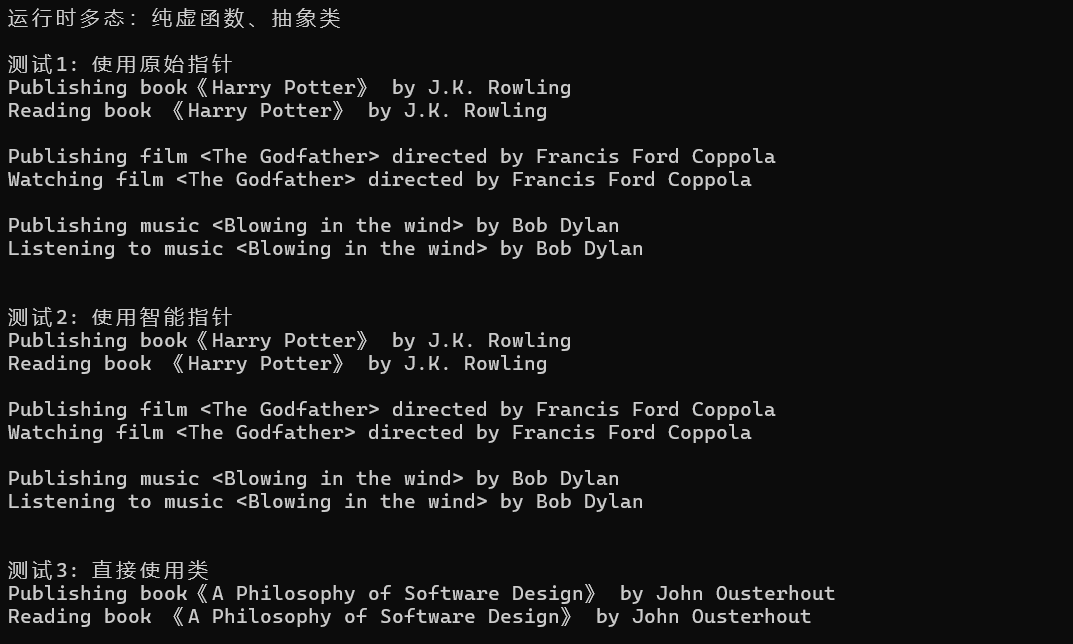
问题
问题1:抽象类机制
(1)是什么决定了 Publisher 是抽象类?用一句话说明,并指出代码中的具体依据。
(2)如果在 main.cpp 里直接写 Publisher p; 能否编译通过?为什么?
答:
(1)包含了至少一个纯虚函数。virtual void publish() const = 0;virtual void use() const = 0;
(2)不能。抽象类无法实例化
问题2:纯虚函数与接口继承
(1) Book 、 Film 、 Music 必须实现哪两个函数才能通过编译?请写出其完整函数声明。
(2) 在 publisher.cpp 的 Film 类实现中,把两个成员函数实现里的 const 去掉(保持函数体不变),重新
编译,报错信息是什么?
答:
(1)publish和use函数。void publish() const override; void use() const override;
(2)
问题3:运行时多态与虚析构
(1)在 test1() 里, for (Publisher *ptr : v) 中 ptr 的声明类型是什么?
(2)当循环执行到 ptr->publish(); 时, ptr 实际指向的对象类型分别有哪些?(按循环顺序写出)
(3)基类 Publisher 的析构函数为何声明为 virtual ?若删除 virtual ,执行 delete ptr; 会出现什么
问题?
答:
(1)指向Publish类的指针
(2)实际指向的对象类型依次为:Book、Film、Music。
(3)为了能够调用派生类的析构函数。若删除virtual则只会调用基类析构函数造成内存泄漏
task2
源代码
book.hpp
#pragma once
#include <string>

// 图书描述信息类Book: 声明
class Book {
public:
    Book(const std::string &name_,
         const std::string &author_,
         const std::string &translator_,
         const std::string &isbn_,
         double price_);

    friend std::ostream& operator<<(std::ostream &out, const Book &book);

private:
    std::string name;        // 书名
    std::string author;      // 作者
    std::string translator;  // 译者
    std::string isbn;        // isbn号
    double price;        // 定价
};
booksale.hpp
#pragma once

#include <string>
#include "book.hpp"

// 图书销售记录类BookSales:声明
class BookSale {
public:
    BookSale(const Book &rb_, double sales_price_, int sales_amount_);
    int get_amount() const;   // 返回销售数量
    double get_revenue() const;   // 返回营收

    friend std::ostream& operator<<(std::ostream &out, const BookSale &item);

private:
    Book rb;
    double sales_price;      // 售价
    int sales_amount;       // 销售数量
};
book.cpp
#include <iomanip>
#include <iostream>
#include <string>
#include "book.hpp"


// 图书描述信息类Book: 实现
Book::Book(const std::string &name_,
          const std::string &author_,
          const std::string &translator_,
          const std::string &isbn_,
          double price_):name{name_}, author{author_}, translator{translator_}, isbn{isbn_}, price{price_} {
}

// 运算符<<重载实现
std::ostream& operator<<(std::ostream &out, const Book &book) {
    using std::left;
    using std::setw;

    out << left;
    out << setw(15) << "书名:" << book.name << '\n'
        << setw(15) << "作者:" << book.author << '\n'
        << setw(15) << "译者:" << book.translator << '\n'
        << setw(15) << "ISBN:" << book.isbn << '\n'
        << setw(15) << "定价:" << book.price;

    return out;
}
booksale.cpp
#include <iomanip>
#include <iostream>
#include <string>
#include "booksale.hpp"

// 图书销售记录类BookSales:实现
BookSale::BookSale(const Book &rb_,
                   double sales_price_,
                   int sales_amount_): rb{rb_}, sales_price{sales_price_}, sales_amount{sales_amount_} {
}

int BookSale::get_amount() const {
    return sales_amount;
}

double BookSale::get_revenue() const {
    return sales_amount * sales_price;
}

// 运算符<<重载实现
std::ostream& operator<<(std::ostream &out, const BookSale &item) {
    using std::left;
    using std::setw;

    out << left;
    out << item.rb << '\n'
        << setw(15) << "售价:" << item.sales_price << '\n'
        << setw(15) << "销售数量:" << item.sales_amount << '\n'
        << setw(15) << "营收:" << item.get_revenue();

    return out;
}
task2.cpp
#include <algorithm>
#include <iomanip>
#include <iostream>
#include <string>
#include <vector>
#include "booksale.hpp"

// 按图书销售数量比较
bool compare_by_amount(const BookSale &x1, const BookSale &x2) {
    return x1.get_amount() > x2.get_amount();
}

void test() {
    using std::cin;
    using std::cout;
    using std::getline;
    using std::sort;
    using std::string;
    using std::vector;
    using std::ws;

    vector<BookSale> sales_records;         // 图书销售记录表

    int books_number;
    cout << "录入图书数量: ";
    cin >> books_number;

    cout << "录入图书销售记录\n";
    for(int i = 0; i < books_number; ++i) {
        string name, author, translator, isbn;
        double price;
        cout << string(20, '-') << "第" << i+1 << "本图书信息录入" << string(20, '-') << '\n';
        cout << "录入书名: "; getline(cin>>ws, name);
        cout << "录入作者: "; getline(cin>>ws, author);
        cout << "录入译者: "; getline(cin>>ws, translator);
        cout << "录入isbn: "; getline(cin>>ws, isbn);
        cout << "录入定价: "; cin >> price;

        Book book(name, author, translator, isbn, price);

        double sales_price;
        int sales_amount;

        cout << "录入售价: "; cin >> sales_price;
        cout << "录入销售数量: "; cin >> sales_amount;

        BookSale record(book, sales_price, sales_amount);
        sales_records.push_back(record);
    }

    // 按销售册数排序
    sort(sales_records.begin(), sales_records.end(), compare_by_amount);

    // 按销售册数降序输出图书销售信息
    cout << string(20, '=') <<  "图书销售统计" << string(20, '=') << '\n';
    for(auto &record: sales_records) {
        cout << record << '\n';
        cout << string(40, '-') << '\n';
    }
}

int main() {
    test();
}
运行结果
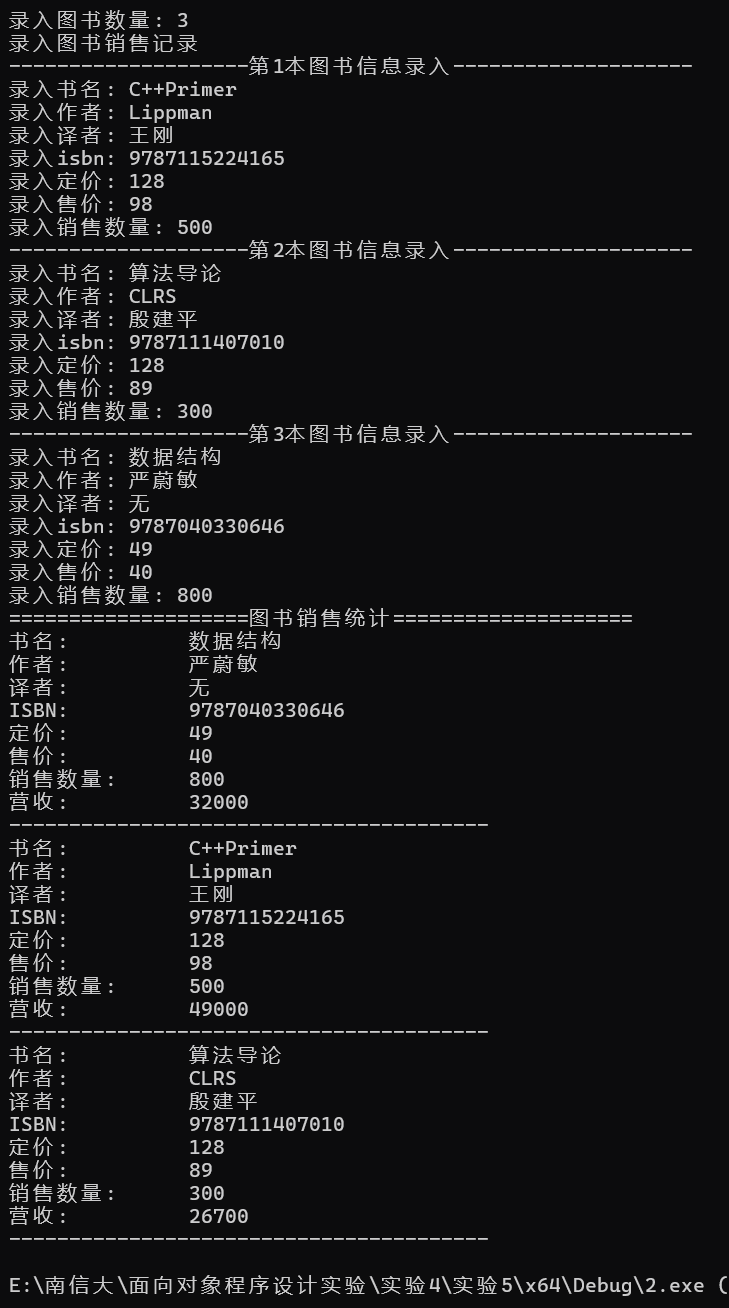
问题
问题1:重载运算符<<
(1)找出运算符 << 被重载了几处?分别用于什么类型?
(2)找出使用重载 << 输出对象的代码,写在下面。
答:
(1)两处。一处用于Book一处用于BookSale
(2)for(auto &record: sales_records) {
cout << record << '\n';
cout << string(40, '-') << '\n';
}
问题2:图书销售统计
(1)图书销售记录"按销售数量降序排序",代码是如何实现的?
(2)拓展(选答*):如果使用lambda表达式,如何实现"按销售数量降序排序"?
答:
(1)bool compare_by_amount(const BookSale &x1, const BookSale &x2) {
return x1.get_amount() > x2.get_amount();
}
(2)sort(sales_lst.begin(), sales_lst.end(), [](const BookSale &x1, const BookSale &x2) { return x1.get_amount() > x2.get_amount(); });
task3
源代码
task3_1.cpp
#include <iostream>

// 类A的定义
class A {
public:
    A(int x0, int y0);
    void display() const;

private:
    int x, y;
};

A::A(int x0, int y0): x{x0}, y{y0} {
}

void A::display() const {
    std::cout << x << ", " << y << '\n';
}

// 类B的定义
class B {
public:
    B(double x0, double y0);
    void display() const;

private:
    double x, y;
};

B::B(double x0, double y0): x{x0}, y{y0} {
}

void B::display() const {
    std::cout << x << ", " << y << '\n';
}

void test() {
    std::cout << "测试类A: " << '\n';
    A a(3, 4);
    a.display();

    std::cout << "\n测试类B: " << '\n';
    B b(3.2, 5.6);
    b.display();
}

int main() {
    test();
}
task3_2.cpp
#include <iostream>
#include <string>

// 定义类模板
template<typename T>
class X{
public:
    X(T x0, T y0);
    void display();

private:
    T x, y;
};

template<typename T>
X<T>::X(T x0, T y0): x{x0}, y{y0} {
}

template<typename T>
void X<T>::display() {
    std::cout << x << ", " << y << '\n';
}


void test() {
    std::cout << "测试1: 用int实例化类模板X" << '\n';
    X<int> x1(3, 4);
    x1.display();

    std::cout << "\n测试2:用double实例化类模板X" << '\n';
    X<double> x2(3.2, 5.6);
    x2.display();

    std::cout << "\n测试3: 用string实例化类模板X" << '\n';
    X<std::string> x3("hello", "oop");
    x3.display();
}

int main() {
    test();
}
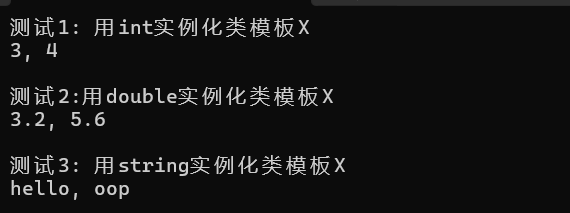
运行结果
task3_1.cpp
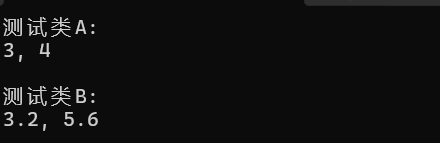
task3_2.cpp
task4
源代码
pet.hpp
#pragma once
#include<string>
// 机械宠物类:MachinePet(抽象类)
class MachinePet {
	public:
		MachinePet(const std::string& nickname_ = ""):nickname(nickname_) {

		}  // 构造函数
		virtual ~MachinePet() = default;
		std::string get_nickname() const {
			return nickname;
		}
		virtual std::string talk() const =0;
	private:
		std::string nickname;   // 宠物昵称
};

// 猫类:PetCat
class PetCat: public MachinePet {
	public:
		PetCat(const std::string& nickname_ = "") :MachinePet(nickname_) {};   // 构造函数
		std::string talk() const override{
			return "miao wu~";
		}
};

// 狗类:PetDog
class PetDog: public MachinePet {
	public:
		PetDog(const std::string& nickname_ = "") :MachinePet(nickname_) {};   // 构造函数
		std::string talk() const override{
			return "wang wang~";
		}
};
task4.cpp
#include <iostream>
#include <memory>
#include <vector>
#include "pet.hpp"

void test1() {
    std::vector<MachinePet*> pets;

    pets.push_back(new PetCat("miku"));
    pets.push_back(new PetDog("da huang"));

    for (MachinePet* ptr : pets) {
        std::cout << ptr->get_nickname() << " says " << ptr->talk() << '\n';
        delete ptr;  // 须手动释放资源
    }
}

void test2() {
    std::vector<std::unique_ptr<MachinePet>> pets;

    pets.push_back(std::make_unique<PetCat>("miku"));
    pets.push_back(std::make_unique<PetDog>("da huang"));

    for (auto const& ptr : pets)
        std::cout << ptr->get_nickname() << " says " << ptr->talk() << '\n';
}

void test3() {
    // MachinePet pet("little cutie");   // 编译报错:无法定义抽象类对象

    const PetCat cat("miku");
    std::cout << cat.get_nickname() << " says " << cat.talk() << '\n';

    const PetDog dog("da huang");
    std::cout << dog.get_nickname() << " says " << dog.talk() << '\n';
}

int main() {
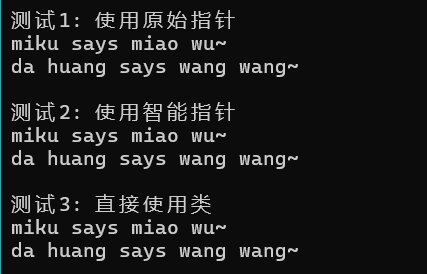
    std::cout << "测试1: 使用原始指针\n";
    test1();

    std::cout << "\n测试2: 使用智能指针\n";
    test2();

    std::cout << "\n测试3: 直接使用类\n";
    test3();
}
运行结果
task5
源代码
Complex.hpp
#pragma once
#include <iostream>
#include <cmath>

// 类模板:支持任意数值类型(int/double等)
template <typename T>
class Complex {
public:
    // 构造函数(默认+带参)
    Complex(T real = 0, T imag = 0) : real_(real), imag_(imag) {}

    // 获取实部/虚部(const成员函数)
    T get_real() const { return real_; }
    T get_imag() const { return imag_; }

    // 重载 += 运算符(成员函数)
    Complex& operator+=(const Complex& other) {
        real_ += other.real_;
        imag_ += other.imag_;
        return *this;
    }

    // 重载 + 运算符(友元函数,支持交换律)
    friend Complex operator+(Complex a, const Complex& b) {
        a += b;
        return a;
    }

    // 重载 == 运算符(处理浮点数精度)
    friend bool operator==(const Complex& a, const Complex& b) {
        // 针对浮点数类型,设置精度阈值;整数类型直接比较
        if constexpr (std::is_floating_point_v<T>) {
            const double eps = 1e-9;  // 精度阈值
            return std::fabs(a.real_ - b.real_) < eps &&
                std::fabs(a.imag_ - b.imag_) < eps;
        }
        else {
            return a.real_ == b.real_ && a.imag_ == b.imag_;
        }
    }

    // 重载 << 运算符(优化输出格式)
    friend std::ostream& operator<<(std::ostream& out, const Complex& c) {
        out << c.real_;
        if (c.imag_ != 0) {  // 虚部为0时不输出虚部
            if (c.imag_ > 0) out << "+";  // 正数加+,负数自然带-
            out << c.imag_ << "i";
        }
        return out;
    }

    // 重载 >> 运算符(兼容实验测试代码的输入格式:实部 虚部)
    friend std::istream& operator>>(std::istream& in, Complex& c) {
        in >> c.real_ >> c.imag_;  // 直接读取两个数值,无需处理i/符号
        return in;
    }

private:
    T real_;  // 模板类型的实部
    T imag_;  // 模板类型的虚部
};
task5.cpp
#include <iostream>
#include "Complex.hpp"

void test1() {
    using std::cout;
    using std::boolalpha;

    Complex<int> c1(2, -5), c2(c1);

    cout << "c1 = " << c1 << '\n';
    cout << "c2 = " << c2 << '\n';
    cout << "c1 + c2 = " << c1 + c2 << '\n';

    c1 += c2;
    cout << "c1 = " << c1 << '\n';
    cout << boolalpha << (c1 == c2) << '\n';
}

void test2() {
    using std::cin;
    using std::cout;

    Complex<double> c1, c2;
    cout << "Enter c1 and c2: ";
    cin >> c1 >> c2;
    cout << "c1 = " << c1 << '\n';
    cout << "c2 = " << c2 << '\n';

    const Complex<double> c3(c1);
    cout << "c3.real = " << c3.get_real() << '\n';
    cout << "c3.imag = " << c3.get_imag() << '\n';
}

int main() {
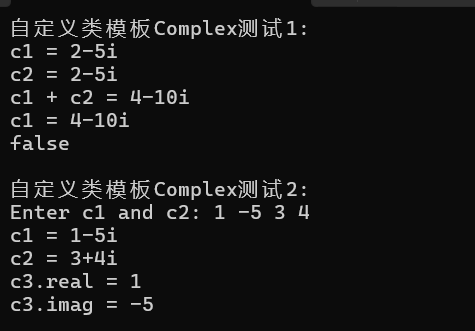
    std::cout << "自定义类模板Complex测试1: \n";
    test1();

    std::cout << "\n自定义类模板Complex测试2: \n";
    test2();
}
运行结果

 浙公网安备 33010602011771号