
Python入门之常用模块
一 time与datetime模块
在Python中,通常有这几种方式来表示时间:
- 时间戳(timestamp):通常来说,时间戳表示的是从1970年1月1日00:00:00开始按秒计算的偏移量。我们运行“type(time.time())”,返回的是float类型。
- 格式化的时间字符串(Format String)
- 结构化的时间(struct_time):struct_time元组共有9个元素共九个元素:(年,月,日,时,分,秒,一年中第几周,一年中第几天,夏令时)
1 import time
2 #--------------------------我们先以当前时间为准,让大家快速认识三种形式的时间
3 print(time.time()) # 时间戳:1487130156.419527
4 print(time.strftime("%Y-%m-%d %X")) #格式化的时间字符串:'2017-02-15 11:40:53'
5
6 print(time.localtime()) #本地时区的struct_time
7 print(time.gmtime())    #UTC时区的struct_time


 1 import time
 2 import datetime
 3
 4 print(time.asctime())      # 返回时间格式:Sun May  7 21:46:15 2017
 5 print(time.time())         # 返回时间戳 ‘1494164954.6677325’
 6 print(time.gmtime())       # 返回本地时间 的struct time对象格式,time.struct_time(tm_year=2017, tm_mon=5, tm_mday=7, tm_hour=22, tm_min=4, tm_sec=53, tm_wday=6, tm_yday=127, tm_isdst=0)
 7 print(time.localtime())    # 返回本地时间 的struct time对象格式,time.struct_time(tm_year=2017, tm_mon=5, tm_mday=7, tm_hour=22, tm_min=4, tm_sec=53, tm_wday=6, tm_yday=127, tm_isdst=0)
 8 print(time.gmtime(time.time()-800000))   # 返回utc时间的struc时间对象格式
 9 print(time.asctime(time.localtime()))    # 返回时间格式Sun May  7 22:15:09 2017
10 print(time.ctime())                      # 返回时间格式Sun May  7 22:15:09 2017
11 print(time.strftime('%Y-%m-%d'))         #默认当前时间 2017-05-07
12 print(time.strftime('%Y-%m-%d',time.localtime())) #默认当前时间 2017-05-07
13
14 string_struct = time.strptime("2016/05/22","%Y/%m/%d") # 将日期字符串 转成 struct时间对象格式
15 print(string_struct)                     # 返回struct time对象格式 time.struct_time(tm_year=2016, tm_mon=5, tm_mday=22, tm_hour=0, tm_min=0, tm_sec=0, tm_wday=6, tm_yday=143, tm_isdst=-1)
16
17 # 将日期字符串转成时间戳
18 struct_stamp = time.mktime(string_struct) # 将struct time时间对象转成时间戳
19 print(struct_stamp)                         # 返回时间戳 ‘1463846400.0’
20
21 # 将时间戳转为字符串格式
22 print(time.gmtime(time.time()-86640))         # 将utc时间戳转换成struct_time格式
23 print(time.strftime("%Y-%m-%d %H:%M:%S",time.gmtime()) ) # 将utc struct_time格式转成指定的字符串格式
24
25
26 # 时间加减
27 print(datetime.datetime.now())           # 返回当前时间 2017-05-07 22:36:45.179732
28 print(datetime.date.fromtimestamp(time.time()))  # 时间戳直接转换成日期格式 2017-05-07
29 print(datetime.datetime.now() + datetime.timedelta(3))    # 返回时间在当前日期上 +3 天
30 print(datetime.datetime.now() + datetime.timedelta(-3))    # 返回时间在当前日期上 -3 天
31 print(datetime.datetime.now() + datetime.timedelta(hours= 3)) # 返回时间在当前时间上 +3 小时
32 print(datetime.datetime.now() + datetime.timedelta(minutes= 30)) # 返回时间在当前时间上 +30 分钟
33
34 c_time  = datetime.datetime.now()
35 print(c_time)                          # 当前时间为 2017-05-07 22:52:44.016732
36 print(c_time.replace(minute=3,hour=2)) # 时间替换 替换时间为‘2017-05-07 02:03:18.181732’
37
38 print(datetime.timedelta)      # 表示时间间隔,即两个时间点之间的长度
39 print (datetime.datetime.now() - datetime.timedelta(days=5))  # 返回时间在当前时间上 -5 天
40
41 # python 日历模块
42 import calendar
43
44 print(calendar.calendar(theyear= 2017))     # 返回2017年整年日历
45 print(calendar.month(2017,5))               # 返回某年某月的日历,返回类型为字符串类型
46
47 calendar.setfirstweekday(calendar.WEDNESDAY) # 设置日历的第一天(第一天以星期三开始)
48 cal = calendar.month(2017, 4)
49 print (cal)
50
51 print(calendar.monthrange(2017,5))        # 返回某个月的第一天和这个月的所有天数
52 print(calendar.monthcalendar(2017,5))     # 返回某个月以每一周为元素的序列
53
54 cal = calendar.HTMLCalendar(calendar.MONDAY)
55 print(cal.formatmonth(2017, 5))           # 在html中打印某年某月的日历
56
57 print(calendar.isleap(2017))             # 判断是否为闰年
58 print(calendar.leapdays(2000,2017))       # 判断两个年份间闰年的个数
%y 两位数的年份表示(00-99)
%Y 四位数的年份表示(000-9999)
%m 月份(01-12)
%d 月内中的一天(0-31)
%H 24小时制小时数(0-23)
%I 12小时制小时数(01-12)
%M 分钟数(00=59)
%S 秒(00-59)

%a 本地简化星期名称
%A 本地完整星期名称
%b 本地简化的月份名称
%B 本地完整的月份名称
%c 本地相应的日期表示和时间表示
%j 年内的一天(001-366)
%p 本地A.M.或P.M.的等价符
%U 一年中的星期数(00-53)星期天为星期的开始
%w 星期(0-6),星期天为星期的开始
%W 一年中的星期数(00-53)星期一为星期的开始
%x 本地相应的日期表示
%X 本地相应的时间表示
%Z 当前时区的名称
%% %号本身
其中计算机认识的时间只能是'时间戳'格式,而程序员可处理的或者说人类能看懂的时间有: '格式化的时间字符串','结构化的时间' ,于是有了下图的转换关系

 1 #--------------------------按图1转换时间
 2 # localtime([secs])
 3 # 将一个时间戳转换为当前时区的struct_time。secs参数未提供,则以当前时间为准。
 4 time.localtime()
 5 time.localtime(1473525444.037215)
 6
 7 # gmtime([secs]) 和localtime()方法类似,gmtime()方法是将一个时间戳转换为UTC时区(0时区)的struct_time。
 8
 9 # mktime(t) : 将一个struct_time转化为时间戳。
10 print(time.mktime(time.localtime()))#1473525749.0
11
12
13 # strftime(format[, t]) : 把一个代表时间的元组或者struct_time(如由time.localtime()和
14 # time.gmtime()返回)转化为格式化的时间字符串。如果t未指定,将传入time.localtime()。如果元组中任何一个
15 # 元素越界,ValueError的错误将会被抛出。
16 print(time.strftime("%Y-%m-%d %X", time.localtime()))#2016-09-11 00:49:56
17
18 # time.strptime(string[, format])
19 # 把一个格式化时间字符串转化为struct_time。实际上它和strftime()是逆操作。
20 print(time.strptime('2011-05-05 16:37:06', '%Y-%m-%d %X'))
21 #time.struct_time(tm_year=2011, tm_mon=5, tm_mday=5, tm_hour=16, tm_min=37, tm_sec=6,
22 #  tm_wday=3, tm_yday=125, tm_isdst=-1)
23 #在这个函数中,format默认为:"%a %b %d %H:%M:%S %Y"。

1 #--------------------------按图2转换时间
2 # asctime([t]) : 把一个表示时间的元组或者struct_time表示为这种形式:'Sun Jun 20 23:21:05 1993'。
3 # 如果没有参数,将会将time.localtime()作为参数传入。
4 print(time.asctime())#Sun Sep 11 00:43:43 2016
5
6 # ctime([secs]) : 把一个时间戳(按秒计算的浮点数)转化为time.asctime()的形式。如果参数未给或者为
7 # None的时候,将会默认time.time()为参数。它的作用相当于time.asctime(time.localtime(secs))。
8 print(time.ctime())  # Sun Sep 11 00:46:38 2016
9 print(time.ctime(time.time()))  # Sun Sep 11 00:46:38 2016

说明:上面的 '%H:%M:%S' 可以直接用 '%X' 代替。
1 #--------------------------其他用法
2 # sleep(secs)
3 # 线程推迟指定的时间运行,单位为秒。
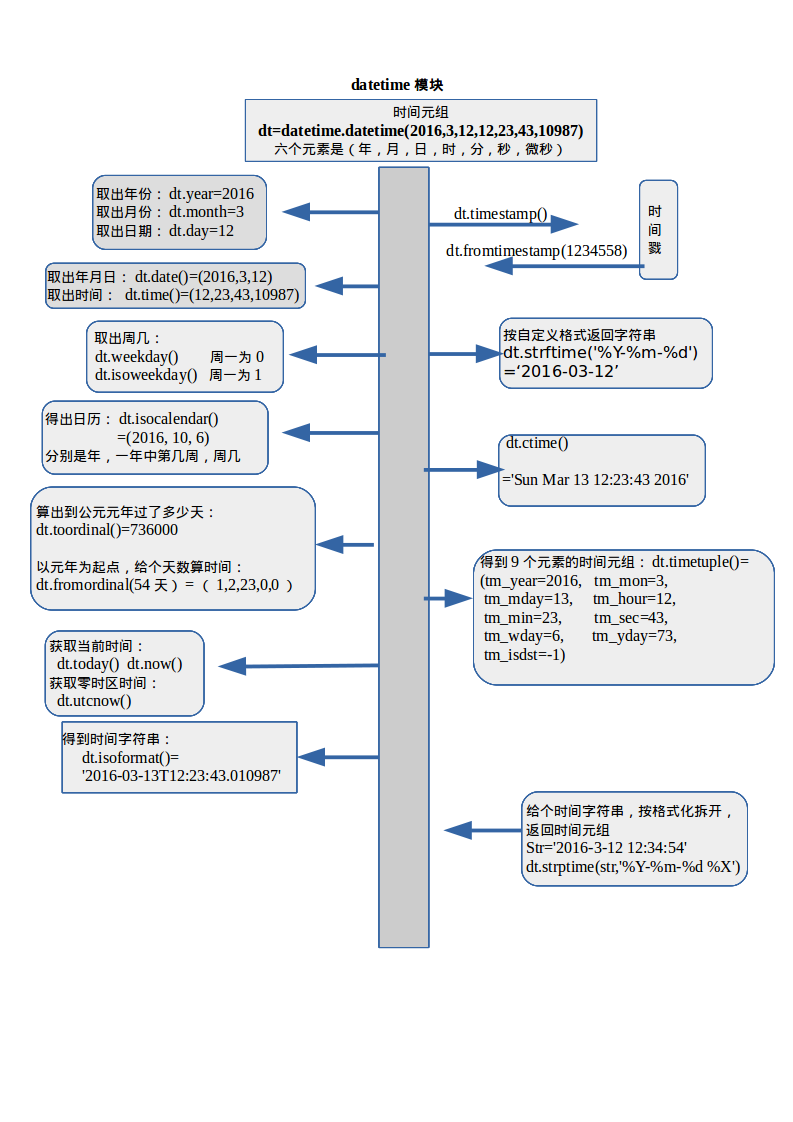
datetime模块
 1 #时间加减
 2 import datetime
 3
 4 # print(datetime.datetime.now()) #返回 2016-08-19 12:47:03.941925
 5 #print(datetime.date.fromtimestamp(time.time()) )  # 时间戳直接转成日期格式 2016-08-19
 6 # print(datetime.datetime.now() )
 7 # print(datetime.datetime.now() + datetime.timedelta(3)) #当前时间+3天
 8 # print(datetime.datetime.now() + datetime.timedelta(-3)) #当前时间-3天
 9 # print(datetime.datetime.now() + datetime.timedelta(hours=3)) #当前时间+3小时
10 # print(datetime.datetime.now() + datetime.timedelta(minutes=30)) #当前时间+30分
11
12
13 #
14 # c_time  = datetime.datetime.now()
15 # print(c_time.replace(minute=3,hour=2)) #时间替换
二 random模块
 1 import random
 2
 3 print(random.random())#(0,1)----float    大于0且小于1之间的小数
 4
 5 print(random.randint(1,3))  #[1,3]    大于等于1且小于等于3之间的整数
 6
 7 print(random.randrange(1,3)) #[1,3)    大于等于1且小于3之间的整数
 8
 9 print(random.choice([1,'23',[4,5]]))#1或者23或者[4,5]
10
11 print(random.sample([1,'23',[4,5]],2))#列表元素任意2个组合
12
13 print(random.uniform(1,3))#大于1小于3的小数,如1.927109612082716
14
15
16 item=[1,3,5,7,9]
17 random.shuffle(item) #打乱item的顺序,相当于"洗牌"
18 print(item)
生成随机验证码
import random
def make_code(n):
    res=''
    for i in range(n):
        s1=chr(random.randint(65,90))
        s2=str(random.randint(0,9))
        res+=random.choice([s1,s2])
    return res

print(make_code(9))
三 os模块
os模块是与操作系统交互的一个接口
 1 os.getcwd() 获取当前工作目录,即当前python脚本工作的目录路径
 2 os.chdir("dirname")  改变当前脚本工作目录;相当于shell下cd
 3 os.curdir  返回当前目录: ('.')
 4 os.pardir  获取当前目录的父目录字符串名:('..')
 5 os.makedirs('dirname1/dirname2')    可生成多层递归目录
 6 os.removedirs('dirname1')    若目录为空,则删除,并递归到上一级目录,如若也为空,则删除,依此类推
 7 os.mkdir('dirname')    生成单级目录;相当于shell中mkdir dirname
 8 os.rmdir('dirname')    删除单级空目录,若目录不为空则无法删除,报错;相当于shell中rmdir dirname
 9 os.listdir('dirname')    列出指定目录下的所有文件和子目录,包括隐藏文件,并以列表方式打印
10 os.remove()  删除一个文件
11 os.rename("oldname","newname")  重命名文件/目录
12 os.stat('path/filename')  获取文件/目录信息
13 os.sep    输出操作系统特定的路径分隔符,win下为"\\",Linux下为"/"
14 os.linesep    输出当前平台使用的行终止符,win下为"\t\n",Linux下为"\n"
15 os.pathsep    输出用于分割文件路径的字符串 win下为;,Linux下为:
16 os.name    输出字符串指示当前使用平台。win->'nt'; Linux->'posix'
17 os.system("bash command")  运行shell命令,直接显示
18 os.environ  获取系统环境变量
19 os.path.abspath(path)  返回path规范化的绝对路径
20 os.path.split(path)  将path分割成目录和文件名二元组返回
21 os.path.dirname(path)  返回path的目录。其实就是os.path.split(path)的第一个元素
22 os.path.basename(path)  返回path最后的文件名。如何path以/或\结尾,那么就会返回空值。即os.path.split(path)的第二个元素
23 os.path.exists(path)  如果path存在,返回True;如果path不存在,返回False
24 os.path.isabs(path)  如果path是绝对路径,返回True
25 os.path.isfile(path)  如果path是一个存在的文件,返回True。否则返回False
26 os.path.isdir(path)  如果path是一个存在的目录,则返回True。否则返回False
27 os.path.join(path1[, path2[, ...]])  将多个路径组合后返回,第一个绝对路径之前的参数将被忽略
28 os.path.getatime(path)  返回path所指向的文件或者目录的最后存取时间
29 os.path.getmtime(path)  返回path所指向的文件或者目录的最后修改时间
30 os.path.getsize(path) 返回path的大小
在Linux和Mac平台上,该函数会原样返回path,在windows平台上会将路径中所有字符转换为小写,并将所有斜杠转换为饭斜杠。
>>> os.path.normcase('c:/windows\\system32\\')
'c:\\windows\\system32\\'


规范化路径,如..和/
>>> os.path.normpath('c://windows\\System32\\../Temp/')
'c:\\windows\\Temp'

>>> a='/Users/jieli/test1/\\\a1/\\\\aa.py/../..'
>>> print(os.path.normpath(a))
/Users/jieli/test1
os路径处理
#方式一:推荐使用
import os
#具体应用
import os,sys
possible_topdir = os.path.normpath(os.path.join(
    os.path.abspath(__file__),
    os.pardir, #上一级
    os.pardir,
    os.pardir
))
sys.path.insert(0,possible_topdir)


#方式二:不推荐使用
os.path.dirname(os.path.dirname(os.path.dirname(os.path.abspath(__file__))))
四 sys模块
1 sys.argv           命令行参数List,第一个元素是程序本身路径
2 sys.exit(n)        退出程序,正常退出时exit(0)
3 sys.version        获取Python解释程序的版本信息
4 sys.maxint         最大的Int值
5 sys.path           返回模块的搜索路径,初始化时使用PYTHONPATH环境变量的值
6 sys.platform       返回操作系统平台名称
 1 #=========知识储备==========
 2 #进度条的效果
 3 [#             ]
 4 [##            ]
 5 [###           ]
 6 [####          ]
 7
 8 #指定宽度
 9 print('[%-15s]' %'#')
10 print('[%-15s]' %'##')
11 print('[%-15s]' %'###')
12 print('[%-15s]' %'####')
13
14 #打印%
15 print('%s%%' %(100)) #第二个%号代表取消第一个%的特殊意义
16
17 #可传参来控制宽度
18 print('[%%-%ds]' %50) #[%-50s]
19 print(('[%%-%ds]' %50) %'#')
20 print(('[%%-%ds]' %50) %'##')
21 print(('[%%-%ds]' %50) %'###')
22
23
24 #=========实现打印进度条函数==========
25 import sys
26 import time
27
28 def progress(percent,width=50):
29     if percent >= 1:
30         percent=1
31     show_str=('[%%-%ds]' %width) %(int(width*percent)*'#')
32     print('\r%s %d%%' %(show_str,int(100*percent)),file=sys.stdout,flush=True,end='')
33
34
35 #=========应用==========
36 data_size=1025
37 recv_size=0
38 while recv_size < data_size:
39     time.sleep(0.1) #模拟数据的传输延迟
40     recv_size+=1024 #每次收1024
41
42     percent=recv_size/data_size #接收的比例
43     progress(percent,width=70) #进度条的宽度70
五 shutil模块
高级的 文件、文件夹、压缩包 处理模块
shutil.copyfileobj(fsrc, fdst[, length])
将文件内容拷贝到另一个文件中
1 import shutil
2
3 shutil.copyfileobj(open('old.xml','r'), open('new.xml', 'w'))
shutil.copyfile(src, dst)
拷贝文件
1 shutil.copyfile('f1.log', 'f2.log') #目标文件无需存在
shutil.copymode(src, dst)
仅拷贝权限。内容、组、用户均不变
1 shutil.copymode('f1.log', 'f2.log') #目标文件必须存在
shutil.copystat(src, dst)
仅拷贝状态的信息,包括:mode bits, atime, mtime, flags
1 shutil.copystat('f1.log', 'f2.log') #目标文件必须存在
shutil.copy(src, dst)
拷贝文件和权限
1 import shutil
2
3 shutil.copy('f1.log', 'f2.log')
shutil.copy2(src, dst)
拷贝文件和状态信息
1 import shutil
2
3 shutil.copy2('f1.log', 'f2.log')
shutil.ignore_patterns(*patterns)
shutil.copytree(src, dst, symlinks=False, ignore=None)
递归的去拷贝文件夹
1 import shutil
2
3 shutil.copytree('folder1', 'folder2', ignore=shutil.ignore_patterns('*.pyc', 'tmp*')) #目标目录不能存在,注意对folder2目录父级目录要有可写权限,
ignore的意思是排除
1 import shutil
2
3 shutil.copytree('f1', 'f2', symlinks=True, ignore=shutil.ignore_patterns('*.pyc', 'tmp*'))
4
5 '''
6 通常的拷贝都把软连接拷贝成硬链接,即对待软连接来说,创建新的文件
7 '''
shutil.rmtree(path[, ignore_errors[, onerror]])
递归的去删除文件
1 import shutil
2
3 shutil.rmtree('folder1')
shutil.move(src, dst)
递归的去移动文件,它类似mv命令,其实就是重命名。
1 import shutil
2
3 shutil.move('folder1', 'folder3')
shutil.make_archive(base_name, format,...)
创建压缩包并返回文件路径,例如:zip、tar
创建压缩包并返回文件路径,例如:zip、tar
- base_name: 压缩包的文件名,也可以是压缩包的路径。只是文件名时,则保存至当前目录,否则保存至指定路径,
如 data_bak =>保存至当前路径
如:/tmp/data_bak =>保存至/tmp/ - format: 压缩包种类,“zip”, “tar”, “bztar”,“gztar”
- root_dir: 要压缩的文件夹路径(默认当前目录)
- owner: 用户,默认当前用户
- group: 组,默认当前组
- logger: 用于记录日志,通常是logging.Logger对象
1 #将 /data 下的文件打包放置当前程序目录
2 import shutil
3 ret = shutil.make_archive("data_bak", 'gztar', root_dir='/data')
4
5
6 #将 /data下的文件打包放置 /tmp/目录
7 import shutil
8 ret = shutil.make_archive("/tmp/data_bak", 'gztar', root_dir='/data')
shutil 对压缩包的处理是调用 ZipFile 和 TarFile 两个模块来进行的,详细:
 1 import zipfile
 2
 3 # 压缩
 4 z = zipfile.ZipFile('laxi.zip', 'w')
 5 z.write('a.log')
 6 z.write('data.data')
 7 z.close()
 8
 9 # 解压
10 z = zipfile.ZipFile('laxi.zip', 'r')
11 z.extractall(path='.')
12 z.close()
 1 import tarfile
 2
 3 # 压缩
 4 >>> t=tarfile.open('/tmp/egon.tar','w')
 5 >>> t.add('/test1/a.py',arcname='a.bak')
 6 >>> t.add('/test1/b.py',arcname='b.bak')
 7 >>> t.close()
 8
 9
10 # 解压
11 >>> t=tarfile.open('/tmp/egon.tar','r')
12 >>> t.extractall('/egon')
13 >>> t.close()
六 json&pickle模块
之前我们学习过用eval内置方法可以将一个字符串转成python对象,不过,eval方法是有局限性的,对于普通的数据类型,json.loads和eval都能用,但遇到特殊类型的时候,eval就不管用了,所以eval的重点还是通常用来执行一个字符串表达式,并返回表达式的值。
1 import json
2 x="[null,true,false,1]"
3 print(eval(x)) #报错,无法解析null类型,而json就可以
4 print(json.loads(x))
什么是序列化?
我们把对象(变量)从内存中变成可存储或传输的过程称之为序列化,在Python中叫pickling,在其他语言中也被称之为serialization,marshalling,flattening等等,都是一个意思。
为什么要序列化?
1:持久保存状态
需知一个软件/程序的执行就在处理一系列状态的变化,在编程语言中,'状态'会以各种各样有结构的数据类型(也可简单的理解为变量)的形式被保存在内存中。
内存是无法永久保存数据的,当程序运行了一段时间,我们断电或者重启程序,内存中关于这个程序的之前一段时间的数据(有结构)都被清空了。
在断电或重启程序之前将程序当前内存中所有的数据都保存下来(保存到文件中),以便于下次程序执行能够从文件中载入之前的数据,然后继续执行,这就是序列化。
具体的来说,你玩使命召唤闯到了第13关,你保存游戏状态,关机走人,下次再玩,还能从上次的位置开始继续闯关。或如,虚拟机状态的挂起等。
2:跨平台数据交互
序列化之后,不仅可以把序列化后的内容写入磁盘,还可以通过网络传输到别的机器上,如果收发的双方约定好实用一种序列化的格式,那么便打破了平台/语言差异化带来的限制,实现了跨平台数据交互。
反过来,把变量内容从序列化的对象重新读到内存里称之为反序列化,即unpickling。
如何序列化之json和pickle:
json
如果我们要在不同的编程语言之间传递对象,就必须把对象序列化为标准格式,比如XML,但更好的方法是序列化为JSON,因为JSON表示出来就是一个字符串,可以被所有语言读取,也可以方便地存储到磁盘或者通过网络传输。JSON不仅是标准格式,并且比XML更快,而且可以直接在Web页面中读取,非常方便。
JSON表示的对象就是标准的JavaScript语言的对象,JSON和Python内置的数据类型对应如下:


 1 import json
 2
 3 dic={'name':'alvin','age':23,'sex':'male'}
 4 print(type(dic))#<class 'dict'>
 5
 6 j=json.dumps(dic)
 7 print(type(j))#<class 'str'>
 8
 9
10 f=open('序列化对象','w')
11 f.write(j)  #-------------------等价于json.dump(dic,f)
12 f.close()
13 #-----------------------------反序列化<br>
14 import json
15 f=open('序列化对象')
16 data=json.loads(f.read())#  等价于data=json.load(f)
1 import json
2 #dct="{'1':111}"#json 不认单引号
3 #dct=str({"1":111})#报错,因为生成的数据还是单引号:{'one': 1}
4
5 dct='{"1":"111"}'
6 print(json.loads(dct))
7
8 #conclusion:
9 #        无论数据是怎样创建的,只要满足json格式,就可以json.loads出来,不一定非要dumps的数据才能loads
pickle

 1 import pickle
 2
 3 dic={'name':'alvin','age':23,'sex':'male'}
 4
 5 print(type(dic))#<class 'dict'>
 6
 7 j=pickle.dumps(dic)
 8 print(type(j))#<class 'bytes'>
 9
10
11 f=open('序列化对象_pickle','wb')#注意是w是写入str,wb是写入bytes,j是'bytes'
12 f.write(j)  #-------------------等价于pickle.dump(dic,f)
13
14 f.close()
15 #-------------------------反序列化
16 import pickle
17 f=open('序列化对象_pickle','rb')
18
19 data=pickle.loads(f.read())#  等价于data=pickle.load(f)
20
21
22 print(data['age'])
Pickle的问题和所有其他编程语言特有的序列化问题一样,就是它只能用于Python,并且可能不同版本的Python彼此都不兼容,因此,只能用Pickle保存那些不重要的数据,不能成功地反序列化也没关系。
七 shelve模块
shelve模块比pickle模块简单,只有一个open函数,返回类似字典的对象,可读可写;key必须为字符串,而值可以是python所支持的数据类型
1 import shelve
2
3 f=shelve.open(r'sheve.txt')
4 # f['stu1_info']={'name':'egon','age':18,'hobby':['piao','smoking','drinking']}
5 # f['stu2_info']={'name':'gangdan','age':53}
6 # f['school_info']={'website':'http://www.pypy.org','city':'beijing'}
7
8 print(f['stu1_info']['hobby'])
9 f.close()
八 xml模块
xml是实现不同语言或程序之间进行数据交换的协议,跟json差不多,但json使用起来更简单,不过,古时候,在json还没诞生的黑暗年代,大家只能选择用xml呀,至今很多传统公司如金融行业的很多系统的接口还主要是xml。
xml的格式如下,就是通过<>节点来区别数据结构的:
 1 <?xml version="1.0"?>
 2 <data>
 3     <country name="Liechtenstein">
 4         <rank updated="yes">2</rank>
 5         <year>2008</year>
 6         <gdppc>141100</gdppc>
 7         <neighbor name="Austria" direction="E"/>
 8         <neighbor name="Switzerland" direction="W"/>
 9     </country>
10     <country name="Singapore">
11         <rank updated="yes">5</rank>
12         <year>2011</year>
13         <gdppc>59900</gdppc>
14         <neighbor name="Malaysia" direction="N"/>
15     </country>
16     <country name="Panama">
17         <rank updated="yes">69</rank>
18         <year>2011</year>
19         <gdppc>13600</gdppc>
20         <neighbor name="Costa Rica" direction="W"/>
21         <neighbor name="Colombia" direction="E"/>
22     </country>
23 </data>
xml协议在各个语言里的都 是支持的,在python中可以用以下模块操作xml:
1 # print(root.iter('year')) #全文搜索
2 # print(root.find('country')) #在root的子节点找,只找一个
3 # print(root.findall('country')) #在root的子节点找,找所有
 1 import xml.etree.ElementTree as ET
 2
 3 tree = ET.parse("xmltest.xml")
 4 root = tree.getroot()
 5 print(root.tag)
 6
 7 #遍历xml文档
 8 for child in root:
 9     print('========>',child.tag,child.attrib,child.attrib['name'])
10     for i in child:
11         print(i.tag,i.attrib,i.text)
12
13 #只遍历year 节点
14 for node in root.iter('year'):
15     print(node.tag,node.text)
16 #---------------------------------------
17
18 import xml.etree.ElementTree as ET
19
20 tree = ET.parse("xmltest.xml")
21 root = tree.getroot()
22
23 #修改
24 for node in root.iter('year'):
25     new_year=int(node.text)+1
26     node.text=str(new_year)
27     node.set('updated','yes')
28     node.set('version','1.0')
29 tree.write('test.xml')
30
31
32 #删除node
33 for country in root.findall('country'):
34    rank = int(country.find('rank').text)
35    if rank > 50:
36      root.remove(country)
37
38 tree.write('output.xml')
 1 #在country内添加(append)节点year2
 2 import xml.etree.ElementTree as ET
 3 tree = ET.parse("a.xml")
 4 root=tree.getroot()
 5 for country in root.findall('country'):
 6     for year in country.findall('year'):
 7         if int(year.text) > 2000:
 8             year2=ET.Element('year2')
 9             year2.text='新年'
10             year2.attrib={'update':'yes'}
11             country.append(year2) #往country节点下添加子节点
12
13 tree.write('a.xml.swap')
自己创建xml文档:
 1 import xml.etree.ElementTree as ET
 2
 3
 4 new_xml = ET.Element("namelist")
 5 name = ET.SubElement(new_xml,"name",attrib={"enrolled":"yes"})
 6 age = ET.SubElement(name,"age",attrib={"checked":"no"})
 7 sex = ET.SubElement(name,"sex")
 8 sex.text = '33'
 9 name2 = ET.SubElement(new_xml,"name",attrib={"enrolled":"no"})
10 age = ET.SubElement(name2,"age")
11 age.text = '19'
12
13 et = ET.ElementTree(new_xml) #生成文档对象
14 et.write("test.xml", encoding="utf-8",xml_declaration=True)
15
16 ET.dump(new_xml) #打印生成的格式
九 configparser模块
 1 # 注释1
 2 ; 注释2
 3
 4 [section1]
 5 k1 = v1
 6 k2:v2
 7 user=egon
 8 age=18
 9 is_admin=true
10 salary=31
11
12 [section2]
13 k1 = v1
读取
 1 import configparser
 2
 3 config=configparser.ConfigParser()
 4 config.read('a.cfg')
 5
 6 #查看所有的标题
 7 res=config.sections() #['section1', 'section2']
 8 print(res)
 9
10 #查看标题section1下所有key=value的key
11 options=config.options('section1')
12 print(options) #['k1', 'k2', 'user', 'age', 'is_admin', 'salary']
13
14 #查看标题section1下所有key=value的(key,value)格式
15 item_list=config.items('section1')
16 print(item_list) #[('k1', 'v1'), ('k2', 'v2'), ('user', 'egon'), ('age', '18'), ('is_admin', 'true'), ('salary', '31')]
17
18 #查看标题section1下user的值=>字符串格式
19 val=config.get('section1','user')
20 print(val) #egon
21
22 #查看标题section1下age的值=>整数格式
23 val1=config.getint('section1','age')
24 print(val1) #18
25
26 #查看标题section1下is_admin的值=>布尔值格式
27 val2=config.getboolean('section1','is_admin')
28 print(val2) #True
29
30 #查看标题section1下salary的值=>浮点型格式
31 val3=config.getfloat('section1','salary')
32 print(val3) #31.0
改写
 1 import configparser
 2
 3 config=configparser.ConfigParser()
 4 config.read('a.cfg',encoding='utf-8')
 5
 6
 7 #删除整个标题section2
 8 config.remove_section('section2')
 9
10 #删除标题section1下的某个k1和k2
11 config.remove_option('section1','k1')
12 config.remove_option('section1','k2')
13
14 #判断是否存在某个标题
15 print(config.has_section('section1'))
16
17 #判断标题section1下是否有user
18 print(config.has_option('section1',''))
19
20
21 #添加一个标题
22 config.add_section('egon')
23
24 #在标题egon下添加name=egon,age=18的配置
25 config.set('egon','name','egon')
26 config.set('egon','age',18) #报错,必须是字符串
27
28
29 #最后将修改的内容写入文件,完成最终的修改
30 config.write(open('a.cfg','w'))
 1 import configparser
 2
 3 config = configparser.ConfigParser()
 4 config["DEFAULT"] = {'ServerAliveInterval': '45',
 5                       'Compression': 'yes',
 6                      'CompressionLevel': '9'}
 7
 8 config['bitbucket.org'] = {}
 9 config['bitbucket.org']['User'] = 'hg'
10 config['topsecret.server.com'] = {}
11 topsecret = config['topsecret.server.com']
12 topsecret['Host Port'] = '50022'     # mutates the parser
13 topsecret['ForwardX11'] = 'no'  # same here
14 config['DEFAULT']['ForwardX11'] = 'yes'
15 with open('example.ini', 'w') as configfile:
16    config.write(configfile)
十 hashlib模块
1 # 1、什么叫hash:hash是一种算法(3.x里代替了md5模块和sha模块,主要提供 SHA1, SHA224, SHA256, SHA384, SHA512 ,MD5 算法),该算法接受传入的内容,经过运算得到
一串hash值
2 # 2、hash值的特点是:
3 #2.1 只要传入的内容一样,得到的hash值必然一样=====>要用明文传输密码文件完整性校验
4 #2.2 不能由hash值返解成内容=======》把密码做成hash值,不应该在网络传输明文密码
5 #2.3 只要使用的hash算法不变,无论校验的内容有多大,得到的hash值长度是固定的
hash算法就像一座工厂,工厂接收你送来的原材料(可以用m.update()为工厂运送原材料),经过加工返回的产品就是hash值

 1 import hashlib
 2
 3 m=hashlib.md5()# m=hashlib.sha256()
 4
 5 m.update('hello'.encode('utf8'))
 6 print(m.hexdigest())  #5d41402abc4b2a76b9719d911017c592
 7
 8 m.update('alvin'.encode('utf8'))
 9
10 print(m.hexdigest())  #92a7e713c30abbb0319fa07da2a5c4af
11
12 m2=hashlib.md5()
13 m2.update('helloalvin'.encode('utf8'))
14 print(m2.hexdigest()) #92a7e713c30abbb0319fa07da2a5c4af
15
16 '''
17 注意:把一段很长的数据update多次,与一次update这段长数据,得到的结果一样
18 但是update多次为校验大文件提供了可能。
19 '''
以上加密算法虽然依然非常厉害,但时候存在缺陷,即:通过撞库可以反解。所以,有必要对加密算法中添加自定义key再来做加密。
1 import hashlib
2
3 # ######## 256 ########
4
5 hash = hashlib.sha256('898oaFs09f'.encode('utf8'))
6 hash.update('alvin'.encode('utf8'))
7 print (hash.hexdigest())#e79e68f070cdedcfe63eaf1a2e92c83b4cfb1b5c6bc452d214c1b7e77cdfd1c7
 1 import hashlib
 2 passwds=[
 3     'alex3714',
 4     'alex1313',
 5     'alex94139413',
 6     'alex123456',
 7     '123456alex',
 8     'a123lex',
 9     ]
10 def make_passwd_dic(passwds):
11     dic={}
12     for passwd in passwds:
13         m=hashlib.md5()
14         m.update(passwd.encode('utf-8'))
15         dic[passwd]=m.hexdigest()
16     return dic
17
18 def break_code(cryptograph,passwd_dic):
19     for k,v in passwd_dic.items():
20         if v == cryptograph:
21             print('密码是===>\033[46m%s\033[0m' %k)
22
23 cryptograph='aee949757a2e698417463d47acac93df'
24 break_code(cryptograph,make_passwd_dic(passwds))
python 还有一个 hmac 模块,它内部对我们创建 key 和 内容 进行进一步的处理然后再加密:
 1 #要想保证hmac最终结果一致,必须保证:
 2 #1:hmac.new括号内指定的初始key一样
 3 #2:无论update多少次,校验的内容累加到一起是一样的内容
 4
 5 import hmac
 6
 7 h1=hmac.new(b'egon')
 8 h1.update(b'hello')
 9 h1.update(b'world')
10 print(h1.hexdigest())
11
12 h2=hmac.new(b'egon')
13 h2.update(b'helloworld')
14 print(h2.hexdigest())
15
16 h3=hmac.new(b'egonhelloworld')
17 print(h3.hexdigest())
18
19 '''
20 f1bf38d054691688f89dcd34ac3c27f2
21 f1bf38d054691688f89dcd34ac3c27f2
22 bcca84edd9eeb86f30539922b28f3981
23 '''
十一 suprocess模块
 1 import  subprocess
 2
 3 '''
 4 sh-3.2# ls /Users/egon/Desktop |grep txt$
 5 mysql.txt
 6 tt.txt
 7 事物.txt
 8 '''
 9
10 res1=subprocess.Popen('ls /Users/jieli/Desktop',shell=True,stdout=subprocess.PIPE)
11 res=subprocess.Popen('grep txt$',shell=True,stdin=res1.stdout,
12                  stdout=subprocess.PIPE)
13
14 print(res.stdout.read().decode('utf-8'))
15
16
17 #等同于上面,但是上面的优势在于,一个数据流可以和另外一个数据流交互,可以通过爬虫得到结果然后交给grep
18 res1=subprocess.Popen('ls /Users/jieli/Desktop |grep txt$',shell=True,stdout=subprocess.PIPE)
19 print(res1.stdout.read().decode('utf-8'))
20
21
22 #windows下:
23 # dir | findstr 'test*'
24 # dir | findstr 'txt$'
25 import subprocess
26 res1=subprocess.Popen(r'dir C:\Users\Administrator\PycharmProjects\test\函数备课',shell=True,stdout=subprocess.PIPE)
27 res=subprocess.Popen('findstr test*',shell=True,stdin=res1.stdout,
28                  stdout=subprocess.PIPE)
29
30 print(res.stdout.read().decode('gbk')) #subprocess使用当前系统默认编码,得到结果为bytes类型,在windows下需要用gbk解码
十二 logging模块
一 日志级别
1 CRITICAL = 50 #FATAL = CRITICAL
2 ERROR = 40
3 WARNING = 30 #WARN = WARNING
4 INFO = 20
5 DEBUG = 10
6 NOTSET = 0 #不设置
二 默认级别为warning,默认打印到终端
 1 import logging
 2
 3 logging.debug('调试debug')
 4 logging.info('消息info')
 5 logging.warning('警告warn')
 6 logging.error('错误error')
 7 logging.critical('严重critical')
 8
 9 '''
10 WARNING:root:警告warn
11 ERROR:root:错误error
12 CRITICAL:root:严重critical
三 为logging模块指定全局配置,针对所有logger有效,控制打印到文件中
 1 可在logging.basicConfig()函数中通过具体参数来更改logging模块默认行为,可用参数有
 2 filename:用指定的文件名创建FiledHandler(后边会具体讲解handler的概念),这样日志会被存储在指定的文件中。
 3 filemode:文件打开方式,在指定了filename时使用这个参数,默认值为“a”还可指定为“w”。
 4 format:指定handler使用的日志显示格式。
 5 datefmt:指定日期时间格式。
 6 level:设置rootlogger(后边会讲解具体概念)的日志级别
 7 stream:用指定的stream创建StreamHandler。可以指定输出到sys.stderr,sys.stdout或者文件,默认为sys.stderr。若同时列出了filename和stream两个参数,则stream参数会被忽略。
 8
 9
10
11 #格式
12 %(name)s:Logger的名字,并非用户名,详细查看
13
14 %(levelno)s:数字形式的日志级别
15
16 %(levelname)s:文本形式的日志级别
17
18 %(pathname)s:调用日志输出函数的模块的完整路径名,可能没有
19
20 %(filename)s:调用日志输出函数的模块的文件名
21
22 %(module)s:调用日志输出函数的模块名
23
24 %(funcName)s:调用日志输出函数的函数名
25
26 %(lineno)d:调用日志输出函数的语句所在的代码行
27
28 %(created)f:当前时间,用UNIX标准的表示时间的浮 点数表示
29
30 %(relativeCreated)d:输出日志信息时的,自Logger创建以 来的毫秒数
31
32 %(asctime)s:字符串形式的当前时间。默认格式是 “2003-07-08 16:49:45,896”。逗号后面的是毫秒
33
34 %(thread)d:线程ID。可能没有
35
36 %(threadName)s:线程名。可能没有
37
38 %(process)d:进程ID。可能没有
39
40 %(message)s:用户输出的消息
41
42
43
44 logging.basicConfig()
 1 #======介绍
 2 可在logging.basicConfig()函数中可通过具体参数来更改logging模块默认行为,可用参数有
 3 filename:用指定的文件名创建FiledHandler(后边会具体讲解handler的概念),这样日志会被存储在指定的文件中。
 4 filemode:文件打开方式,在指定了filename时使用这个参数,默认值为“a”还可指定为“w”。
 5 format:指定handler使用的日志显示格式。
 6 datefmt:指定日期时间格式。
 7 level:设置rootlogger(后边会讲解具体概念)的日志级别
 8 stream:用指定的stream创建StreamHandler。可以指定输出到sys.stderr,sys.stdout或者文件,默认为sys.stderr。若同时列出了filename和stream两个参数,则stream参数会被忽略。
 9
10
11 format参数中可能用到的格式化串:
12 %(name)s Logger的名字
13 %(levelno)s 数字形式的日志级别
14 %(levelname)s 文本形式的日志级别
15 %(pathname)s 调用日志输出函数的模块的完整路径名,可能没有
16 %(filename)s 调用日志输出函数的模块的文件名
17 %(module)s 调用日志输出函数的模块名
18 %(funcName)s 调用日志输出函数的函数名
19 %(lineno)d 调用日志输出函数的语句所在的代码行
20 %(created)f 当前时间,用UNIX标准的表示时间的浮 点数表示
21 %(relativeCreated)d 输出日志信息时的,自Logger创建以 来的毫秒数
22 %(asctime)s 字符串形式的当前时间。默认格式是 “2003-07-08 16:49:45,896”。逗号后面的是毫秒
23 %(thread)d 线程ID。可能没有
24 %(threadName)s 线程名。可能没有
25 %(process)d 进程ID。可能没有
26 %(message)s用户输出的消息
27
28
29
30
31 #========使用
32 import logging
33 logging.basicConfig(filename='access.log',
34                     format='%(asctime)s - %(name)s - %(levelname)s -%(module)s:  %(message)s',
35                     datefmt='%Y-%m-%d %H:%M:%S %p',
36                     level=10)
37
38 logging.debug('调试debug')
39 logging.info('消息info')
40 logging.warning('警告warn')
41 logging.error('错误error')
42 logging.critical('严重critical')
43
44
45
46
47
48 #========结果
49 access.log内容:
50 2017-07-28 20:32:17 PM - root - DEBUG -test:  调试debug
51 2017-07-28 20:32:17 PM - root - INFO -test:  消息info
52 2017-07-28 20:32:17 PM - root - WARNING -test:  警告warn
53 2017-07-28 20:32:17 PM - root - ERROR -test:  错误error
54 2017-07-28 20:32:17 PM - root - CRITICAL -test:  严重critical
55
56 part2: 可以为logging模块指定模块级的配置,即所有logger的配置
四 logging模块的Formatter,Handler,Logger,Filter对象
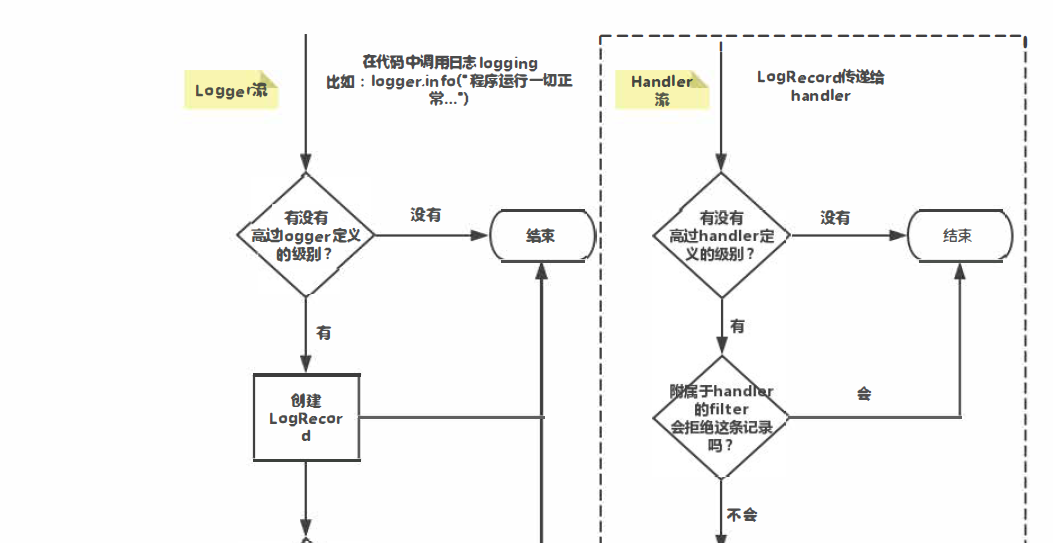
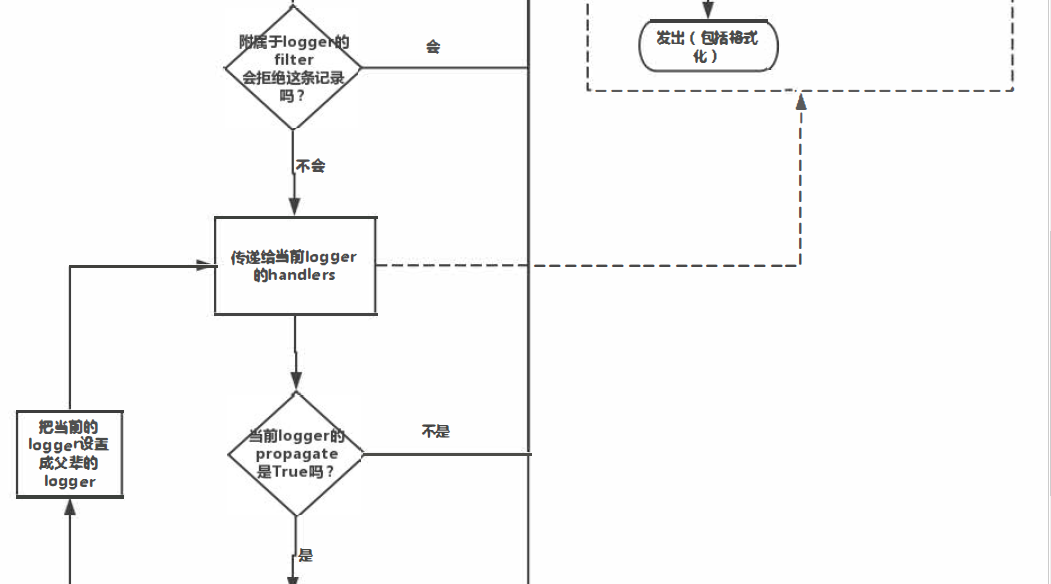

#logger:产生日志的对象

#Filter:过滤日志的对象

#Handler:接收日志然后控制打印到不同的地方,FileHandler用来打印到文件中,StreamHandler用来打印到终端

#Formatter对象:可以定制不同的日志格式对象,然后绑定给不同的Handler对象使用,以此来控制不同的Handler的日志格式
 1 '''
 2 critical=50
 3 error =40
 4 warning =30
 5 info = 20
 6 debug =10
 7 '''
 8
 9
10 import logging
11
12 #1、logger对象:负责产生日志,然后交给Filter过滤,然后交给不同的Handler输出
13 logger=logging.getLogger(__file__)
14
15 #2、Filter对象:不常用,略
16
17 #3、Handler对象:接收logger传来的日志,然后控制输出
18 h1=logging.FileHandler('t1.log') #打印到文件
19 h2=logging.FileHandler('t2.log') #打印到文件
20 h3=logging.StreamHandler() #打印到终端
21
22 #4、Formatter对象:日志格式
23 formmater1=logging.Formatter('%(asctime)s - %(name)s - %(levelname)s -%(module)s:  %(message)s',
24                     datefmt='%Y-%m-%d %H:%M:%S %p',)
25
26 formmater2=logging.Formatter('%(asctime)s :  %(message)s',
27                     datefmt='%Y-%m-%d %H:%M:%S %p',)
28
29 formmater3=logging.Formatter('%(name)s %(message)s',)
30
31
32 #5、为Handler对象绑定格式
33 h1.setFormatter(formmater1)
34 h2.setFormatter(formmater2)
35 h3.setFormatter(formmater3)
36
37 #6、将Handler添加给logger并设置日志级别
38 logger.addHandler(h1)
39 logger.addHandler(h2)
40 logger.addHandler(h3)
41 logger.setLevel(10)
42
43 #7、测试
44 logger.debug('debug')
45 logger.info('info')
46 logger.warning('warning')
47 logger.error('error')
48 logger.critical('critical')
五 Logger与Handler的级别
logger是第一级过滤,然后才能到handler,我们可以给logger和handler同时设置level,但是需要注意的是
 1 Logger is also the first to filter the message based on a level — if you set the logger to INFO, and all handlers to DEBUG, you still won't receive DEBUG messages on handlers — they'll be rejected by the logger itself. If you set logger to DEBUG, but all handlers to INFO, you won't receive any DEBUG messages either — because while the logger says "ok, process this", the handlers reject it (DEBUG < INFO).
 2
 3
 4
 5 #验证
 6 import logging
 7
 8
 9 form=logging.Formatter('%(asctime)s - %(name)s - %(levelname)s -%(module)s:  %(message)s',
10                     datefmt='%Y-%m-%d %H:%M:%S %p',)
11
12 ch=logging.StreamHandler()
13
14 ch.setFormatter(form)
15 # ch.setLevel(10)
16 ch.setLevel(20)
17
18 l1=logging.getLogger('root')
19 # l1.setLevel(20)
20 l1.setLevel(10)
21 l1.addHandler(ch)
22
23 l1.debug('l1 debug')
六 Logger的继承(了解)
 1 import logging
 2
 3 formatter=logging.Formatter('%(asctime)s - %(name)s - %(levelname)s -%(module)s:  %(message)s',
 4                     datefmt='%Y-%m-%d %H:%M:%S %p',)
 5
 6 ch=logging.StreamHandler()
 7 ch.setFormatter(formatter)
 8
 9
10 logger1=logging.getLogger('root')
11 logger2=logging.getLogger('root.child1')
12 logger3=logging.getLogger('root.child1.child2')
13
14
15 logger1.addHandler(ch)
16 logger2.addHandler(ch)
17 logger3.addHandler(ch)
18 logger1.setLevel(10)
19 logger2.setLevel(10)
20 logger3.setLevel(10)
21
22 logger1.debug('log1 debug')
23 logger2.debug('log2 debug')
24 logger3.debug('log3 debug')
25 '''
26 2017-07-28 22:22:05 PM - root - DEBUG -test:  log1 debug
27 2017-07-28 22:22:05 PM - root.child1 - DEBUG -test:  log2 debug
28 2017-07-28 22:22:05 PM - root.child1 - DEBUG -test:  log2 debug
29 2017-07-28 22:22:05 PM - root.child1.child2 - DEBUG -test:  log3 debug
30 2017-07-28 22:22:05 PM - root.child1.child2 - DEBUG -test:  log3 debug
31 2017-07-28 22:22:05 PM - root.child1.child2 - DEBUG -test:  log3 debug
32 '''
七 应用
 1 """
 2 logging配置
 3 """
 4
 5 import os
 6 import logging.config
 7
 8 # 定义三种日志输出格式 开始
 9
10 standard_format = '[%(asctime)s][%(threadName)s:%(thread)d][task_id:%(name)s][%(filename)s:%(lineno)d]' \
11                   '[%(levelname)s][%(message)s]' #其中name为getlogger指定的名字
12
13 simple_format = '[%(levelname)s][%(asctime)s][%(filename)s:%(lineno)d]%(message)s'
14
15 id_simple_format = '[%(levelname)s][%(asctime)s] %(message)s'
16
17 # 定义日志输出格式 结束
18
19 logfile_dir = os.path.dirname(os.path.abspath(__file__))  # log文件的目录
20
21 logfile_name = 'all2.log'  # log文件名
22
23 # 如果不存在定义的日志目录就创建一个
24 if not os.path.isdir(logfile_dir):
25     os.mkdir(logfile_dir)
26
27 # log文件的全路径
28 logfile_path = os.path.join(logfile_dir, logfile_name)
29
30 # log配置字典
31 LOGGING_DIC = {
32     'version': 1,
33     'disable_existing_loggers': False,
34     'formatters': {
35         'standard': {
36             'format': standard_format
37         },
38         'simple': {
39             'format': simple_format
40         },
41     },
42     'filters': {},
43     'handlers': {
44         #打印到终端的日志
45         'console': {
46             'level': 'DEBUG',
47             'class': 'logging.StreamHandler',  # 打印到屏幕
48             'formatter': 'simple'
49         },
50         #打印到文件的日志,收集info及以上的日志
51         'default': {
52             'level': 'DEBUG',
53             'class': 'logging.handlers.RotatingFileHandler',  # 保存到文件
54             'formatter': 'standard',
55             'filename': logfile_path,  # 日志文件
56             'maxBytes': 1024*1024*5,  # 日志大小 5M
57             'backupCount': 5,
58             'encoding': 'utf-8',  # 日志文件的编码,再也不用担心中文log乱码了
59         },
60     },
61     'loggers': {
62         #logging.getLogger(__name__)拿到的logger配置
63         '': {
64             'handlers': ['default', 'console'],  # 这里把上面定义的两个handler都加上,即log数据既写入文件又打印到屏幕
65             'level': 'DEBUG',
66             'propagate': True,  # 向上(更高level的logger)传递
67         },
68     },
69 }
70
71
72 def load_my_logging_cfg():
73     logging.config.dictConfig(LOGGING_DIC)  # 导入上面定义的logging配置
74     logger = logging.getLogger(__name__)  # 生成一个log实例
75     logger.info('It works!')  # 记录该文件的运行状态
76
77 if __name__ == '__main__':
78     load_my_logging_cfg()
 1 """
 2 MyLogging Test
 3 """
 4
 5 import time
 6 import logging
 7 import my_logging  # 导入自定义的logging配置
 8
 9 logger = logging.getLogger(__name__)  # 生成logger实例
10
11
12 def demo():
13     logger.debug("start range... time:{}".format(time.time()))
14     logger.info("中文测试开始。。。")
15     for i in range(10):
16         logger.debug("i:{}".format(i))
17         time.sleep(0.2)
18     else:
19         logger.debug("over range... time:{}".format(time.time()))
20     logger.info("中文测试结束。。。")
21
22 if __name__ == "__main__":
23     my_logging.load_my_logging_cfg()  # 在你程序文件的入口加载自定义logging配置
24     demo()
 1 注意注意注意:
 2
 3
 4 #1、有了上述方式我们的好处是:所有与logging模块有关的配置都写到字典中就可以了,更加清晰,方便管理
 5
 6
 7 #2、我们需要解决的问题是:
 8     1、从字典加载配置:logging.config.dictConfig(settings.LOGGING_DIC)
 9
10     2、拿到logger对象来产生日志
11     logger对象都是配置到字典的loggers 键对应的子字典中的
12     按照我们对logging模块的理解,要想获取某个东西都是通过名字,也就是key来获取的
13     于是我们要获取不同的logger对象就是
14     logger=logging.getLogger('loggers子字典的key名')
15
16
17     但问题是:如果我们想要不同logger名的logger对象都共用一段配置,那么肯定不能在loggers子字典中定义n个key
18  'loggers': {
19         'l1': {
20             'handlers': ['default', 'console'],  #
21             'level': 'DEBUG',
22             'propagate': True,  # 向上(更高level的logger)传递
23         },
24         'l2: {
25             'handlers': ['default', 'console' ],
26             'level': 'DEBUG',
27             'propagate': False,  # 向上(更高level的logger)传递
28         },
29         'l3': {
30             'handlers': ['default', 'console'],  #
31             'level': 'DEBUG',
32             'propagate': True,  # 向上(更高level的logger)传递
33         },
34
35 }
36
37
38 #我们的解决方式是,定义一个空的key
39     'loggers': {
40         '': {
41             'handlers': ['default', 'console'],
42             'level': 'DEBUG',
43             'propagate': True,
44         },
45
46 }
47
48 这样我们再取logger对象时
49 logging.getLogger(__name__),不同的文件__name__不同,这保证了打印日志时标识信息不同,但是拿着该名字去loggers里找key名时却发现找不到,于是默认使用key=''的配置
另外一个django的配置,瞄一眼就可以,跟上面的一样
 1 #logging_config.py
 2 LOGGING = {
 3     'version': 1,
 4     'disable_existing_loggers': False,
 5     'formatters': {
 6         'standard': {
 7             'format': '[%(asctime)s][%(threadName)s:%(thread)d][task_id:%(name)s][%(filename)s:%(lineno)d]'
 8                       '[%(levelname)s][%(message)s]'
 9         },
10         'simple': {
11             'format': '[%(levelname)s][%(asctime)s][%(filename)s:%(lineno)d]%(message)s'
12         },
13         'collect': {
14             'format': '%(message)s'
15         }
16     },
17     'filters': {
18         'require_debug_true': {
19             '()': 'django.utils.log.RequireDebugTrue',
20         },
21     },
22     'handlers': {
23         #打印到终端的日志
24         'console': {
25             'level': 'DEBUG',
26             'filters': ['require_debug_true'],
27             'class': 'logging.StreamHandler',
28             'formatter': 'simple'
29         },
30         #打印到文件的日志,收集info及以上的日志
31         'default': {
32             'level': 'INFO',
33             'class': 'logging.handlers.RotatingFileHandler',  # 保存到文件,自动切
34             'filename': os.path.join(BASE_LOG_DIR, "xxx_info.log"),  # 日志文件
35             'maxBytes': 1024 * 1024 * 5,  # 日志大小 5M
36             'backupCount': 3,
37             'formatter': 'standard',
38             'encoding': 'utf-8',
39         },
40         #打印到文件的日志:收集错误及以上的日志
41         'error': {
42             'level': 'ERROR',
43             'class': 'logging.handlers.RotatingFileHandler',  # 保存到文件,自动切
44             'filename': os.path.join(BASE_LOG_DIR, "xxx_err.log"),  # 日志文件
45             'maxBytes': 1024 * 1024 * 5,  # 日志大小 5M
46             'backupCount': 5,
47             'formatter': 'standard',
48             'encoding': 'utf-8',
49         },
50         #打印到文件的日志
51         'collect': {
52             'level': 'INFO',
53             'class': 'logging.handlers.RotatingFileHandler',  # 保存到文件,自动切
54             'filename': os.path.join(BASE_LOG_DIR, "xxx_collect.log"),
55             'maxBytes': 1024 * 1024 * 5,  # 日志大小 5M
56             'backupCount': 5,
57             'formatter': 'collect',
58             'encoding': "utf-8"
59         }
60     },
61     'loggers': {
62         #logging.getLogger(__name__)拿到的logger配置
63         '': {
64             'handlers': ['default', 'console', 'error'],
65             'level': 'DEBUG',
66             'propagate': True,
67         },
68         #logging.getLogger('collect')拿到的logger配置
69         'collect': {
70             'handlers': ['console', 'collect'],
71             'level': 'INFO',
72         }
73     },
74 }
75
76
77 # -----------
78 # 用法:拿到俩个logger
79
80 logger = logging.getLogger(__name__) #线上正常的日志
81 collect_logger = logging.getLogger("collect") #领导说,需要为领导们单独定制领导们看的日志
十三 re模块
一:什么是正则?
正则就是用一些具有特殊含义的符号组合到一起(称为正则表达式)来描述字符或者字符串的方法。或者说:正则就是用来描述一类事物的规则。(在Python中)它内嵌在Python中,并通过 re 模块实现。正则表达式模式被编译成一系列的字节码,然后由用 C 编写的匹配引擎执行。
生活中处处都是正则:
比如我们描述:4条腿
你可能会想到的是四条腿的动物或者桌子,椅子等
继续描述:4条腿,活的
就只剩下四条腿的动物这一类了
二:常用匹配模式(元字符)
http://blog.csdn.net/yufenghyc/article/details/51078107

 1 # =================================匹配模式=================================
 2 #一对一的匹配
 3 # 'hello'.replace(old,new)
 4 # 'hello'.find('pattern')
 5
 6 #正则匹配
 7 import re
 8 #\w与\W
 9 print(re.findall('\w','hello egon 123')) #['h', 'e', 'l', 'l', 'o', 'e', 'g', 'o', 'n', '1', '2', '3']
10 print(re.findall('\W','hello egon 123')) #[' ', ' ']
11
12 #\s与\S
13 print(re.findall('\s','hello  egon  123')) #[' ', ' ', ' ', ' ']
14 print(re.findall('\S','hello  egon  123')) #['h', 'e', 'l', 'l', 'o', 'e', 'g', 'o', 'n', '1', '2', '3']
15
16 #\n \t都是空,都可以被\s匹配
17 print(re.findall('\s','hello \n egon \t 123')) #[' ', '\n', ' ', ' ', '\t', ' ']
18
19 #\n与\t
20 print(re.findall(r'\n','hello egon \n123')) #['\n']
21 print(re.findall(r'\t','hello egon\t123')) #['\n']
22
23 #\d与\D
24 print(re.findall('\d','hello egon 123')) #['1', '2', '3']
25 print(re.findall('\D','hello egon 123')) #['h', 'e', 'l', 'l', 'o', ' ', 'e', 'g', 'o', 'n', ' ']
26
27 #\A与\Z
28 print(re.findall('\Ahe','hello egon 123')) #['he'],\A==>^
29 print(re.findall('123\Z','hello egon 123')) #['he'],\Z==>$
30
31 #^与$
32 print(re.findall('^h','hello egon 123')) #['h']
33 print(re.findall('3$','hello egon 123')) #['3']
34
35 # 重复匹配:| . | * | ? | .* | .*? | + | {n,m} |
36 #.
37 print(re.findall('a.b','a1b')) #['a1b']
38 print(re.findall('a.b','a1b a*b a b aaab')) #['a1b', 'a*b', 'a b', 'aab']
39 print(re.findall('a.b','a\nb')) #[]
40 print(re.findall('a.b','a\nb',re.S)) #['a\nb']
41 print(re.findall('a.b','a\nb',re.DOTALL)) #['a\nb']同上一条意思一样
42
43 #*
44 print(re.findall('ab*','bbbbbbb')) #[]
45 print(re.findall('ab*','a')) #['a']
46 print(re.findall('ab*','abbbb')) #['abbbb']
47
48 #?
49 print(re.findall('ab?','a')) #['a']
50 print(re.findall('ab?','abbb')) #['ab']
51 #匹配所有包含小数在内的数字
52 print(re.findall('\d+\.?\d*',"asdfasdf123as1.13dfa12adsf1asdf3")) #['123', '1.13', '12', '1', '3']
53
54 #.*默认为贪婪匹配
55 print(re.findall('a.*b','a1b22222222b')) #['a1b22222222b']
56
57 #.*?为非贪婪匹配:推荐使用
58 print(re.findall('a.*?b','a1b22222222b')) #['a1b']
59
60 #+
61 print(re.findall('ab+','a')) #[]
62 print(re.findall('ab+','abbb')) #['abbb']
63
64 #{n,m}
65 print(re.findall('ab{2}','abbb')) #['abb']
66 print(re.findall('ab{2,4}','abbb')) #['abb']
67 print(re.findall('ab{1,}','abbb')) #'ab{1,}' ===> 'ab+'
68 print(re.findall('ab{0,}','abbb')) #'ab{0,}' ===> 'ab*'
69
70 #[]
71 print(re.findall('a[1*-]b','a1b a*b a-b')) #[]内的都为普通字符了,且如果-没有被转意的话,应该放到[]的开头或结尾
72 print(re.findall('a[^1*-]b','a1b a*b a-b a=b')) #[]内的^代表的意思是取反,所以结果为['a=b']
73 print(re.findall('a[0-9]b','a1b a*b a-b a=b')) #[]内的^代表的意思是取反,所以结果为['a=b']
74 print(re.findall('a[a-z]b','a1b a*b a-b a=b aeb')) #[]内的^代表的意思是取反,所以结果为['a=b']
75 print(re.findall('a[a-zA-Z]b','a1b a*b a-b a=b aeb aEb')) #[]内的^代表的意思是取反,所以结果为['a=b']
76
77 #\# print(re.findall('a\\c','a\c')) #对于正则来说a\\c确实可以匹配到a\c,但是在python解释器读取a\\c时,会发生转义,然后交给re去执行,
所以抛出异常
78 print(re.findall(r'a\\c','a\c')) #r代表告诉解释器使用rawstring,即原生字符串,把我们正则内的所有符号都当普通字符处理,不要转义
79 print(re.findall('a\\\\c','a\c')) #同上面的意思一样,和上面的结果一样都是['a\\c']
80
81 #():分组
82 print(re.findall('ab+','ababab123')) #['ab', 'ab', 'ab']
83 print(re.findall('(ab)+123','ababab123')) #['ab'],匹配到末尾的ab123中的ab
84 print(re.findall('(?:ab)+123','ababab123')) #findall的结果不是匹配的全部内容,而是组内的内容,?:可以让结果为匹配的全部内容
85 print(re.findall('href="(.*?)"','<a href="http://www.baidu.com">点击</a>'))#['http://www.baidu.com']
86 print(re.findall('href="(?:.*?)"','<a href="http://www.baidu.com">点击</a>'))#['href="http://www.baidu.com"']
87
88 #|
89 print(re.findall('compan(?:y|ies)','Too many companies have gone bankrupt, and the next one is my company'))
 1 # ===========================re模块提供的方法介绍===========================
 2 import re
 3 #1
 4 print(re.findall('e','alex make love') )   #['e', 'e', 'e'],返回所有满足匹配条件的结果,放在列表里
 5 #2
 6 print(re.search('e','alex make love').group()) #e,只到找到第一个匹配然后返回一个包含匹配信息的对象,该对象可以通过调用group()方法得到
匹配的字符串,如果字符串没有匹配,则返回None。
 7
 8 #3
 9 print(re.match('e','alex make love'))    #None,同search,不过在字符串开始处进行匹配,完全可以用search+^代替match
10
11 #4
12 print(re.split('[ab]','abcd'))     #['', '', 'cd'],先按'a'分割得到''和'bcd',再对''和'bcd'分别按'b'分割
13
14 #5
15 print('===>',re.sub('a','A','alex make love')) #===> Alex mAke love,不指定n,默认替换所有
16 print('===>',re.sub('a','A','alex make love',1)) #===> Alex make love
17 print('===>',re.sub('a','A','alex make love',2)) #===> Alex mAke love
18 print('===>',re.sub('^(\w+)(.*?\s)(\w+)(.*?\s)(\w+)(.*?)$',r'\5\2\3\4\1','alex make love')) #===> love make alex
19
20 print('===>',re.subn('a','A','alex make love')) #===> ('Alex mAke love', 2),结果带有总共替换的个数
21
22
23 #6
24 obj=re.compile('\d{2}')
25
26 print(obj.search('abc123eeee').group()) #12
27 print(obj.findall('abc123eeee')) #['12'],重用了obj
1 import re
2 print(re.findall("<(?P<tag_name>\w+)>\w+</(?P=tag_name)>","<h1>hello</h1>")) #['h1']
3 print(re.search("<(?P<tag_name>\w+)>\w+</(?P=tag_name)>","<h1>hello</h1>").group()) #<h1>hello</h1>
4 print(re.search("<(?P<tag_name>\w+)>\w+</(?P=tag_name)>","<h1>hello</h1>").groupdict()) #<h1>hello</h1>
5
6 print(re.search(r"<(\w+)>\w+</(\w+)>","<h1>hello</h1>").group())
7 print(re.search(r"<(\w+)>\w+</\1>","<h1>hello</h1>").group())
1 import re
2
3 print(re.findall(r'-?\d+\.?\d*',"1-12*(60+(-40.35/5)-(-4*3))")) #找出所有数字['1', '-12', '60', '-40.35', '5', '-4', '3']
4
5
6 #使用|,先匹配的先生效,|左边是匹配小数,而findall最终结果是查看分组,所有即使匹配成功小数也不会存入结果
7 #而不是小数时,就去匹配(-?\d+),匹配到的自然就是,非小数的数,在此处即整数
8 print(re.findall(r"-?\d+\.\d*|(-?\d+)","1-2*(60+(-40.35/5)-(-4*3))")) #找出所有整数['1', '-2', '60', '', '5', '-4', '3']
#计算器作业参考:http://www.cnblogs.com/wupeiqi/articles/4949995.html
expression='1-2*((60+2*(-3-40.0/5)*(9-2*5/3+7/3*99/4*2998+10*568/14))-(-4*3)/(16-3*2))'

content=re.search('\(([\-\+\*\/]*\d+\.?\d*)+\)',expression).group() #(-3-40.0/5)
1 #为何同样的表达式search与findall却有不同结果:
2 print(re.search('\(([\+\-\*\/]*\d+\.?\d*)+\)',"1-12*(60+(-40.35/5)-(-4*3))").group()) #(-40.35/5)
3 print(re.findall('\(([\+\-\*\/]*\d+\.?\d*)+\)',"1-12*(60+(-40.35/5)-(-4*3))")) #['/5', '*3']
4
5 #看这个例子:(\d)+相当于(\d)(\d)(\d)(\d)...,是一系列分组
6 print(re.search('(\d)+','123').group()) #group的作用是将所有组拼接到一起显示出来
7 print(re.findall('(\d)+','123')) #findall结果是组内的结果,且是最后一个组的结果
1 #_*_coding:utf-8_*_ 2 __author__ = 'Linhaifeng' 3 #在线调试工具:tool.oschina.net/regex/# 4 import re 5 6 s=''' 7 http://www.baidu.com 8 egon@oldboyedu.com 9 你好 10 010-3141 11 ''' 12 13 #最常规匹配 14 # content='Hello 123 456 World_This is a Regex Demo' 15 # res=re.match('Hello\s\d\d\d\s\d{3}\s\w{10}.*Demo',content) 16 # print(res) 17 # print(res.group()) 18 # print(res.span()) 19 20 #泛匹配 21 # content='Hello 123 456 World_This is a Regex Demo' 22 # res=re.match('^Hello.*Demo',content) 23 # print(res.group()) 24 25 26 #匹配目标,获得指定数据 27 28 # content='Hello 123 456 World_This is a Regex Demo' 29 # res=re.match('^Hello\s(\d+)\s(\d+)\s.*Demo',content) 30 # print(res.group()) #取所有匹配的内容 31 # print(res.group(1)) #取匹配的第一个括号内的内容 32 # print(res.group(2)) #去陪陪的第二个括号内的内容 33 34 35 36 #贪婪匹配:.*代表匹配尽可能多的字符 37 # import re 38 # content='Hello 123 456 World_This is a Regex Demo' 39 # 40 # res=re.match('^He.*(\d+).*Demo$',content) 41 # print(res.group(1)) #只打印6,因为.*会尽可能多的匹配,然后后面跟至少一个数字 42 43 44 #非贪婪匹配:?匹配尽可能少的字符 45 # import re 46 # content='Hello 123 456 World_This is a Regex Demo' 47 # 48 # res=re.match('^He.*?(\d+).*Demo$',content) 49 # print(res.group(1)) #只打印6,因为.*会尽可能多的匹配,然后后面跟至少一个数字 50 51 52 #匹配模式:.不能匹配换行符 53 content='''Hello 123456 World_This 54 is a Regex Demo 55 ''' 56 # res=re.match('He.*?(\d+).*?Demo$',content) 57 # print(res) #输出None 58 59 # res=re.match('He.*?(\d+).*?Demo$',content,re.S) #re.S让.可以匹配换行符 60 # print(res) 61 # print(res.group(1)) 62 63 64 #转义:\ 65 66 # content='price is $5.00' 67 # res=re.match('price is $5.00',content) 68 # print(res) 69 # 70 # res=re.match('price is \$5\.00',content) 71 # print(res) 72 73 74 #总结:尽量精简,详细的如下 75 # 尽量使用泛匹配模式.* 76 # 尽量使用非贪婪模式:.*? 77 # 使用括号得到匹配目标:用group(n)去取得结果 78 # 有换行符就用re.S:修改模式 79 80 81 82 83 84 85 86 87 88 89 90 91 92 93 94 #re.search:会扫描整个字符串,不会从头开始,找到第一个匹配的结果就会返回 95 96 # import re 97 # content='Extra strings Hello 123 456 World_This is a Regex Demo Extra strings' 98 # 99 # res=re.match('Hello.*?(\d+).*?Demo',content) 100 # print(res) #输出结果为None 101 102 # 103 # import re 104 # content='Extra strings Hello 123 456 World_This is a Regex Demo Extra strings' 105 # 106 # res=re.search('Hello.*?(\d+).*?Demo',content) # 107 # print(res.group(1)) #输出结果为 108 109 110 111 #re.search:只要一个结果,匹配演练, 112 import re 113 content=''' 114 <tbody> 115 <tr id="4766303201494371851675" class="even "><td><div class="hd"><span class="num">1</span><div class="rk "><span class="u-icn u-icn-75"></span></div></div></td><td class="rank"><div class="f-cb"><div class="tt"><a href="/song?id=476630320"><img class="rpic" src="http://p1.music.126.net/Wl7T1LBRhZFg0O26nnR2iQ==/19217264230385030.jpg?param=50y50&quality=100"></a><span data-res-id="476630320" " 116 # res=re.search('<a\shref=.*?<b\stitle="(.*?)".*?b>',content) 117 # print(res.group(1)) 118 119 120 #re.findall:找到符合条件的所有结果 121 # res=re.findall('<a\shref=.*?<b\stitle="(.*?)".*?b>',content) 122 # for i in res: 123 # print(i) 124 125 126 127 #re.sub:字符串替换 128 import re 129 content='Extra strings Hello 123 456 World_This is a Regex Demo Extra strings' 130 131 # content=re.sub('\d+','',content) 132 # print(content) 133 134 135 #用\1取得第一个括号的内容 136 #用法:将123与456换位置 137 # import re 138 # content='Extra strings Hello 123 456 World_This is a Regex Demo Extra strings' 139 # 140 # # content=re.sub('(Extra.*?)(\d+)(\s)(\d+)(.*?strings)',r'\1\4\3\2\5',content) 141 # content=re.sub('(\d+)(\s)(\d+)',r'\3\2\1',content) 142 # print(content) 143 144 145 146 147 # import re 148 # content='Extra strings Hello 123 456 World_This is a Regex Demo Extra strings' 149 # 150 # res=re.search('Extra.*?(\d+).*strings',content) 151 # print(res.group(1)) 152 153 154 # import requests,re 155 # respone=requests.get('https://book.douban.com/').text 156 157 # print(respone) 158 # print('======'*1000) 159 # print('======'*1000) 160 # print('======'*1000) 161 # print('======'*1000) 162 # res=re.findall('<li.*?cover.*?href="(.*?)".*?title="(.*?)">.*?more-meta.*?author">(.*?)</span.*?year">(.*?)</span.*?publisher">(.*?)</span.*?</li>',respone,re.S) 163 # # res=re.findall('<li.*?cover.*?href="(.*?)".*?more-meta.*?author">(.*?)</span.*?year">(.*?)</span.*?publisher">(.*?)</span>.*?</li>',respone,re.S) 164 # 165 # 166 # for i in res: 167 # print('%s %s %s %s' %(i[0].strip(),i[1].strip(),i[2].strip(),i[3].strip()))

 浙公网安备 33010602011771号