
容斥原理
对于两个集合A、B
A ∪ B=A+B - A∩B
对于三个集合A、B、C
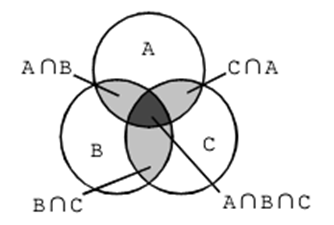
A∪B∪C=A+B+C -(A∩B+A∩C+B∩C)+A∩B∩C
用维恩图表示:
对于四个集合A、B、C、D
A∪B∪C∪D = A+B+C+D - (A∩B+B∩C+C∩D+A∩C+A∩D+B∩D)+(A∩B∩C+A∩B∩D+B∩C∩D)﹣A∩B∩C∩D
猜想:对于n个集合a1、a2、a3……an
a1∪a2∪a3∪……∪an=∑(选一个集合相交)-∑(选2个集合相交)+……+(-1)n-1∑ (选n个集合相交)=∑( (-1)i-1∑ (选i个集合相交) |1<=i<=n)
证明:(不会,自行百度)
ACM应用:
我第一次看到上面这个式子时,就在想这么复杂怎么应用?这么多种情况怎么表示啊?下面就到了二进制表现的地方了。
将n个集合编号从1到n,n个集合的选取情况一共有2n-1种(不考虑什么都不选),对于n不太大的情况下,我们可以使用一个数的二进制来表示每个集合是否选取(二进制的i位是1表示选取第i个集合),从1到(1<<n)-1的数就能表示出上式右侧中所有的选取情况,如果选取的个数是奇数,就是加上这种情况;是偶数,就是减去这种情况。
例:有5个集合,编号为1、2、3、4、5
对于一个数9,其二进制是:01001,就表示选取集合1和集合4这种情况,因为选取集合个数为2,所以减去这种情况。
这样从1到25-1就表示出了所有情况
题目:
1、牛客小白赛5:A题无关
链接:https://www.nowcoder.com/acm/contest/135/A
题意:给一个质数集合A,求区间[L,R]中不能被集合A中任意一个数整除的数的个数


 1 #include <bits/stdc++.h>
 2 using namespace std;
 3 #define infy 0x3f3f3f3f
 4 #define lowbit(x) (x&(-x))
 5 #define e exp(1)
 6 #define pi acos(-1)
 7 typedef unsigned long long int ull;
 8 ull l,r;
 9 int k,p[25];
10 ull solve(ull x)
11 {
12     ull ans1=0,temp=1,ans2=0;
13     int num=0;
14     for(int i=1;i<(1<<k);i++)
15     {
16         num=0,temp=1;
17         for(int j=1;j<=k;j++)
18             if(i&(1<<(j-1)))
19         {
20             num++;
21             temp*=p[j];
22             if(temp>x||temp<0)
23                 temp=0;
24         }
25         if(temp&&(num&1))
26         ans1+=x/temp;
27         else
28             if(temp)
29             ans2+=x/temp;
30     }
31     return x-(ans1-ans2);
32 }
33 int main()
34 {
35     cin.sync_with_stdio(false);
36     cin.tie(0);
37     cout.tie(0);
38     cin>>l>>r>>k;
39     for(int i=1;i<=k;i++)
40         cin>>p[i];
41     ull ans=solve(r)-solve(l-1);
42     cout<<ans<<endl;
43     return 0;
44 }

 浙公网安备 33010602011771号