面向对象程序设计
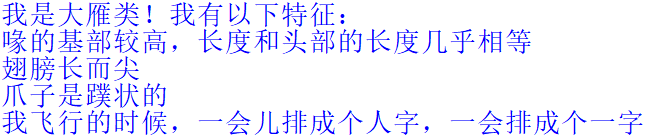
实例1、创建大雁类并定义飞行方法
class Geese:
'''大雁类'''
def __init__(self,beak,wing,claw):
print("我是大雁类!我有以下特征:")
print(beak)
print(wing)
print(claw)
def fly(self,state):
print(state)
beak_1="喙的基部较高,长度和头部的长度几乎相等"
wing_1="翅膀长而尖"
claw_1="爪子是蹼状的"
wildGoose=Geese(beak_1,wing_1,claw_1)
wildGoose.fly("我飞行的时候,一会儿排成个人字,一会排成个一字")
实例2、通过类属性统计类的实例个数
class Geese:
'''雁类'''
neck="脖子较长"
wing="振翅频率高"
leg="腿位于身体的中心支点,行走自如"
number=0
def __init__(self):
Geese.number+=1
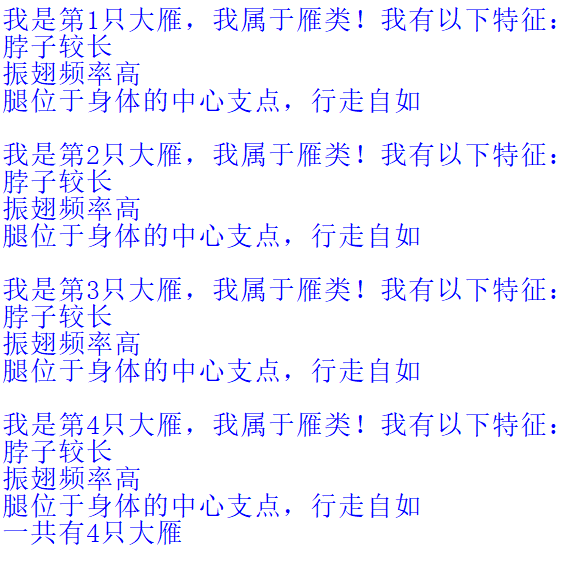
print("\n我是第"+str(Geese.number)+"只大雁,我属于雁类!我有以下特征:")
print(Geese.neck)
print(Geese.wing)
print(Geese.leg)
list1=[]
for i in range(4):
list1.append(Geese())
print("一共有"+str(Geese.number)+"只大雁")
实例3、在模拟电影点播功能时应用属性
class TVshow:
list_film=["战狼2","红海行动","西游记女儿国","熊出没·变形记"]
def __init__(self,show):
self.__show=show
@property
def show(self):
return self.__show
@show.setter
def show(self,value):
if value in TVshow.list_film:
self.__show="您选择了《"+value+"》,稍后将播放"
else:
self.__show="您点播的电影不存在"
tvshow = TVshow("战狼2")
print("正在播放:《",tvshow.show,"》")
print("您可以从",tvshow.list_film,"中选择要点播放的电影")
tvshow.show="红海行动"
print(tvshow.show)

实例4、创建水果基类及其派生类
class Fruit:
color="绿色"
def harvest(self,color):
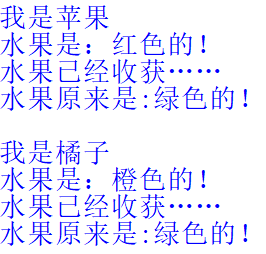
print("水果是:"+color+"的!")
print("水果已经收获……")
print("水果原来是:"+Fruit.color+"的!")
class Apple(Fruit):
color="红色"
def __init__(self):
print("我是苹果")
class Orange(Fruit):
color="橙色"
def __init__(self):
print("\n我是橘子")
apple = Apple()
apple.harvest(apple.color)
orange=Orange()
orange.harvest(orange.color)
实例5、在派生类中调用基类的__init__()方法定义类属性
class Fruit:
def __init__(self,color="绿色"):
Fruit.color=color
def harvest(self,color):
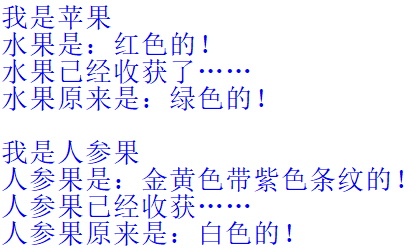
print("水果是:"+self.color+"的!")
print("水果已经收获了……")
print("水果原来是:"+Fruit.color+"的!")
class Apple(Fruit):
color="红色"
def __init__(self):
print("我是苹果")
super().__init__()
class Sapodilla(Fruit):
def __init__(self,color):
print("\n我是人参果")
super().__init__(color)
def harvest(self,color):
print("人参果是:"+color+"的!")
print("人参果已经收获……")
print("人参果原来是:"+Fruit.color+"的!")
apple=Apple()
apple.harvest(apple.color)
sapodilla=Sapodilla("白色")
sapodilla.harvest("金黄色带紫色条纹")
实战1、修改手机默认语言
class a:
def __init__(self):
print("智能手机的默认语言为英文")
def b(self,c):
print("将智能手机的默认语言设置为"+str(c))
m=a()
n=m.b("中文")

实战2、给信用卡设置默认密码
class card:
def __init__(self,a,b="123456"):
if b=="123456":
print("信用卡"+str(a)+"的默认密码为123456")
else:
print("重置信用卡"+str(a)+"的密码为"+str(b))
card("4013735633800642")
card("4013735633800642","168779")

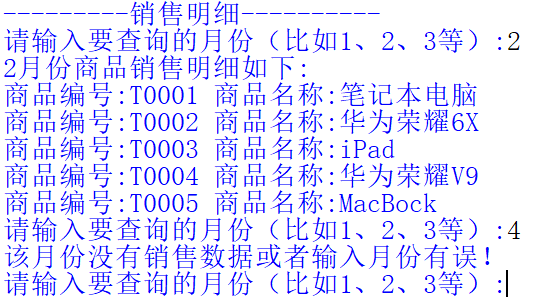
实战3、打印每月销售明细
class a:
def __init__(self):
self.__b_data={
"2":[('T0001','笔记本电脑'),
('T0002','华为荣耀6X'),
('T0003','iPad'),
('T0004','华为荣耀V9'),
('T0005','MacBock')]}
def c(self,d_month):
if d_month in self.__b_data:
print("%s月份商品销售明细如下:"%d_month)
for item in self.__b_data[d_month]:
print("商品编号:%s 商品名称:%s"%item)
else:
print("该月份没有销售数据或者输入月份有误!")
print("---------销售明细----------")
a1=a()
while True:
month=input("请输入要查询的月份(比如1、2、3等):")
if month=='quit':
break
a1.c(month)
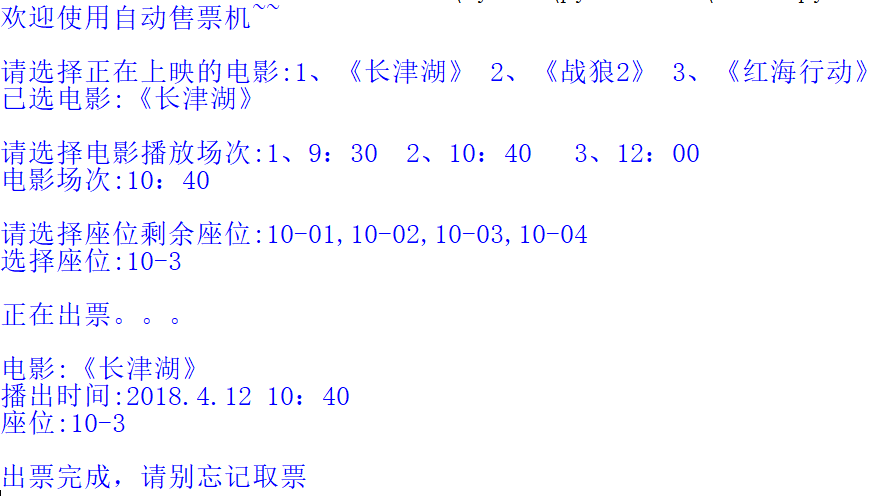
实战4、模拟电影院的自动售票机选票页面
class a:
def __init__(self):
print("欢迎使用自动售票机~~")
def film(self,film1):
a.film=film1
print("已选电影:"+film1)
def time(self,time1):
a.time=time1
print("电影场次:"+time1)
def seat(self,seat1):
a.seat=seat1
print("选择座位:"+seat1)
def h(self):
print("\n电影:"+a.film)
print("播出时间:2018.4.12 "+a.time)
print("座位:"+a.seat)
b=a()
print("\n请选择正在上映的电影:1、《长津湖》 2、《战狼2》 3、《红海行动》")
b.film("《长津湖》")
print("\n请选择电影播放场次:1、9:30 2、10:40 3、12:00")
b.time("10:40")
print("\n请选择座位剩余座位:10-01,10-02,10-03,10-04")
b.seat("10-3")
print("\n正在出票。。。")
b.h()
print("\n出票完成,请别忘记取票")

 浙公网安备 33010602011771号