
实验四
第一题
//battery.h
#ifndef BATTERY_H
#define BATTERY_H

class Battery
{
public:
    Battery(int batterysize0 = 70);
    int  showbattery()const{
        return batterysize;
    }

private:
    int batterysize;
};

#endif
//battery.cpp
#include"battery.h"
#include<iostream>
using namespace std;
Battery::Battery(int batterysize0):batterysize(batterysize0){}
//car.h
#ifndef CAR_H
#define CAR_H
#include<iostream>
using namespace std;
class Car
{
public:
    Car(string maker0, string model0, int year0 = 0, const int odometer0 = 0) :maker(maker0), model(model0), year(year0), odometer(odometer0) {}
    friend ostream &operator <<(ostream &out,Car &a);
    void updateodometer(int t)
    {
        if (odometer > t)
            cout << "wrong" << endl;
        else
            odometer = t;
    }
    string getmaker()
    {
        return maker;
    }
    string getmodel()
    {
        return model;
    }
    int getyear()
    {
        return year;
    }
    int getodo()
    {
        return odometer;
    }
    void getodo1(int n)
    {
        odometer = n;
    }
private:
    string maker;
    string model;
    int year;
    int odometer;
};
#endif
//car.cpp
#include"car.h"
#include<iostream>
#include<string>
using namespace std;
ostream & operator<<(ostream &out,Car & a)
{
    out << "maker:" << a.getmaker() << endl;   //或者是直接输出a.maker
    out << "model:" << a.getmodel() << endl;   //同上,直接输出a.model
    out << "year:" << a.getyear() << endl;     //同上
    out << "odometer:" << a.getodo() << endl;  //同上
    return out;
}
//electriccar.h
#ifndef ELECTRICCAR_H
#define ELECTRICCAR_H
#include"battery.h"
#include"car.h"


class ElectricCar :public Car,public Battery
{
public:
    ElectricCar(string a, string b, int c,  int e = 70 ,const int d = 0):Car(a,b,c,d),battery(e){}
    friend ostream &operator<<(ostream &out, ElectricCar & a);
    void updateodometer(int m)
    {
        if (getodo() > m)
            cout << "wrong" << endl;
        else
            getodo1(m);
    }
private:
    Battery battery;

};

#endif
//electriccar.cpp
#include"electriccar.h"
#include<iostream>
#include<string>
using namespace std;
ostream &operator<<(ostream &out, ElectricCar & a)
{
    out << "maker:" << a.getmaker() << endl;
    out << "model:" << a.getmodel() << endl;
    out << "year:" << a.getyear() << endl;
    out << "odometer:" << a.getodo() << endl;
    out << "batterysize:" << a.battery.showbattery() << "-kWh" << endl;
    return out;
}
//main.cpp
#include <iostream>
using namespace std;

#include "car.h"
#include "electriccar.h"

int main() {
    // 测试Car类
    Car oldcar("Audi","a4",2016);
    cout << "--------oldcar's info--------" << endl;
    oldcar.updateodometer(25000);
    cout << oldcar << endl;

    // 测试ElectricCar类
    ElectricCar newcar("Tesla","model s",2016);
    newcar.updateodometer(2500);
    cout << "\n--------newcar's info--------\n";
    cout << newcar << endl;

    system("pause");

    return 0;
}
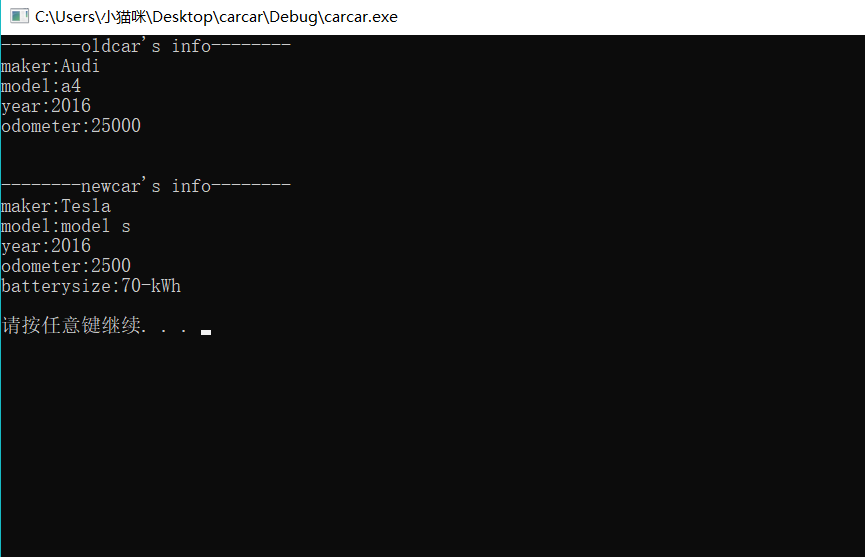
运行结果如图
第二题
//arrayInt.h
#ifndef ARRAY_INT_H
#define ARRAY_INT_H

class ArrayInt{
    public:
        ArrayInt(int n, int value=0);
        ~ArrayInt();
        // 补足:将运算符[]重载为成员函数的声明
        int & operator[](int y);
        void print();
    private:
        int *p;
        int size;
};

#endif
//arrayInyt.cpp
#include "arrayInt.h"
#include <iostream>
#include <cstdlib>
using std::cout;
using std::endl;

ArrayInt::ArrayInt(int n, int value): size(n) {
    p = new int[size];

    if (p == nullptr) {
        cout << "fail to mallocate memory" << endl;
        exit(0);
    }

    for(int i=0; i<size; i++)
        p[i] = value;
}

ArrayInt::~ArrayInt() {
    delete[] p;
}

void ArrayInt::print() {
    for(int i=0; i<size; i++)
        cout << p[i] << " ";
    cout << endl;
}

// 补足:将运算符[]重载为成员函数的实现
int & ArrayInt::operator[](int y)
{
    return p[y];
}
//main.cpp
#include <iostream>
using namespace std;

#include "arrayInt.h"

int main() {
    // 定义动态整型数组对象a,包含2个元素,初始值为0
    ArrayInt a(2);
    a.print();

    // 定义动态整型数组对象b,包含3个元素,初始值为6
    ArrayInt b(3, 6);
    b.print();

    // 通过对象名和下标方式访问并修改对象元素
    b[0] = 2;
    cout << b[0] << endl;
    b.print();

    system("pause");

    return 0;
}
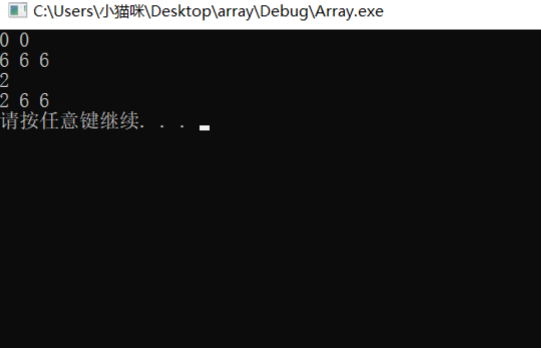
运行结果如图:
关于第一题
第一题写的蛮久的,周日和周二实验课用了不少时间,关于这一题,我觉得难点在于知识之间的交叉相融,在于如何把书上的东西变成正确的代码。
1.battery.h与battery.cpp没有什么难点,注意Battery类的构造函数有默认参数值。
2.car.h中对于运算符“<<”的重载函数的声明定义为友元函数,不是类的成员函数,写法可以模仿书上的例题,在car.h的前几行还要#include<iostream>,否则ostrem就是一个未定义的标志符。
3.在car.cpp中对重载函数定义的时候注意不用再添上friend了,它不允许定义在类外,输出car的四个私有成员时,以输出maker为例,可以写“out<<a.getmaker()<<endl;”也可以是“out<<a.maker<<endl;”友元函数虽不是类的成员函数,但它是可以通过对象来访问类的私有成员的,所以这里既可以访问对象的public成员函数,也可以直接访问私有成员。还要注意#include<string>,否则会导致maker和model的类型未定义。
4.在electriccar.h中,一开始我只把Car类作为ElectricCar的基类,没有想到还要把Battery也作为ElectricCar的基类,导致在这里卡了挺长时间的,定义<<的重载函数的时候,电车类的对象一直访问不了它自己的私有成员battery,后来把这里改了还是发现访问不了,最后求助同学,俩人找了二十多分钟愣是没找到哪里错了,最后终于发现,重载函数声明和定义的时候,形参中电车类对象我一个定义成const,一个没定义成const,就导致参数没办法传递了,改掉后就可以使用a.battery.showbattery()啦。
关于第二题
1.第二题周日写的挺快的,形参是一个整形,以这个整形作为动态数组p[]的下标返回,这样就可以通过下标来访问动态数组元素了。
2.[]必须要声明为类的成员函数,这样第一个操作数就是类的对象了

 浙公网安备 33010602011771号