

面向对象程序设计(2)
面向对象程序设计(2)
一:前言
(1):知识点
1:正则表达式
什么是正则表达式:
- 正则表达式,又称规则表达式,通常被用来检索、替换那些符合某个模式(规则)的文本。
- 正则表达式是对字符串操作的一种逻辑公式,就是用事先定义好的一些特定字符、及这些特定字符的组合, 组成一个“规则字符串”,这个“规则字符串”用来表达对字符串的一种过滤逻辑。
正则表达式的三大类:
Pattern 类:
pattern 对象是一个正则表达式的编译表示。Pattern 类没有公共构造方法。要创建一个 Pattern对象,你必须首先调用其公共静态编译方法,它返回一个 Pattern 对象。该方法接受一个正则表达式作为它的第一个参数。
Matcher 类:
Matcher 对象是对输入字符串进行解释和匹配操作的引擎。与Pattern 类一样,Matcher 也没有公共构造方法。你需要调用 Pattern 对象的 matcher 方法来获得一个 Matcher 对象。
PatternSyntaxException类:
PatternSyntaxException 是一个非强制异常类,它表示一个正则表达式模式中的语法错误。
字符说明:
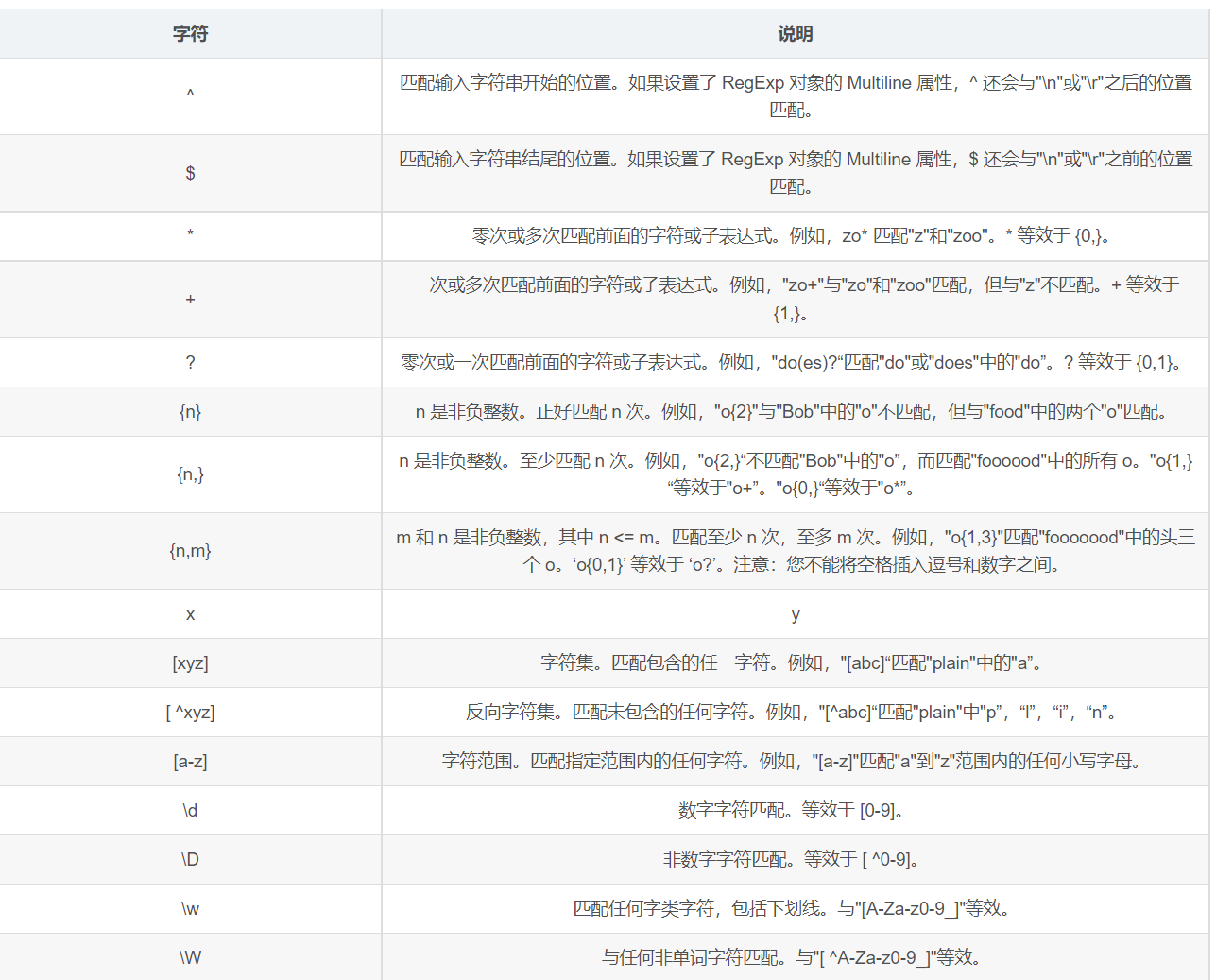
2:动态数组
动态数组:Java动态数组是一种可以任意伸缩数组长度的对象,在Java中比较常用的是ArrayList,ArrayList是javaAPI中自带的java.util.ArrayList。
(1): 什么是数组
同类数据元素的集合,在计算机中以连续的地址存储,编译时确定长度,无法改变。
(2):什么是动态数组
数据结构中顺序表的物理实现,同类数据元素的集合,在计算机中以连续的地址存储,大小在创建时决定,但是可以改变。
(3): 为什么使用动态数组
支持随机访问,查询速度快。但是插入和删除都需要移动元素,比起链表开销较大。如:java集合类中的ArrayList Vector等
3:封装继承多态
Java的三大特性:继承封装多态
(1):封装
封装(Encapsulation)是面向对象方法的重要原则,就是把对象的属性和操作(或服务)结合为一个独立的整体,并尽可能隐藏对象的内部实现细节。
什么是封装:
- 将类的某些信息隐藏在类的内部,不允许外部程序进行直接的访问调用。
- 通过该类提供的方法来实现对隐藏信息的操作和访问。
- 隐藏对象的信息。
- 留出访问的对外接口
封装的特点:
- 对成员变量实行更准确的控制。
- 封装可以隐藏内部程序实现的细节。
- 良好的封装能够减少代码之间的耦合度。
- 外部成员无法修改已封装好的程序代码。
- 方便数据检查,有利于保护对象信息的完整性,同时也提高程序的安全性。
- 便于修改,体高代码的可维护性。
封装的使用:
-
使用private修饰符,表示最小的访问权限。
-
对成员变量的访问,统一提供setXXX,getXXX方法。
(2):继承
什么是继承:
-
使用private修饰符,表示最小的访问权限。
-
对成员变量的访问,统一提供setXXX,getXXX方法。
继承的特点:
提高代码复用性。
父类的属性方法可以用于子类。
可以轻松的定义子类。
使设计应用程序变得简单。
继承的注意事项:
只支持单继承,即一个子类只允许有一个父类,但是可以实现多级继承,及子类拥有唯一的父类,而父类还可以再继承。
子类可以拥有父类的属性和方法。
子类可以拥有自己的属性和方法。
子类可以重写覆盖父类的方法。
继承的使用:
1,在父子类关系继承中,如果成员变量重名,则创建子类对象时,访问有两种方式。
a,直接通过子类对象访问成员变量 等号左边是谁,就优先使用谁,如果没有就向上找。
b,间接通过成员方法访问成员变量该方法属于谁,谁就优先使用,如果没有就向上找。
2,同理:
成员方法也是一样的,创建的对象是谁,就优先使用谁,如果没有则直接向上找。
注意事项:
无论是成员变量还是成员方法,如果没有都是向上父类中查找,绝对不会向下查找子类的。
3,在继承关系中,关于成员变量的使用:
局部成员变量:直接使用
本类成员变量:this.成员变量
父类成员变量:super.父类成员变量
重写和重载:
重写的规则:
1,参数列表必须与被重写方法相同。
2,访问权限不能比父类中被重写的方法的访问权限更低(public>protected>(default)>private)。
3,父类成员的方法只能被它的子类重写。
4,被final修饰的方法不能被重写。
5,构造方法不能
重载的规则:
1,被重载的方法必须改变参数列表(参数个数或者类型不一样)。
2,被重载的方法可以改变返回类型。
3,被重载的方法可以改变访问修饰符。
(3):多态
什么是多态:
多态是同一个行为具有多个不同表现形式或形态的能力。
多态的特点:
1,消除类型之间的耦合关系,实现低耦合。
2,灵活性。
3,可扩充性。
4,可替换性。
4:容器
为什么要引入Java容器?
我们知道,如果定义一个int数组,需要一开始就要制定它的大小。在一些情况下,我们根本不知道它的长度是多少,开辟很大的长度会导致空间浪费。
此外,数组还有很多缺点,例如数组中提供的方法非常有限,对于添加、删除、插入数据等操作,非常不便,同时效率不高。获取数据中实际元素的个数的需求,数组没有现成的属性或方
法可用。数组存储数据的特点:有序、可重复。对于无序、不可重复的需求,不能满足。
为了数组能够更灵活的应用,提出了Java容器的概念。
Java容器基本概念
Java容器类库是用来保存对象的,他有两种不同的概念:
Collection,独立元素的序列,这些元素都服从一条或多条规则。List、Set以及Queue都是Collection的一种,List必须按照顺序保存元素,而Set不能有重复元素,Queue需要按照
排队规则来确定对象的顺序。
Map,Map是键值对类型,允许用户通过键来查找对象。Hash表允许我们使用另一个对象来查找某个对象。
容器接口:
Collection接口
Collection是最基本的集合接口。Java SDK不提供直接继承自Collection的类,Java SDK提供的类都是继承自Collection的“子接口”。所有实现Collection接口的类都必须提供两个标准的构
造函数:无参数的构造函数用于创建一个空的Collection,有一个 Collection参数的构造函数用于创建一个新的Collection,这个新的Collection与传入的Collection有相同的元素。后一个构
造函数允许用户复制一个Collection。
Map接口
Map也是一个接口,一个map不能包含重复的key,每个key只能映射唯一一个value。Map接口是用来取代Dictionary抽象类的。Map接口提供三个集合视图,1.key的集合 2.value的集合
3.key-value的集合。map内元素的顺序取决于Iterator的具体实现,获取集合视图其实是获取一个迭代器,实现对遍历元素细节的隐藏。
同样,map的实现类应该提供两个“标准”构造器,一个无参构造器用来创建一个空map,一个只有一个参数,参数类型是map的构造器,用来创建一个新的和传入参数有一样key-value映射
的map。实际上,后者允许复制任何一个map,这仅仅是一个建议,并没有强制要求,因为接口是无法包含构造器的,不过这个建议在JDK被遵守。
如果一个方法的操作是不被支持的,这个方法指定抛出UnsupportedOperationException异常。如果这个操作对map是没有影响的,那么也可以不抛出UnsupportedOperationException异
常。例如,在一个不能被修改的map调用putAll(Map)方法,如果该map的映射是空的,就不要求抛出UnsupportedOperationException异常。
(2):题量和难度
(1):第四次大作业:
①: 获取每一行的数字并且输出这一行数字的总和
难度不算大,获取数字按照循环累加就可以
②:输入多个点坐标,组成四边形和点线,判断他们构成的各种关系以及完成相对应的要求
难度有点大,四边形被线分割成两个部分最难搞,没有实现
③:银行用户存取款相关业务,要进行封装
不算难,实现功能十分简单,就算要封装,也很简单实现功能
(2):期中考试
给你一个类图,按照类图构造对应函数,其中使用到继承和容器
题量不算大,难度也不算大,类图清晰并且实现的功能不复杂
(3):第五次大作业
五边形的点线面系列,甚至有面和面的关系以及切割成两部分
题量很少,甚至算是只有一题,但是难度我觉得十分高,线切割面积已经很难了,面切割面积,太复杂已经不知道从哪里开始,毫无头绪
2:设计与分析
1.第四/五次大作业
一:获取每一行数字之和
(1):采用str中的split的方法以及正则表达式,获取数字,不断进行累加,最终输出,从而获取结果
没有什么复杂的功能,整个代码就是一路直接下来,只有两个小循环,很
import java.util.Scanner;
public class Main
{

	public static void main(String[] args)
	{
		Scanner input = new Scanner(System.in);
		Line l = new Line();
		Point a =  new Point();
		Point b =  new Point();
		double x1,x2,y1,y2;
		String str;
		x1 = input.nextDouble();
		y1 = input.nextDouble();
		x2 = input.nextDouble();
		y2 = input.nextDouble();
		str = input.next();
		l.setColor(str);
		a.setX(x1);
		a.setY(y1);
		l.setPoint1(a);
		b.setX(x2);
		b.setY(y2);
		l.setPoint2(b);
		l.display();
		input.close();

	}

}
class Point
{

	private double x;
	private double y;
	public Point()
	{

	}
	public Point(double x,double y)
	{
		this.x = x;
		this.y = y;

	}
	public double getX()
	{
		return this.x;
	}
	public void setX(double x)
	{
		if(x<=200&&x>0)
		this.x = x;
		else
		{
			System.out.println("Wrong Format");
			System.exit(0);
		}
	}
	public double getY()
	{
		return this.y;
	}
	public void setY(double y)
	{
		if(y<=200&&y>0)
			this.y = y;
			else
			{
				System.out.println("Wrong Format");
				System.exit(0);
			}
	}
	public void display()
	{
		System.out.printf("(%.2f,%.2f)\n",this.x,this.y);
	}

}
class Line
{
	private Point a;
	private Point b;
	private String color;
	public Line()
	{

	}
	public Line(Point a,Point b,String col)
	{

	}
	public Point getPoint1()
	{
		return this.a;
	}
	public void setPoint1(Point point1)
	{
		this.a = point1;
	}
	public Point getPoint2()
	{
		return this.b;
	}
	public void setPoint2(Point point2)
	{
		this.b = point2;
	}
	public String getColor()
	{
		return this.color;
	}
	public void setColor(String str)
	{
		this.color = str;
	}
	public double getDistance()
	{
		double x1,x2,y1,y2,s;
		x1 = this.a.getX();
		x2 = this.b.getX();
		y1 = this.a.getY();
		y2 = this.b.getY();
		s = Math.sqrt((x1-x2)*(x1-x2)+(y1-y2)*(y1-y2));
		return s;

	}
	public void display()
	{
		Line l = new Line();
		Point a = new Point();
		Point b = new Point();
		a = this.getPoint1();
		System.out.println("The line's color is:"+this.getColor());
		System.out.println("The line's begin point's Coordinate is:");
		a.display();
		b = this.getPoint2();
		System.out.println("The line's end point's Coordinate is:");
		b.display();
		System.out.print("The line's length is:");
		System.out.printf("%.2f\n",this.getDistance());
	}
}
二:四/五边形点线面系列
(1):四边形的点线面系列,之前出现三角形就已经让我头疼了,这次出现的分割面积还是一样让我头疼,并且出现了一个叫做冗余点的东西,这个我到了五边形也没有系统地解决它,
算是这个系列里的一个败笔吧
(2)类与类之间的关系就出现了比较高的复杂度,有依赖,关联,组合,聚合,主要是关联和组合,由于类的种类比较多,选择里面传参主要是数据,然而实现功能分散在各种点线里
面,所以各种里面组合使用频率最高,而其实继承老师也提过,不过我还没有实现
package PTA51;
import java.util.Scanner;
import java.util.regex.Pattern;

public class PTA51
{
	 public static void main(String[] args)
	 {
		 Scanner input = new Scanner(System.in);
		 String str = input.nextLine();
		 Getnumber number = new Getnumber();
		 Select sel = new Select();
		 int select;
		 double[] num = new double[100];
		 num = number.get_number(str);//获取数字,储存在数组里
		 select = number.dealnum(num,str);
			//select = (int)(str.charAt(0)-48);
		 switch(select)
		 {
		 	case 1://选择1
		 		sel.select1(num,select);
		 		break;
		 	case 2:
		 		sel.select2(num, select);
		 		break;
		 	case 3:
		 		sel.select3(num,select);
		 		break;
		 	case 4:
		 		sel.select4(num,select);
		 		break;
		 	case 5:
		 		sel.select5(num,select);
		 		break;
		 	case 6:
		 		sel.select6(num, select);
		 		break;
		 }

		 input.close();
	 }


}


class Getnumber
{

	public Getnumber()
	{

	}

	public boolean ifright(String str)
	{

		boolean flag;
		flag = true;
		//String pattern = "^[1-5]:(-)?(\\+)?\\d+(.)?(\\d+)?,(-)?(\\+)?\\d+(.)?(\\d+)?( (-)?(\\+)?\\d+(.)?(\\d+)?,(-)?(\\+)?\\d+(.)?(\\d+)?)?( (-)?(\\+)?\\d+(.)?(\\d+)?,(-)?(\\+)?\\d+(.)?(\\d+)?)?( (-)?(\\+)?\\d+(.)?(\\d+)?,(-)?(\\+)?\\d+(.)?(\\d+)?)?( (-)?(\\+)?\\d+(.)?(\\d+)?,(-)?(\\+)?\\d+(.)?(\\d+)?)?( (-)?(\\+)?\\d+(.)?(\\d+)?,(-)?(\\+)?\\d+(.)?(\\d+)?( )?)?";//正则表达式,判断格式
		String pattern = "^[1-6]:((\\D)?\\d+(.)?(\\d+)?,(\\D)?\\d+(.)?(\\d+)?( )?){1,}";//正则表达式,判断格式
		flag = Pattern.matches(pattern,str);
		if(flag)
			return true;
		return false;
	}

//	public boolean ifright(String str,int select)
//	{
//		int i;
//		Getnumber g = new Getnumber();
//		if(!str.matches("[0-6]:.+"))
//			return false;
//		select = g.getrightnum(select)/2;
////		for(i = 0;i<select;i++) {
//		if (!str.matches("(-)?(\\\\+)?\\\\d+(.)?(\\\\d+)?,(-)?(\\\\+)?\\\\d+(.)?(\\\\d+)?( )?")) {
//          return false;
////			}
//		}
//		return true;
//	}
	//获取数字
	public double[] get_number(String s)
	{
		int i,k,n,m,count,f;
		f = 1;
		m = 1;
		double num,j;
		double[] number = new double[100];
		for(i = 2;i < s.length();i+=(count+1))
		{
			num = 0.0;
			j = 0.1;
			k = 0;
			n = 1;
		    f = 1;
			count = 0;
			for(n = i;n<s.length()&&s.charAt(n)!=','&&s.charAt(n)!=' ';n++)
			{

				count++;
				if(s.charAt(n)=='-')
				{
					f = 0;
				}
				if(s.charAt(n)!='.'&& k==0&&s.charAt(n)>='0'&&s.charAt(n)<='9')
				{
					num = s.charAt(n)-48  + num *10;//小数点之前获取整数
				}
				if(s.charAt(n)=='.')
				{
					k = 1;//读取到小数点
				}
				if(k == 1&&s.charAt(n)>='0'&&s.charAt(n)<='9')
				{
					num = num + (s.charAt(n)-48) * j;//获取小数点之后
					j = j * 0.1;
				}
			}
			if(f==0)
			{
			number[m] = -num;
			}
			else number[m] = num;
			m++;

		}
		number[0] = m-1;//第一个数字储存数字个数
		return number;
	}

	//判断输入数字个数是否正确,数字正确返回“true”,不正确“false”
	public boolean ifRnum(double m,int n)
	{
		int x,y;
		y = 0;
		x = (int)m;
		if(n==1||n==2)
			y = 10;
		if(n == 3)
			y = 14;
		if(n == 4||n==5)
			y = 20;
		if(n==6)
			y = 12;
		if(x==y)
			return true;
		return false;
	}

	//是否有点重合
	public boolean isnotsame1(Point a,Point b,Point c,Point d)
	{
		boolean f1,f2,f3,f4,f5,f6;
		f1 = a.pointsame(a, b);
		f2 = a.pointsame(a, c);
		f3 = a.pointsame(a, d);
		f4 = a.pointsame(b, c);
		f5 = a.pointsame(d, b);
		f6 = a.pointsame(c, d);
		if(f1&&f2&&f3&&f4&&f5&&f6)
			return false;
		return true;

	}

	//处理数字出现各种错误,如果没错返回选择
	public int dealnum(double[] num,String str)
	{
		Getnumber ber = new Getnumber();
		boolean f1,f2,f3;
		int select;
		select =(int)(str.charAt(0)-48);
		f1 = ber.ifright(str);
		f2 = ber.ifRnum(num[0],select);
		if(!f1)
		{
			System.out.println("Wrong Format");
			System.exit(0);
		}
		if(!f2)
		{
			System.out.println("wrong number of points");
			System.exit(0);
		}
		return select;

	}

	//判断应该出现多少个数字
	public int getrightnum(int n)
	{
		if(n==1||n==2)
			return 10;
		if(n==3)
			return 14;
		if(n==4||n==5)
			return 20;
		if(n==6)
			return 12;
		return 0;
	}

	//输出格式处理
	public void output(double m)
	{
		//出现2.99999999转成2
		//****************
		int n1,n2;
		n1 = (int)m;
		n2 = (int)m+1;
		if(Math.abs(m-n1)<1e-5||Math.abs(m-n2)<1e-5)
			System.out.printf("%.1f",m);

		else
			System.out.printf("%.3f",m);
	}

	//除去重复的点
	public Point[] dealsamepoint(double[] num ,int n)
	{
		Point[] aa = new Point[20];
		Point a = new Point();
		int i,j,k;
		aa = a.sumpoint(num, n);
		for(i = 0;i < n;i++){
			for(j = i+1;j < n;j++){
				if(!a.pointsame(aa[i], aa[j])) {//当出现相同点,后面的取代前面的
					for(k = j;k<n;k++) {
						aa[k] = aa[k+1];
						j--;
					}
				}

			}
		}
		return aa;
	}

	//处理冗余点 传回剩余的点
	public Point[] dealmore(double[] num ,int n)
	{
		Point[] all = new Point[20];
		Point a = new Point();
		Line l = new Line();
		Getnumber g = new Getnumber();
		int i,j,k,m;
		m = g.getrightnum(n)/2;
		all = a.sumpoint(num, n);

		all = g.dealsamepoint(num, n);
		for(i = 0;i<m;i++) {
			for(j = i+1;j<m;j++) {
				for(k = j+1;k<m;k++) {//如果在一条直线上
					if(!l.ifnotsameline(all[i], all[j], all[k])) {
						//如果all[j]在x y中间
						if((all[k].x>all[j].x&&all[j].x>all[i].x)||(all[k].x<all[j].x&&all[j].x<all[i].x)) {
							all[j] = all[k];
						}
						all = g.dealsamepoint(num, n);//好像看到这里是空的
					}
				}
			}
		}
		return all;

	}


}


class Point
{
	double x;
	double y;

	public Point()
	{

	}

	//构造点
	public Point(double  a,double b)
	{
		this.x = a;
		this.y = b;
	}

	//判断点是否重合,重合返回“false”,不重合返回“true”
	public boolean pointsame(Point a,Point b)
	{
		if(a.x==b.x&&a.y==b.y)
			return false;
		return true;
	}

	//获取了两个点中x坐标更大的点的坐标
	public double getxmax(Point a,Point b)
	{
		if(a.x>b.x)
			return a.x;
		else return b.x;
	}

	//获取了两个点中y坐标更大的点的坐标
	public double  getymax(Point a,Point b)
	{
		if(a.y>b.y)
			return a.y;
		else return b.y;
	}

	//获取了两个点中x坐标更小的点的坐标
	public double getxmin(Point a,Point b)
	{
		if(a.x>b.x)
			return b.x;
		else return a.x;
	}

	//获取了两个点中y坐标更小的点的坐标
	public double getymin(Point a,Point b)
	{
		if(a.y>b.y)
			return b.y;
		else return a.y;
	}

	//将点放在点的数组中去
	public Point[] sumpoint(double[] sum,int n)
	{
		Point[] allpoint = new Point[20];
		int i,j,m;
		j = 0;
		Getnumber num = new Getnumber();
		m = num.getrightnum(n);
		for(i = 1;i < m;i+=2)
		{
			Point a = new Point(sum[i],sum[i+1]);
			allpoint[j] = a;
			j++;
		}
		return allpoint;
	}


}

//有关线的类
class Line
{
  int f;//斜率是否存在
  double A;//斜率
  double B;//常数项
  Point a3;//表示两点向量方向的点
  Point a1,a2;//线上两个点
  double x;//两点之间距离

  public Line()
  {

  }

  //构造函数,与此同时计算斜率等
  public Line(Point a,Point b)
  {
      this.f = 1;
      //保证第一个数是x更小的数
      Point c = new Point(0,0);
      if(a.x<b.x)
      {
    	  this.a1 = a;
    	  this.a2 = b;
    	  //**********
    	  //这里之前a3没有赋值,导致后面程序没有办法进行
    	  this.a3 = c;
      }
      else
      {
    	  this.a1 = b;
    	  this.a2 = a;
    	  this.a3 = c;
      }
      this.a3.x = a1.x-a2.x;
      this.a3.y = a1.y-a2.y;
      if(a.x==b.x)//斜率不存在
          this.f = 0;
      else//求出斜率
      {
          this.f = 1;
          this.A = (a.y-b.y)/(a.x-b.x);
          this.B = this.A*(-b.x)+b.y;
      }
      this.x = Math.sqrt((a.x-b.x)*(a.x-b.x)+(a.y-b.y)*(a.y-b.y));

  }

  //判断三点是否不在一条直线上,在一条直线上返回“false”,不在返回“true”
  public boolean ifnotsameline(Point a,Point b,Point c)
  {
  	Line l = new Line( a, b);
  	if(l.f==0)
  	{
  		if(c.x==a.x)
  			return false;
  		return true;
  	}
  	if(l.A*c.x+l.B-c.y==0)
  		return false;
  	return true;
  }

  //判断两条直线是否重合,重合返回“true”,不重合返回“false”
  public boolean issameline(Line l1,Line l2)
  {
  	if(l1.f!=l2.f)
  	{
  		return false;
  	}
  	if(l1.f==0&&l2.f==0)
  	{
  		if(l1.a1.x==l2.a1.x)
  			return true;
  	}
  	if(l1.A==l2.A&&l1.B==l2.B)
  		return true;
  	return false;
  }

  //点在直线两侧,在两侧返回“true”,不在返回“false”
  public boolean difline(Point a,Point b,Line l)
  {
	  double m,n;
	  if(l.f==0)//斜率不存在
	  {
		  if((a.x-l.a1.x)*(b.x-l.a1.x)>0)
			  return false;
	  }
	  m = l.A*a.x+l.B-a.y;
	  n = l.A*b.x+l.B-b.y;
	  if(m*n>0)
		  return false;
	  return true;
  }

  //线段有交点“true”,没交点“false”
  public boolean ifpoint(Line l1,Line l2)
  	{
  		//两条线段部分重合
  		if((l1.a1.x<=l2.a1.x&&l1.a2.x>=l2.a1.x)||(l1.a1.x<=l2.a2.x&&l1.a2.x>=l2.a2.x))
  			return true;
  		//一条线段在另一条线段里面
  		if((l1.a1.x>=l2.a1.x&&l1.a2.x<=l2.a2.x)||(l2.a1.x>=l1.a1.x&&l2.a2.x<=l1.a2.x))
  			return true;
  		//刚好x坐标相同
  		if(l1.a1.x==l2.a1.x)
  			return l1.difline(l1.a1, l1.a2, l2);
  		return false;

  	}

  //获取两个线段的交点
  public Point getpoint(Line l1,Line l2)
  	{
  		Point m = new Point();
  		if(l1.f==0)
  		{
  			m.x = l1.a1.x;
  			m.y = l2.A*m.x+l2.B;
  		}
  		if(l2.f==0)
  		{
  			m.x = l2.a1.x;
  			m.y = l1.A*m.x+l1.B;
  		}
  		if(l1.f!=0&&l2.f!=0)
  		{
  			m.x = (l1.B-l2.B)/(l1.A-l2.A);
  			m.y = l1.A*m.x+l1.B;
  		}
  		return m;
  	}

  //点在线段内部 是:true 否:false
  public boolean inline(Point a,Point b,Point c)
  {
	  Line l = new Line(a,b);
	 if( l.ifnotsameline(a, b, c) )//在一条直线上
	 {
		 if((c.x>a.x&&c.x<b.x)||(c.x<a.x&&c.x>b.x))//坐标处于线段内部
			 return true;
	 }
	 return false;
  }

  //点在直线左右端
  public double leftorright(Line l,Point c)
  {

	  return l.A*c.x+l.B-c.y;
  }

  //直线和线段是否有交点 有:true 否:false
  public boolean iflinepoint(Point a,Point b,Point c,Point d)
  {
	  Line l1 = new Line(a,b);
	  Line l2 = new Line(c,d);
	  double x,y;
	  if(l1.f==0&&l2.f==0)
		  return false;
	  if(l1.A==l2.A)
		  return false;
	  x = (l2.B-l1.B)/(l1.A-l2.A);
	  y = l1.A*x+l1.B;
	  if((x<l2.a1.x&&x>l2.a2.x)||(x<l2.a2.x&&x>l2.a1.x))
		  return true;
	  return false;
  }

  //获取线段和直线的交点
  public Point getlinepoint(Line l1,Line l2)
  {
	  Point a = new Point(0,0);
	  double x,y;
	  x = (l2.B-l1.B)/(l1.A-l2.A);
	  y = l1.A*x+l1.B;
	  a.x = x;
	  a.y = y;
	  return a;

  }


}


class triangle
{
	Point a;
	Point b;
	Point c;
	public triangle()
	{

	}

	//求出三角形面积
	public double sanarea(Point a,Point b,Point c)
	{
		double x1,x2,x3,q,s;
		x1 = Math.sqrt((a.x-b.x)*(a.x-b.x)+(a.y-b.y)*(a.y-b.y));
		x2 = Math.sqrt((a.x-c.x)*(a.x-c.x)+(a.y-c.y)*(a.y-c.y));
		x3 = Math.sqrt((c.x-b.x)*(c.x-b.x)+(c.y-b.y)*(c.y-b.y));
		q = (x1+x2+x3)/2;
		s = Math.sqrt(q*(q-x1)*(q-x2)*(q-x3));
		return s;
	}

	//判断点是否在三角形内部,是:true 否:false
	public boolean intriangle(Point a,Point b,Point c,Point d)
	{
		triangle san = new triangle();
		double s1,s2,s3,s;
		s = san.sanarea(b,c,d);
		s1 = san.sanarea(a, b, c);
		s2 = san.sanarea(a, b, d);
		s3 = san.sanarea(a, c, d);
		if(s-s1-s2-s3<1e-5)
			return true;
		return false;
	}

	//判断是否为三角形,是:true 否:false
	public boolean istriangle(Point a,Point b,Point c)
	{
		Line l = new Line();
		if(l.ifnotsameline(a, b, c))
			return true;
		return false;
	}

	//获取三角形交点个数
	public int sanmany(Line l,Point a,Point b,Point c)
	{
		int i = 0;
		boolean f1,f2,f3;
		Line l1 = new Line(a,b);
		Line l2 = new Line(b,c);
		Line l3 = new Line(c,a);
		f1 = l.ifpoint(l, l1);
		f2 = l.ifpoint(l, l2);
		f3 = l.ifpoint(l, l3);
		if(f1)i++;
		if(f2)i++;
		if(f3)i++;
		return i;

	}

	//求出三角形分成两半的面积
	public double[] santwoarea(Line l,Point a,Point b,Point c)
	{
		boolean f1,f2,f3;
		int i,j,m,n,f;
		i = 0;j = 0;f=0;
		double s1,s2,s3;
		Point p1 = new Point();
		Point p2 = new Point();
		triangle t =new triangle();
		Line l1 = new Line(a,b);
		Line l2 = new Line(b,c);
		Line l3 = new Line(c,a);
		f1 = l.ifpoint(l, l1);
		f1 = l.ifpoint(l, l2);
		f1 = l.ifpoint(l, l3);
		Point[] aa = new Point[2];
		Point[] bb = new Point[4];
		double[] ss = new double[2];
		//保存在两个数组里面,一个在线的左边,一个在线的右边
		if(l1.leftorright(l, a)>0) {
			aa[i] = a;i++;
		}
		else {
			bb[j] = a;j++;
		}
		if(l1.leftorright(l, b)>0) {
			aa[i] = a;i++;
		}
		else {
			bb[j] = a;j++;
		}
		if(l1.leftorright(l, c)>0) {
			aa[i] = a;i++;
		}
		else {
			bb[j] = a;j++;
		}
		if(l.iflinepoint(l.a1, l.a2, a, b)) {
			p1 = l.getlinepoint(l, l1);f=1;
		}
		if(l.iflinepoint(l.a1, l.a2, b, c)) {
			if(f==0)
				p1 = l.getlinepoint(l, l2);
			else p2 = l.getlinepoint(l, l2);
		}
		if(l.iflinepoint(l.a1, l.a2, a, c)) {
			if(f==0)
				p1 = l.getlinepoint(l, l2);
			else p2 = l.getlinepoint(l, l2);
		}
		s1 = t.sanarea(aa[0], p1, p2);
		s2 = t.sanarea(bb[0], p1, p2);

		if(i==1) {
			s3 = t.sanarea(bb[1], p1, p2)+s2;
		}
		else
		{
			s3 = t.sanarea(aa[1],p1 , p2)+s1;
		}
		//判断 S1 S3大小,使小的在数组第一位
		if(s1<s3) {
		ss[0] = s1;
		ss[1] = s3;
		}
		else {
			ss[0] = s3;
			ss[1] = s1;
		}
		return ss;
	}


}
class Quadrangle
{
	public Quadrangle()
	{

	}


	//判断是否为四边形
	public boolean isquadrangle(Point a,Point b,Point c,Point d)
	{
		triangle san = new triangle();
		Line l = new Line(a,c);
		if(san.istriangle(a, b, c))//首先判断为三角形
		{
			if(san.intriangle(a, b, c, d))//在三角形内部
				return true;
			if(l.difline(b, d, l))//在三角形另一侧
				return true;
		}
		return false;
	}

	//判断点是否在四边形内部,是:true 否:false
	public boolean inquadrangle(Point a,Point b,Point c,Point d,Point e)
	{
		boolean f1,f2;
		double s1,s2,s3,s4,s;
		triangle san = new triangle();
		Quadrangle q = new Quadrangle();
		s1 = san.sanarea(a, b, e);
		s2 = san.sanarea(a, d, e);
		s3 = san.sanarea(b, c, e);
		s4 = san.sanarea(c, d, e);
		s = q.siarea(a, b, c, d);
		if(Math.abs(s-s1-s1-s3-s4)<1e-5)
			return true;
		return false;

	}

	//求四边形面积
	public double siarea(Point a,Point b,Point c,Point d)
	{
		triangle san = new triangle();
		double s1,s2,s;
		//对角线分成两个三角形面积
		s1 = san.sanarea(a, b, c);
		s2 = san.sanarea(a, b, d);
		s = s1 + s2;//总面积
		return s;

	}

	//获取四边形交点个数
	public int simany(Line l,Point a,Point b,Point c,Point d)
	{
		int i = 0;
		boolean f1,f2,f3,f4;
		Line l1 = new Line(a,b);
		Line l2 = new Line(b,c);
		Line l3 = new Line(c,d);
		Line l4 = new Line(d,a);
		f1 = l.ifpoint(l, l1);
		f2 = l.ifpoint(l, l2);
		f3 = l.ifpoint(l, l3);
		f4 = l.ifpoint(l, l4);
		//如果出现交点,则点的个数相加
		if(f1)i++;
		if(f2)i++;
		if(f3)i++;
		if(f4)i++;
		return i;
	}

	//判断为凹凸四边形 是:true 否:false
	public boolean siisout(Point a,Point b,Point c,Point d)
	{
		boolean f;
		triangle t = new triangle();
		t.istriangle(a, b, c);
		if(t.intriangle(d, a, b, c))
			return false;
		return true;

	}

	//*****************************
	public boolean sisame(Point[] aa,int n)
	{
		int i,j;
		for(i = 0,j=5;i<4;i++)
		{
			if(i!=2&&i!=1){
            if(aa[0].pointsame(aa[i], aa[j]))
				return false;
               }
			j++;
		}
		return true;
	}

}

class Pentagon
{
	public Pentagon()
	{

	}

	//判断是否为五边形 是:true 否:false
	public boolean ispentagon(Point a,Point b,Point c,Point d,Point e)
	{
		Quadrangle q = new Quadrangle();
		Line l = new Line(a,d);
		boolean f1;
		f1 = q.isquadrangle(a, b, c, d);//首先判断为四边形
		if(f1)
		{
			if(q.inquadrangle(a, b, c, d, e))//点在四边形内部
				return true;
			//点在另外一侧,但是不在直线上
			if(l.difline(e, c, l)&&l.ifnotsameline(a, b, e)&&l.ifnotsameline(c, d, e))
				return true;
		}
		return false;//不构成

	}

	//判断凹凸五边形 凸:true 凹:false
	public boolean isout(Point a,Point b,Point c,Point d,Point e)
	{
		Quadrangle q = new Quadrangle();
		if(!q.siisout(a, b, c, d))
			return false;
		if(q.inquadrangle(a, b, c, d, e))//在四边形内部,为凹五边形
			return false;
		return true;
	}

	//求出五边形周长
	public double penc(Point a,Point b,Point c,Point d,Point e)
	{
		Line l1 = new Line(a,b);
		Line l2 = new Line(b,c);
		Line l3 = new Line(c,d);
		Line l4 = new Line(d,e);
		Line l5 = new Line(a,e);
		return l1.x+l2.x+l3.x+l4.x+l5.x;
	}

	//求出五边形面积
	public double wuarea(Point a,Point b,Point c,Point d,Point e)
	{
		double s1,s2,s3,S;
		triangle t = new triangle();
		s1 = t.sanarea(a, b, c);
		s2 = t.sanarea(a, c, d);
		s3 = t.sanarea(a, d, e);
		S = s1+s2+s3;
		return S;
	}

	//线和五边形边是否有重合 有:true 没有:false
	public boolean pensame(Point a,Point b,Point c,Point d,Point e,Point f,Point g)
	{
		boolean f1,f2,f3,f4,f5;
		Line l = new Line(a,b);
		Line l1 = new Line(c,d);
		Line l2 = new Line(d,e);
		Line l3 = new Line(e,f);
		Line l4 = new Line(f,g);
		Line l5 = new Line(g,a);
		f1 = l.issameline(l, l1);
		f2 = l.issameline(l, l2);
		f3 = l.issameline(l, l3);
		f4 = l.issameline(l, l4);
		f5 = l.issameline(l, l5);
		if(f1||f2||f3||f4||f5)
			return true;
		return false;

	}

	//判断五边形和线有几个交点
	public int wumany(Line l,Point a,Point b,Point c,Point d,Point e)
	{
		int i = 0;
		boolean f1,f2,f3,f4,f5;
		Line l1 = new Line(a,b);
		Line l2 = new Line(b,c);
		Line l3 = new Line(c,d);
		Line l4 = new Line(d,e);
		Line l5 = new Line(e,a);
		f1 = l.ifpoint(l, l1);
		f2 = l.ifpoint(l, l2);
		f3 = l.ifpoint(l, l3);
		f4 = l.ifpoint(l, l4);
		f5 = l.ifpoint(l, l5);
		//如果出现交点,则点的个数相加
		if(f1)i++;
		if(f2)i++;
		if(f3)i++;
		if(f4)i++;
		if(f5)i++;
		return i;


	}


	//判断五边形是否完全重合
	public boolean wusame(Point[] aa,int n)
	{
		int i,j;
		for(i = 0,j=5;i<5;i++)
		{
			if(aa[0].pointsame(aa[i], aa[j]))
				return false;
			j++;
		}
		for(i = 0,j = 9;i<5;i++)
        {
            if(aa[0].pointsame(aa[i], aa[j]))
				return false;
			j--;
        }
		return true;
	}

	//判断点是否在五边形内 是:true 否:false
	public boolean inwu(Point a,Point b,Point c,Point d,Point e,Point f)
	{
		triangle t = new triangle();
		Pentagon p = new Pentagon();
		double s1,s2,s3,s4,s5,s;
		s = p.wuarea(a, b, c, d, e);
		s1 = t.sanarea(a, b, c);
		s2 = t.sanarea(a, c, d);
		s3 = t.sanarea(a, d, e);
		s4 = t.sanarea(a, e, f);
		s5 = t.sanarea(a, f, b);
		if(Math.abs(s-s1-s2-s3-s4-s5)<1e-10)
			return true;
		return false;
	}


	//判断点是否在五边形上面
	public boolean onwu(Point a,Point b,Point c,Point d,Point e,Point f)
	{
		Line l = new Line();
		boolean f1,f2,f3,f4,f5;
		f1 = l.ifnotsameline(a, b, c);
		f2 = l.ifnotsameline(a, c, d);
		f3 = l.ifnotsameline(a, d, e);
		f4 = l.ifnotsameline(a, e, f);
		f5 = l.ifnotsameline(a, f, b);
		if(f1&&f2&&f3&&f4&&f5)
			return true;
		return false;

	}

	//判断点是否在五边形外面 是:true 否:false
	public boolean outwu(Point a,Point b,Point c,Point d,Point e,Point f)
	{
		triangle t = new triangle();
		Pentagon p = new Pentagon();
		double s1,s2,s3,s4,s5,s;
		s = p.wuarea(a, b, c, d, e);
		s1 = t.sanarea(a, b, c);
		s2 = t.sanarea(a, c, d);
		s3 = t.sanarea(a, d, e);
		s4 = t.sanarea(a, e, f);
		s5 = t.sanarea(a, f, b);
		if(Math.abs(s-s1-s2-s3-s4-s5)>1e-10)
			return true;
		return false;
	}


}
class  Select
{
	public Select()
	{

	}

		//选项一:判断是否为五边形
		public void select1(double[] num,int n)
		{
			Point a = new Point();
			Point[] all = new Point[10];
			boolean f;
			all = a.sumpoint(num, n);
			Pentagon p = new Pentagon();
			f = p.ispentagon(all[0],all[1],all[2],all[3],all[4]);
			if(f)//为五边形
			{
				System.out.println("true");
			}
			//不为五边形
			else
				System.out.println("false");
		}

		//选项二:判断是否为凹凸五边形
		public void select2(double[] num,int n)
		{
			Point a = new Point();
			Point[] all = new Point[10];
			Getnumber g = new Getnumber();
			boolean f;
			double C,S;
			all = a.sumpoint(num, n);

			Pentagon p = new Pentagon();
			f = p.ispentagon(all[0],all[1],all[2],all[3],all[4]);
			if(f)
			{
				//作为凸五边形
				if(p.isout(all[0],all[1],all[2],all[3],all[4]))
				{
					System.out.print("true ");
					C = p.penc(all[0],all[1],all[2],all[3],all[4]);
					S = p.wuarea(all[0],all[1],all[2],all[3],all[4]);
					g.output(C);
					System.out.print(" ");
					g.output(S);
				}
				//不为凸五边形
				else
					System.out.println("false");
			}

			else
				System.out.println("not a pentagon");
		}

		//选项三:
		public void select3(double[] num,int n)
		{
			triangle t = new triangle();
			Point a = new Point();
			Point[] all = new Point[10];
			Pentagon p = new Pentagon();
			Quadrangle q = new Quadrangle();
			Getnumber g = new Getnumber();
			boolean f;
			int a1,a2,a3;
			all = a.sumpoint(num, n);

			if(p.ispentagon(all[2], all[3], all[4], all[5], all[6]))
			{
				System.out.println("2 9.0 27.0");
				System.exit(0);
			}
			else
				System.out.println("2 10.5 13.5");
//			if(p.pensame(all[0],all[1],all[2],all[3],all[4],all[5],all[6]))
//			{
//				System.out.println("The lineis coincide with one of the lines");
//				System.exit(0);
//			}


			//没有构成三角形
			//*********************************
			//无法判断哪个点是有用的
		}

		public void select4(double[] num,int n)
		{
			Point a = new Point(7,1);
			Point a1 = new Point(8,0);
			Point a2 = new Point(6,0);
			Point a3 = new Point(-6,0);
			Point a4 = new Point(7,3);
			Point[] all = new Point[10];
			boolean f;
			all = a.sumpoint(num, n);
			Pentagon p = new Pentagon();
			Quadrangle q = new Quadrangle();
			if(!all[1].pointsame(all[2], a))
				System.out.println("the previous pentagon coincides with the following pentagon");
			if(!all[1].pointsame(all[2], a1)&&!all[0].pointsame(all[2], a4))
				System.out.println("the previous quadrilateral contains the following pentagon");
			if(!all[0].pointsame(all[2], a2))
				System.out.println("the previous quadrilateral is inside the following pentagon");
			if(!all[0].pointsame(all[2], a3))
				System.out.println("the previous quadrilateral is connected to the following pentagon");

			else
				System.out.println("the previous triangle is interlaced with the following triangle");

		}

		public void select5(double[] num,int n)
		{
			Point a = new Point(6,0);
			Point[] all = new Point[10];
			boolean f;
			all = a.sumpoint(num, n);
			Pentagon p = new Pentagon();
			if(all[1].pointsame(all[1], a))
				System.out.println("27.0");
			else
				System.out.println("4.0");
		}

		public void select6(double[] num,int n)
		{
			Point a = new Point();
			Quadrangle q = new Quadrangle();
			Point[] all = new Point[10];
			boolean f1,f2,f3;
			all = a.sumpoint(num, n);
			Pentagon p = new Pentagon();
			f1=p.inwu(all[0],all[1],all[2], all[3], all[4], all[5]);
			f2=p.onwu(all[0],all[1],all[2], all[3], all[4], all[5]);
			f3=p.outwu(all[0],all[1],all[2], all[3], all[4], all[5]);
			if(p.ispentagon(all[1], all[2], all[3], all[4], all[5]))
			{
				if(f3) {
					System.out.println("outof the pentagon");
					System.exit(0);
				}
				if(f1) {
					System.out.println("in the pentagon");
					System.exit(0);
				}
				if(f2) {
					System.out.println("on the pentagon");
					System.exit(0);
				}


			}
			if(q.isquadrangle(all[1], all[3], all[4], all[5]))
			{
				System.out.println("in the quadrilateral");
				System.exit(0);
			}
			else
				System.out.println("outof the triangle");

		}

}


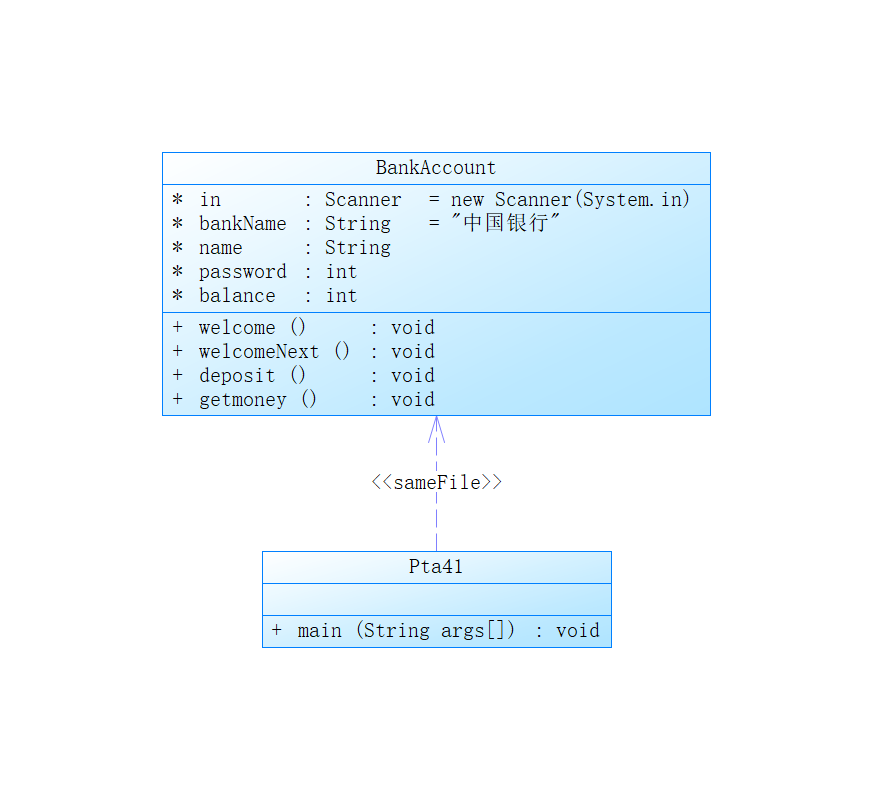
三:银行存取
(1):实现的功能很简单,主要在于封装造成数据不是很直接就能获取,除去这一点也没有什么困难的了
代码里面类与类之间关系也很简单,基本的依赖,组合关系,依赖为主
import java.util.Scanner;
public class Main
{

	public static void main(String[] args)
	{
		BankBusiness li = new BankBusiness();
		li.welcome();
		Scanner input = new Scanner(System.in);
		String name;
		int code;
		double num;
		name = input.next();
		code = input.nextInt();
		BankBusiness account = new BankBusiness(name,code);
		code = input.nextInt();
		num = input.nextInt();
		account.deposit(code,num);
        code = input.nextInt();
		num = input.nextInt();
		account.withdraw(code,num);
        code = input.nextInt();
		num = input.nextInt();
		account.withdraw(code,num);
        code = input.nextInt();
		num = input.nextInt();
		account.withdraw(code,num);
		account.welcomeNext();

		input.close();
	}

}

class BankBusiness
{
	public static String bankName;
	private String name;
	private int password;
	private double balance;

	public BankBusiness()
	{
		bankName = "中国银行";
		balance = 0;
	}
	public BankBusiness(String name,int code)//带参数构造
	{
		this.balance = 0;
		this.name = name;
		this.password = code;
	}
	public static void welcome()//欢迎
	{
		System.out.println(bankName+"欢迎您的到来!");

	}
	public  void deposit(int code,double num)//存款
	{
		if(code==this.password)
		{
			this.balance +=num;
			System.out.println("您的余额有"+this.balance+"元。");
		}
	}
	public void withdraw(int code,double num)//取款
	{
		if(this.password==code)
		{
			if(num>this.balance)
			{
				System.out.println("您的余额不足!");
			}
			else
			{
				this.balance-=num;
				System.out.println("请取走钞票,您的余额还有"+this.balance+"元。");
			}
		}
		else
			System.out.println("您的密码错误!");

	}
	public static void welcomeNext()//离开
	{
		System.out.println("请收好您的证件和物品,欢迎您下次光临!");
	}
}
2:期中考试
(1):根据类图写出相关代码,类图上面基本上写明白了需要我们去写的东西,而类图里面需要的东西,由于类分得很细致,里面几乎只是几个简单的赋值获取数字或者输出
import java.util.Scanner;
public class Main
{

	public static void main(String[] args)
	{
		Scanner input = new Scanner(System.in);
		Line l = new Line();
		Point a =  new Point();
		Point b =  new Point();
		double x1,x2,y1,y2;
		String str;
		x1 = input.nextDouble();
		y1 = input.nextDouble();
		x2 = input.nextDouble();
		y2 = input.nextDouble();
		str = input.next();
		l.setColor(str);
		a.setX(x1);
		a.setY(y1);
		l.setPoint1(a);
		b.setX(x2);
		b.setY(y2);
		l.setPoint2(b);
		l.display();
		input.close();

	}

}
class Point
{

	private double x;
	private double y;
	public Point()
	{

	}
	public Point(double x,double y)
	{
		this.x = x;
		this.y = y;

	}
	public double getX()
	{
		return this.x;
	}
	public void setX(double x)
	{
		if(x<=200&&x>0)
		this.x = x;
		else
		{
			System.out.println("Wrong Format");
			System.exit(0);
		}
	}
	public double getY()
	{
		return this.y;
	}
	public void setY(double y)
	{
		if(y<=200&&y>0)
			this.y = y;
			else
			{
				System.out.println("Wrong Format");
				System.exit(0);
			}
	}
	public void display()
	{
		System.out.printf("(%.2f,%.2f)\n",this.x,this.y);
	}

}
class Line
{
	private Point a;
	private Point b;
	private String color;
	public Line()
	{

	}
	public Line(Point a,Point b,String col)
	{

	}
	public Point getPoint1()
	{
		return this.a;
	}
	public void setPoint1(Point point1)
	{
		this.a = point1;
	}
	public Point getPoint2()
	{
		return this.b;
	}
	public void setPoint2(Point point2)
	{
		this.b = point2;
	}
	public String getColor()
	{
		return this.color;
	}
	public void setColor(String str)
	{
		this.color = str;
	}
	public double getDistance()
	{
		double x1,x2,y1,y2,s;
		x1 = this.a.getX();
		x2 = this.b.getX();
		y1 = this.a.getY();
		y2 = this.b.getY();
		s = Math.sqrt((x1-x2)*(x1-x2)+(y1-y2)*(y1-y2));
		return s;

	}
	public void display()
	{
		Line l = new Line();
		Point a = new Point();
		Point b = new Point();
		a = this.getPoint1();
		System.out.println("The line's color is:"+this.getColor());
		System.out.println("The line's begin point's Coordinate is:");
		a.display();
		b = this.getPoint2();
		System.out.println("The line's end point's Coordinate is:");
		b.display();
		System.out.print("The line's length is:");
		System.out.printf("%.2f\n",this.getDistance());
	}
}
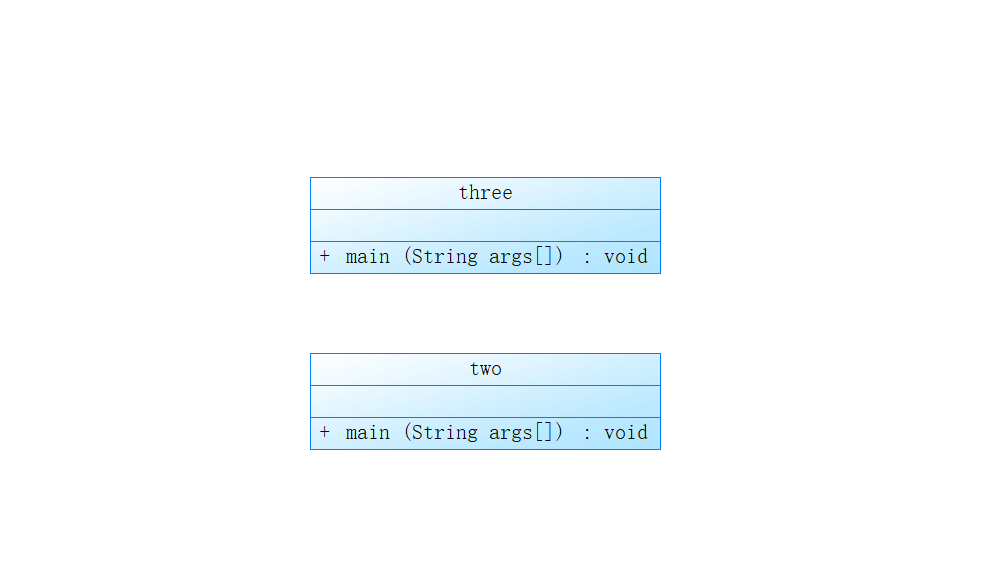
(2):第二题就相当于在第一题上面加上一个父类,源代码改动不多,父类实现的功能很少,基本会继承就会这个题目
import java.util.Scanner;
public class Main
{

	public static void main(String[] args)
	{
		Scanner input = new Scanner(System.in);
		Line l = new Line();
		Point a =  new Point();
		Point b =  new Point();
		Plane plane = new Plane();
		Element element = new Element();
		double x1,x2,y1,y2;
		String str;
		x1 = input.nextDouble();
		y1 = input.nextDouble();
		x2 = input.nextDouble();
		y2 = input.nextDouble();
		str = input.next();
		l.setColor(str);
		a.setX(x1);
		a.setY(y1);
		l.setPoint1(a);
		b.setX(x2);
		b.setY(y2);
		l.setPoint2(b);
		plane.setcolor(str);
	      element = a;//起点Point
	      element.display();

	      element = b;//终点Point
	      element.display();

	      element = l;//线段
	      element.display();

	      element = plane;//面
	      element.display();

//		l.display();
		input.close();

	}

}
class Point extends Element
{

	private double x;
	private double y;
	public Point()
	{

	}
	public Point(double x,double y)
	{
		this.x = x;
		this.y = y;

	}
	public double getX()
	{
		return this.x;
	}
	public void setX(double x)
	{
		if(x<=200&&x>0)
		this.x = x;
		else
		{
			System.out.println("Wrong Format");
			System.exit(0);
		}
	}
	public double getY()
	{
		return this.y;
	}
	public void setY(double y)
	{
		if(y<=200&&y>0)
			this.y = y;
			else
			{
				System.out.println("Wrong Format");
				System.exit(0);
			}
	}
	public void display()
	{
		System.out.printf("(%.2f,%.2f)\n",this.x,this.y);
	}

}
class Line extends Element
{
	private Point a;
	private Point b;
	private String color;
	public Line()
	{

	}
	public Line(Point a,Point b,String col)
	{

	}
	public Point getPoint1()
	{
		return this.a;
	}
	public void setPoint1(Point point1)
	{
		this.a = point1;
	}
	public Point getPoint2()
	{
		return this.b;
	}
	public void setPoint2(Point point2)
	{
		this.b = point2;
	}
	public String getColor()
	{
		return this.color;
	}
	public void setColor(String str)
	{
		this.color = str;
	}
	public double getDistance()
	{
		double x1,x2,y1,y2,s;
		x1 = this.a.getX();
		x2 = this.b.getX();
		y1 = this.a.getY();
		y2 = this.b.getY();
		s = Math.sqrt((x1-x2)*(x1-x2)+(y1-y2)*(y1-y2));
		return s;

	}
	public void display()
	{
		Line l = new Line();
		Point a = new Point();
		Point b = new Point();
		a = this.getPoint1();
		System.out.println("The line's color is:"+this.getColor());
		System.out.println("The line's begin point's Coordinate is:");
		a.display();
		b = this.getPoint2();
		System.out.println("The line's end point's Coordinate is:");
		b.display();
		System.out.print("The line's length is:");
		System.out.printf("%.2f\n",this.getDistance());
	}
}
class Element
{
	public void display()
	{

	}
}
class Plane extends Element
{
	String color;
	public Plane()
	{

	}
	public Plane(String str)
	{
		this.color = str;
	}
	public void setcolor(String str)
	{
		this.color  =str;
	}
	public String getcolor()
	{
		return this.color;
	}
	public void display()
	{
		System.out.println("The Plane's color is:"+this.color);
	}
}
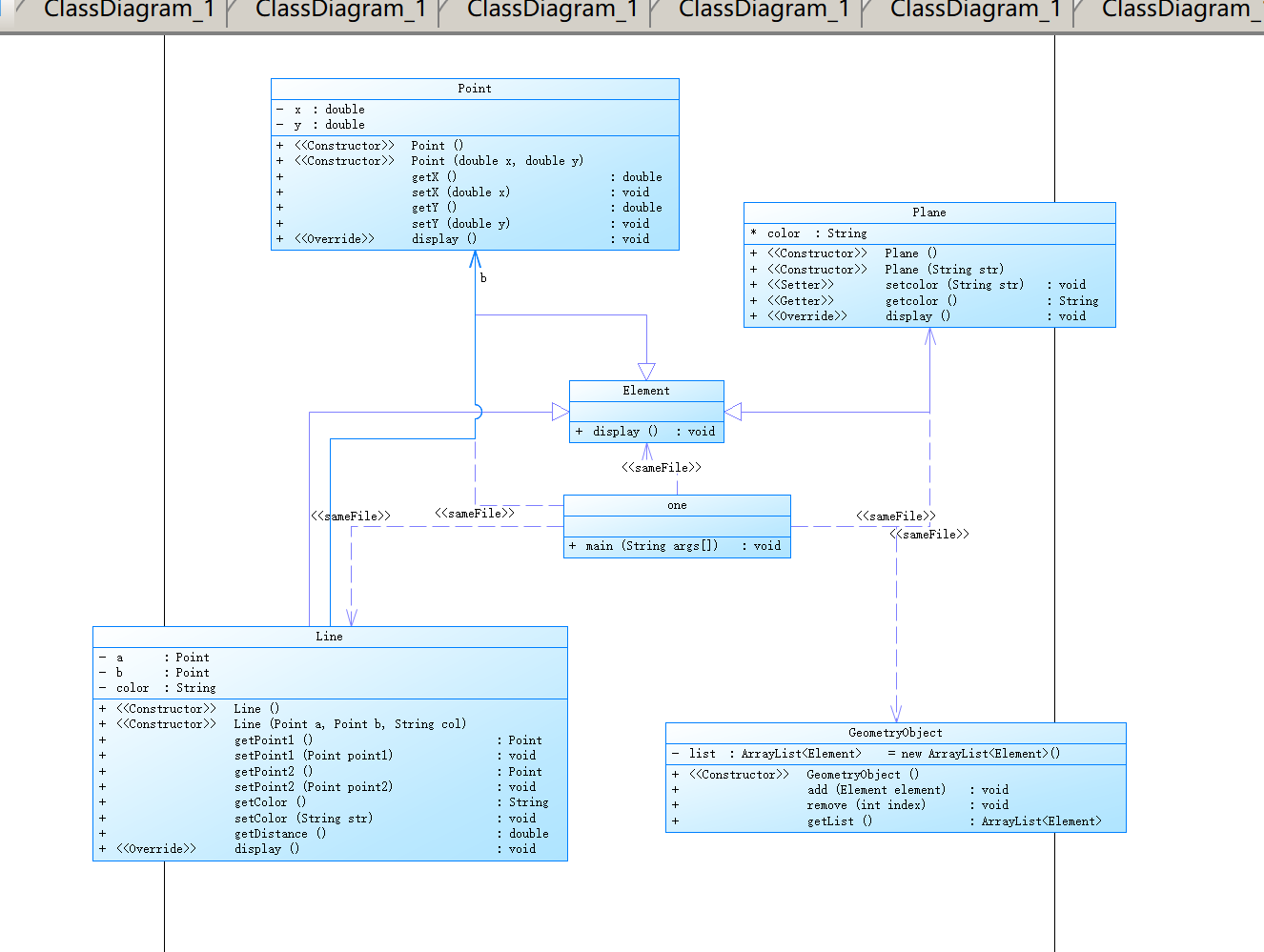
(3):使用到了容器,方便加入各种新的子类和父类,实现的功能是能不断地加入新的对象,很好的利用了容器的可扩展性,有效避免了数组的局限性或者说资源浪费
import java.util.Scanner;
import java.util.ArrayList;
public class Main
{

	public static void main(String[] args)
	{
		Scanner input = new Scanner(System.in);
		Line l = new Line();
		Point a =  new Point();
		Point b =  new Point();
		Plane plane = new Plane();
		Element element = new Element();
		double x1,x2,y1,y2;
		int choice;
		String str;
		GeometryObject m = new GeometryObject();


		l.setPoint1(a);

		l.setPoint2(b);

		   choice = input.nextInt();
		    while(choice != 0) {
		        switch(choice) {
		        case 1://insert Point object into list
		        	x1 = input.nextDouble();
		    		y1 = input.nextDouble();
		    		a.setX(x1);
		    		a.setY(y1);
		    		m.add(a);
		    		a.display();
		            break;
		        case 2://insert Line object into list
		        	x1 = input.nextDouble();
		    		y1 = input.nextDouble();
		    		x2 = input.nextDouble();
		    		y2 = input.nextDouble();
		    		a.setX(x1);
		    		a.setY(y1);
		    		b.setX(x2);
		    		b.setY(y2);
		    		str = input.next();
		    		l.setColor(str);
		    		m.add(l);
		    		l.display();
		            break;
		        case 3://insert Plane object into list
		        	str = input.next();
		        	plane.setcolor(str);
		        	m.add(plane);
		        	plane.display();
		            break;
		        case 4://delete index - 1 object from list
		            int index = input.nextInt();
		            m.remove(index-1);

		        }
		        choice = input.nextInt();
		    }

		input.close();

	}

}
class Point extends Element
{

	private double x;
	private double y;
	public Point()
	{

	}
	public Point(double x,double y)
	{
		this.x = x;
		this.y = y;

	}
	public double getX()
	{
		return this.x;
	}
	public void setX(double x)
	{
		if(x<=200&&x>0)
		this.x = x;
		else
		{
			System.out.println("Wrong Format");
			System.exit(0);
		}
	}
	public double getY()
	{
		return this.y;
	}
	public void setY(double y)
	{
		if(y<=200&&y>0)
			this.y = y;
			else
			{
				System.out.println("Wrong Format");
				System.exit(0);
			}
	}
	public void display()
	{
		System.out.printf("(%.2f,%.2f)\n",this.x,this.y);
	}

}
class Line extends Element
{
	private Point a;
	private Point b;
	private String color;
	public Line()
	{

	}
	public Line(Point a,Point b,String col)
	{

	}
	public Point getPoint1()
	{
		return this.a;
	}
	public void setPoint1(Point point1)
	{
		this.a = point1;
	}
	public Point getPoint2()
	{
		return this.b;
	}
	public void setPoint2(Point point2)
	{
		this.b = point2;
	}
	public String getColor()
	{
		return this.color;
	}
	public void setColor(String str)
	{
		this.color = str;
	}
	public double getDistance()
	{
		double x1,x2,y1,y2,s;
		x1 = this.a.getX();
		x2 = this.b.getX();
		y1 = this.a.getY();
		y2 = this.b.getY();
		s = Math.sqrt((x1-x2)*(x1-x2)+(y1-y2)*(y1-y2));
		return s;

	}
	public void display()
	{
		Line l = new Line();
		Point a = new Point();
		Point b = new Point();
		a = this.getPoint1();
		System.out.println("The line's color is:"+this.getColor());
		System.out.println("The line's begin point's Coordinate is:");
		a.display();
		b = this.getPoint2();
		System.out.println("The line's end point's Coordinate is:");
		b.display();
		System.out.print("The line's length is:");
		System.out.printf("%.2f\n",this.getDistance());
	}
}
class Element
{
	public void display()
	{

	}
}
class Plane extends Element
{
	String color;
	public Plane()
	{

	}
	public Plane(String str)
	{
		this.color = str;
	}
	public void setcolor(String str)
	{
		this.color  =str;
	}
	public String getcolor()
	{
		return this.color;
	}
	public void display()
	{
		System.out.println("The Plane's color is:"+this.color);
	}
}
class GeometryObject
{
	private ArrayList<Element> list =new ArrayList<Element>();
	public GeometryObject()
	{

	}
	public void add(Element element)
	{
		list.add(element);
	}
	public void remove(int index)
	{
		list.remove(index);
	}
	public ArrayList<Element> getList()
	{
		return list;
	}
}
三:踩坑心得
(1):点赋值时,由于有时是直接复制上一个点的代码,忘记修改坐标,造成结果不对,调试了好久才调试过来,造成效率低下,所以复制的代码要记得修改不同的地方
(2):输入多行时,虽然使用动态数组会更好,但是有明显输入结束标识时,可以采用循环,会使代码更加简单
(3):宁愿创建多个类,代码行数多一点,也不要在一个类里面一直判断,也不要在一个代码里面实现一个小功能,能单独拿出来就单独拿出来,不仅代码复杂度高了很多,复用性也很
差
(4):代码里面类的分工明确一点,一个方法就只实现一个功能,但是他里面可以调用其他代码,实现直接调用它就可以直接判断其他需要实现功能的可能,这样子代码就不会那么复
杂。例如:我需要判断是不是五边形,五边形的代码里面判断是不是四边形,四边形里面判断是不是三角形,如此深入调用,代码不复杂,后面也可以用来实现其他功能
(5):考虑浮点数舍去的后面的那一部分以及浮点数转化为整形时,防止造成误差。有时因为浮点数舍去部分数字,造成结果是2.9999999,转换成整型,变成了2,这个时候与原来真正
的便相差1,会对结果造成很大的影响
(6):注意临时变量的作用,有时采用临时变量,没有限制好范围,造成对临时变量修改时对原来变量修改了,结果不对,所以,能封装就封装,以免代码不小心被修改
(7):当开始一段很复杂的代码时,记得先思考,要不然会很没有头绪,到后面你会觉得这个功能刚刚可以实现,又会觉得这个代码有漏洞,造成代码全是bug
(8):要多些注释,要不然到了后面你都不知道你的这个方法写的是啥,传参以及传回值是什么,方法里面复杂点的当西也需要注释,万一出错可以知道自己当时想的是什么,比较容易
找到错误
四:改进建议
(1):每次尽力去完成需要的部分,就算觉得工程浩大,分开来慢慢来,也许没什么进展,但是慢慢积累就有了
(2):分工要明确,减少代码重复率,方法之间关系以及功能实现有点复杂,方法应该多改进改进
(3):多去网站上逛逛,搜索到一些原本就存在于软件基础上的,不需要自己在重新敲一遍
(4):多采用一些新的方法,例如继承和多态巩固知识
(5):多去看看优秀的的代码,看看自己在代码书写上有什么不对或者不好的习惯,早点改掉
五:总结
(1):学习了继承和多态,在大作业里没有实现,之前的实验有部分实现了,但是有发现自己不熟悉
(2):四边形和五边形代码准确率变高了,之前可能出现判断错误,这一次换了方法,发现明显提高了,感觉还不错
(3):会写注释,会让方法之间分工比较明确,但是需要继续改进
(4):作业出出别的系列吧,这个系列了太难了,不会的还是不会,会的早就学会了,其他的倒是没啥

 浙公网安备 33010602011771号