实验四
实验任务五cpp
#include <iostream>
#include "vectorInt.hpp"

void test() {
    using namespace std;

    int n;
    cin >> n;

    vectorInt x1(n);
    for (auto i = 0; i < n; ++i)
        x1.at(i) = i * i;

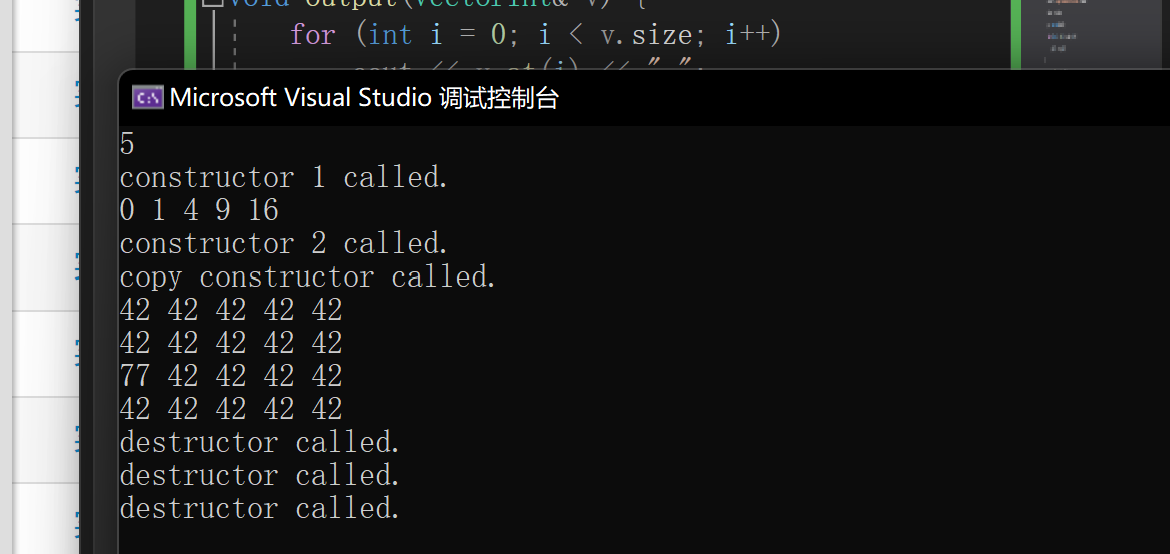
    output(x1);

    vectorInt x2(n, 42);
    vectorInt x3(x2);

    output(x2);
    output(x3);

    x2.at(0) = 77;

    output(x2);
    output(x3);
}

int main() {
    test();
}
hpp
#pragma once
using namespace std;
class vectorInt {
public:
    vectorInt(int n);
    vectorInt(int n, int value);
    vectorInt(const vectorInt& v0);
    ~vectorInt();
    int& at(int n);
    int get_size();
    friend void output(vectorInt& v);
private:
    int size;
    int* p;
};
vectorInt::vectorInt(int n0) {
    cout << "constructor 1 called."<<endl;
    size = n0;
    p = new int[n0];
}
vectorInt::vectorInt(int n0, int value) {
    cout << "constructor 2 called."<<endl;
    size = n0;
    p = new int[n0];
    for (int i = 0; i < n0; i++)
        p[i] = value;
}
vectorInt::vectorInt(const vectorInt& v0) {
    cout << "copy constructor called."<<endl;
    size = v0.size;
    p = new int[size];
    for (int i = 0; i < size; i++)
        p[i] = v0.p[i];
}
vectorInt::~vectorInt() {
    cout << "destructor called."<<endl;
}
int& vectorInt::at(int n) {
    int
    assert(n >= 0 && n < size);
    return p[n];
}
int vectorInt::get_size() {
    return size;
}
void output(vectorInt& v) {
    for (int i = 0; i < v.size; i++)
        cout << v.at(i) << " ";
    cout << endl;
}
实验任务6cpp
#include <iostream>
#include "matrix.hpp"
int main()
{
	using namespace std;
	double x[] = { 1, 2, 3, 4, 5, 6 };
	Matrix m1(3, 2); // 创建一个3×2的矩阵
	m1.set(x);		 // 用一维数组x的值按行为矩阵m1赋值
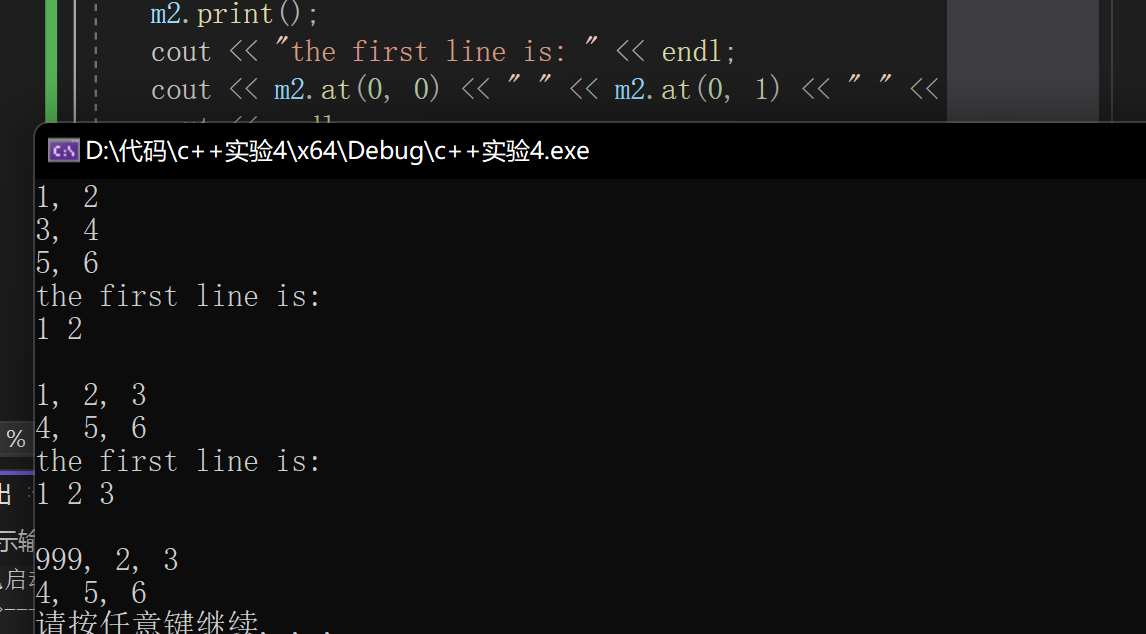
	m1.print();		 // 打印矩阵m1的值
	cout << "the first line is: " << endl;
	cout << m1.at(0, 0) << " " << m1.at(0, 1) << endl; // 输出矩阵m1第1行两个元素的值
	cout << endl;
	Matrix m2(2, 3);
	m2.set(x);
	m2.print();
	cout << "the first line is: " << endl;
	cout << m2.at(0, 0) << " " << m2.at(0, 1) << " " << m2.at(0, 2) << endl;
	cout << endl;
	Matrix m3(m2);	   // 用矩阵m2构造新的矩阵m3
	m3.set(0, 0, 999); // 将矩阵m3第0行第0列元素值设为999
	m3.print();
	system("pause");
}
Matrix.hpp
#pragma once
#include <iostream>
using std::count;
using std::endl;

class Matrix
{
public:
	Matrix(int n);					   // 构造函数,构造一个n*n的矩阵
	Matrix(int n, int m);			   // 构造函数,构造一个n*m的矩阵
	Matrix(const Matrix& X);		   // 复制构造函数,使用已有的矩阵X构造
	~Matrix();						   //析构函数
	void set(const double* pvalue);	   // 用pvalue指向的连续内存块数据按行为矩阵赋值
	void set(int i, int j, int value); //设置矩阵第i行第j列元素值为value
	double& at(int i, int j);		   //返回矩阵第i行第j列元素的引用
	double at(int i, int j) const;	   // 返回矩阵第i行第j列元素的值
	int get_lines() const;			   //返回矩阵行数
	int get_cols() const;			   //返回矩列数
	void print() const;				   // 按行打印输出矩阵
private:
	int lines; // 矩阵行数
	int cols;  // 矩阵列数
	double* p; // 指向存放矩阵数据的内存块的首地址
};
// 类Matrix的实现:待补足
// ×××
Matrix::Matrix(int n) : Matrix(n, n)
{
}
Matrix::Matrix(int n, int m)
{
	lines = n;
	cols = m;
	p = new double[lines * cols];
}
Matrix::Matrix(const Matrix& x)
{
	lines = x.lines;
	cols = x.cols;
	p = new double[lines * cols];
	for (int i = 0; i < cols * lines; i++)
	{
		p[i] = x.p[i];
	}
}
Matrix::~Matrix()
{
	delete[] p;
}

void Matrix::set(const double* pvalue)
{
	for (int i = 0; i < lines * cols; i++) {
		p[i] = pvalue[i];
	}
}
void Matrix::set(int i, int j, int value)
{
	p[i * cols + j] = value;
}
double& Matrix::at(int i, int j)
{
	return p[i * cols + j];
}
double Matrix::at(int i, int j) const
{
	return p[i * cols + j];
}
int Matrix::get_lines() const
{
	return lines;
}
int Matrix::get_cols() const
{
	return cols;
}
void Matrix::print() const
{
	for (int i = 0; i < lines; i++) {
		for (int j = 0; j < cols; j++) {
			std::cout << p[i * cols + j] << ", ";
		}
		std::cout << "\b\b \n";
	}
}
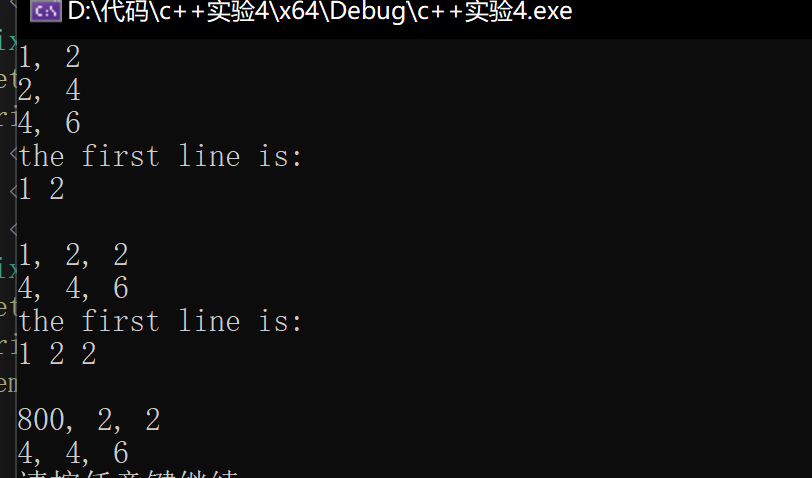
修改数据后

 浙公网安备 33010602011771号