PYTORCH 卷积神经网络+CIFAR10数据分类+用VGG16对CIFAR10分类(代码练习)
一、卷积神经网


import torch
import torch.nn as nn
import torch.nn.functional as F
import torch.optim as optim
from torchvision import datasets, transforms
import matplotlib.pyplot as plt
import numpy

# 一个函数,用来计算模型中有多少参数
def get_n_params(model):
    np=0
    for p in list(model.parameters()):
        np += p.nelement()
    return np

# 使用GPU训练,可以在菜单 "代码执行工具" -> "更改运行时类型" 里进行设置
device = torch.device("cuda:0" if torch.cuda.is_available() else "cpu")
深度神经网络特性:
- 很多层: compositionality
- 卷积: locality + stationarity of images
- 池化: Invariance of object class to translations
1.加载数据(MNIST)
 1 input_size  = 28*28   # MNIST上的图像尺寸是 28x28
 2 output_size = 10      # 类别为 0 到 9 的数字,因此为十类
 3
 4 train_loader = torch.utils.data.DataLoader(
 5     datasets.MNIST('./data', train=True, download=True,
 6         transform=transforms.Compose(
 7             [transforms.ToTensor(),
 8              transforms.Normalize((0.1307,), (0.3081,))])),
 9     batch_size=64, shuffle=True)
10
11 test_loader = torch.utils.data.DataLoader(
12     datasets.MNIST('./data', train=False, transform=transforms.Compose([
13              transforms.ToTensor(),
14              transforms.Normalize((0.1307,), (0.3081,))])),
15     batch_size=1000, shuffle=True)
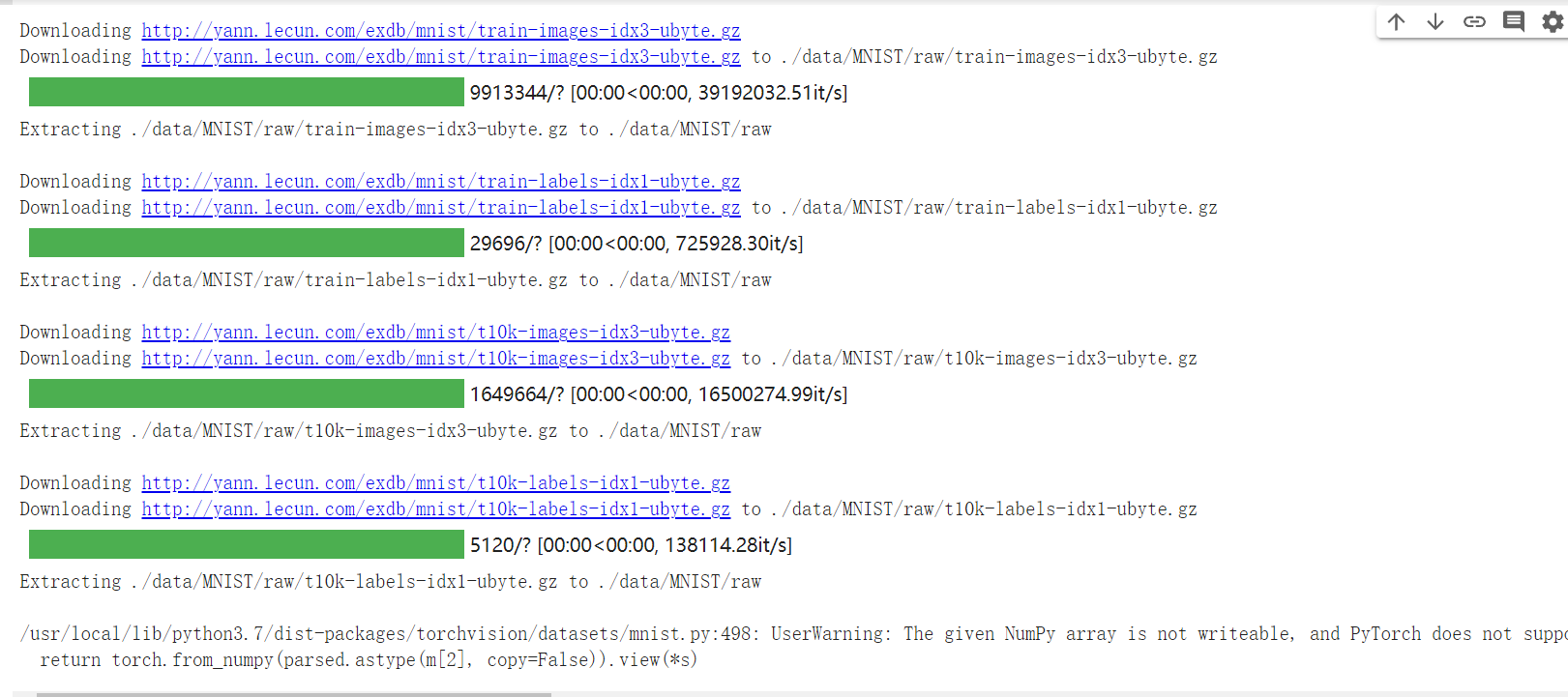
显示数据集中的部分图像
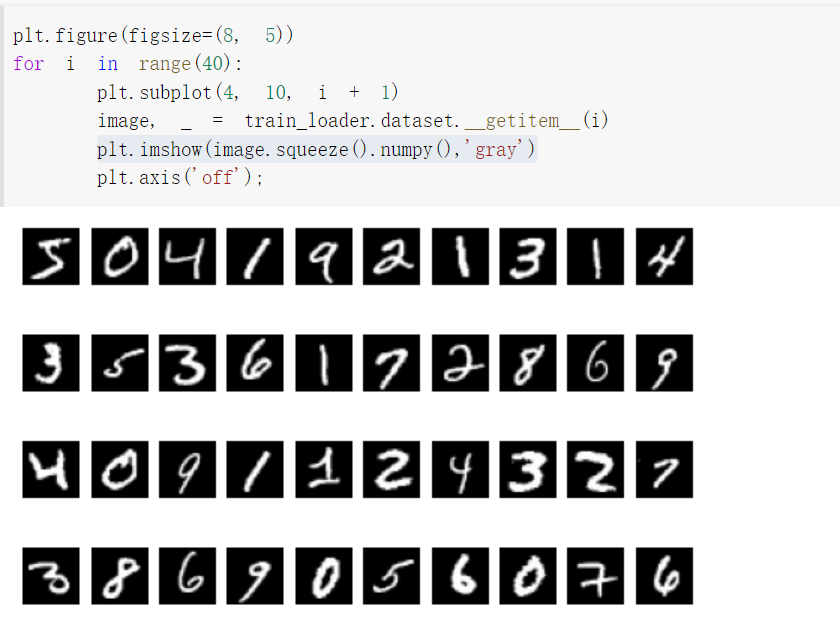
plt.figure(figsize=(8, 5))表示figure的长、宽(单位inch)
plt.imshow(image.squeeze().numpy(),'gray')gray取灰度图。

2.创建网络
定义网络时,需要继承nn.Module,并实现它的forward方法,把网络中具有可学习参数的层放在构造函数init中。
只要在nn.Module的子类中定义了forward函数,backward函数就会自动被实现(利用autograd)。
 1 class FC2Layer(nn.Module):
 2     def __init__(self, input_size, n_hidden, output_size):
 3         # nn.Module子类的函数必须在构造函数中执行父类的构造函数
 4         # 下式等价于nn.Module.__init__(self)
 5         super(FC2Layer, self).__init__()
 6         self.input_size = input_size
 7         # 这里直接用 Sequential 就定义了网络,注意要和下面 CNN 的代码区分开
 8         self.network = nn.Sequential(
 9             nn.Linear(input_size, n_hidden),
10             nn.ReLU(),
11             nn.Linear(n_hidden, n_hidden),
12             nn.ReLU(),
13             nn.Linear(n_hidden, output_size),
14             nn.LogSoftmax(dim=1)
15         )
16     def forward(self, x):
17         # view一般出现在model类的forward函数中,用于改变输入或输出的形状
18         # x.view(-1, self.input_size) 的意思是多维的数据展成二维
19         # 代码指定二维数据的列数为 input_size=784,行数 -1 表示我们不想算,电脑会自己计算对应的数字
20         # 在 DataLoader 部分,我们可以看到 batch_size 是64,所以得到 x 的行数是64
21         # 大家可以加一行代码:print(x.cpu().numpy().shape)
22         # 训练过程中,就会看到 (64, 784) 的输出,和我们的预期是一致的
23
24         # forward 函数的作用是,指定网络的运行过程,这个全连接网络可能看不啥意义,
25         # 下面的CNN网络可以看出 forward 的作用。
26         x = x.view(-1, self.input_size)
27         return self.network(x)
28
29
30
31 class CNN(nn.Module):
32     def __init__(self, input_size, n_feature, output_size):
33         # 执行父类的构造函数,所有的网络都要这么写
34         super(CNN, self).__init__()
35         # 下面是网络里典型结构的一些定义,一般就是卷积和全连接
36         # 池化、ReLU一类的不用在这里定义
37         self.n_feature = n_feature
38         self.conv1 = nn.Conv2d(in_channels=1, out_channels=n_feature, kernel_size=5)
39         self.conv2 = nn.Conv2d(n_feature, n_feature, kernel_size=5)
40         self.fc1 = nn.Linear(n_feature*4*4, 50)
41         self.fc2 = nn.Linear(50, 10)
42
43     # 下面的 forward 函数,定义了网络的结构,按照一定顺序,把上面构建的一些结构组织起来
44     # 意思就是,conv1, conv2 等等的,可以多次重用
45     def forward(self, x, verbose=False):
46         x = self.conv1(x)
47         x = F.relu(x)
48         x = F.max_pool2d(x, kernel_size=2)
49         x = self.conv2(x)
50         x = F.relu(x)
51         x = F.max_pool2d(x, kernel_size=2)
52         x = x.view(-1, self.n_feature*4*4)
53         x = self.fc1(x)
54         x = F.relu(x)
55         x = self.fc2(x)
56         x = F.log_softmax(x, dim=1)
57         return x
 1 def train(model):
 2     model.train()
 3     # 主里从train_loader里,64个样本一个batch为单位提取样本进行训练
 4     for batch_idx, (data, target) in enumerate(train_loader):
 5         # 把数据送到GPU中
 6         data, target = data.to(device), target.to(device)
 7
 8         optimizer.zero_grad()
 9         output = model(data)
10         loss = F.nll_loss(output, target)
11         loss.backward()
12         optimizer.step()
13         if batch_idx % 100 == 0:
14             print('Train: [{}/{} ({:.0f}%)]\tLoss: {:.6f}'.format(
15                 batch_idx * len(data), len(train_loader.dataset),
16                 100. * batch_idx / len(train_loader), loss.item()))
17
18
19 def test(model):
20     model.eval()
21     test_loss = 0
22     correct = 0
23     for data, target in test_loader:
24         # 把数据送到GPU中
25         data, target = data.to(device), target.to(device)
26         # 把数据送入模型,得到预测结果
27         output = model(data)
28         # 计算本次batch的损失,并加到 test_loss 中
29         test_loss += F.nll_loss(output, target, reduction='sum').item()
30         # get the index of the max log-probability,最后一层输出10个数,
31         # 值最大的那个即对应着分类结果,然后把分类结果保存在 pred 里
32         pred = output.data.max(1, keepdim=True)[1]
33         # 将 pred 与 target 相比,得到正确预测结果的数量,并加到 correct 中
34         # 这里需要注意一下 view_as ,意思是把 target 变成维度和 pred 一样的意思
35         correct += pred.eq(target.data.view_as(pred)).cpu().sum().item()
36
37     test_loss /= len(test_loader.dataset)
38     accuracy = 100. * correct / len(test_loader.dataset)
39     print('\nTest set: Average loss: {:.4f}, Accuracy: {}/{} ({:.0f}%)\n'.format(
40         test_loss, correct, len(test_loader.dataset),
41         accuracy))
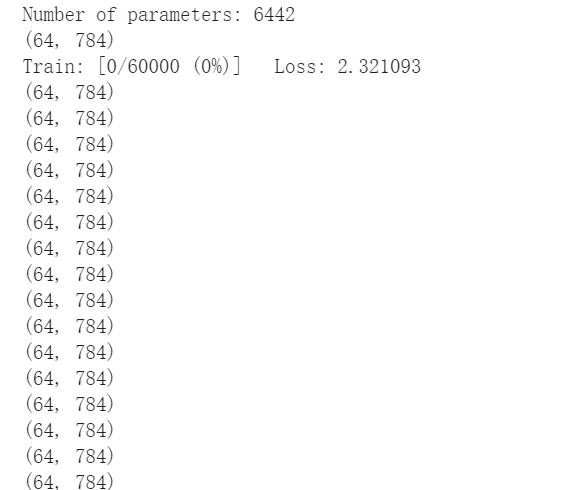
加入print(x.cpu().numpy().shape)出现(64,784)
去掉print(x.cpu().numpy().shape)后
![]()
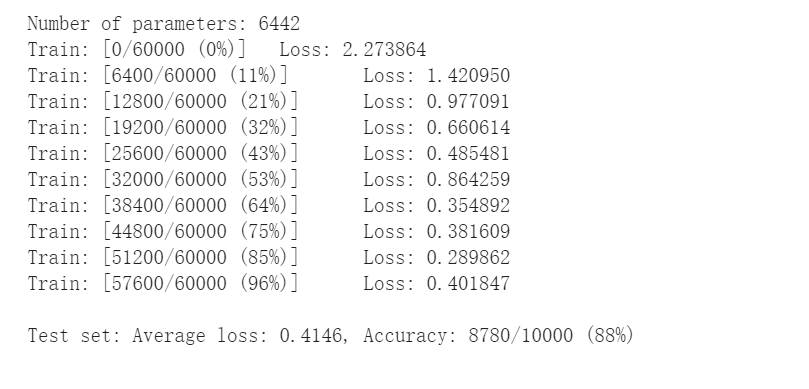
3.在小型全连接网络上训练(Fully-connected network)
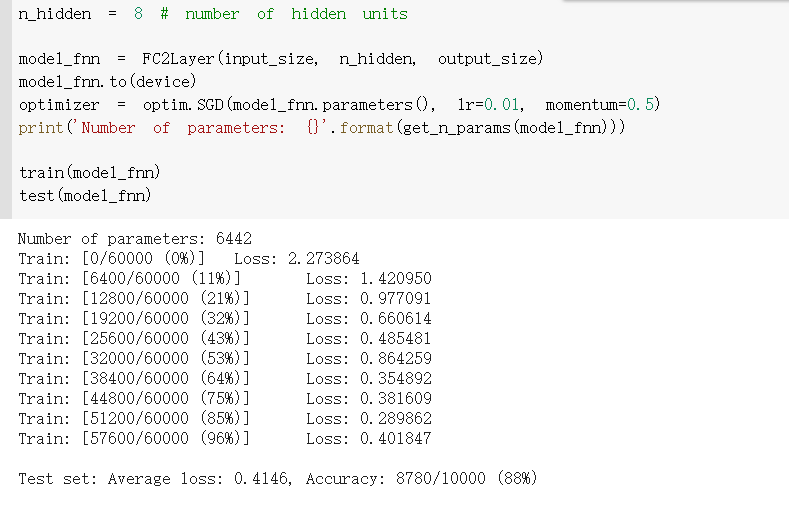
4.在卷积神经网络上训练
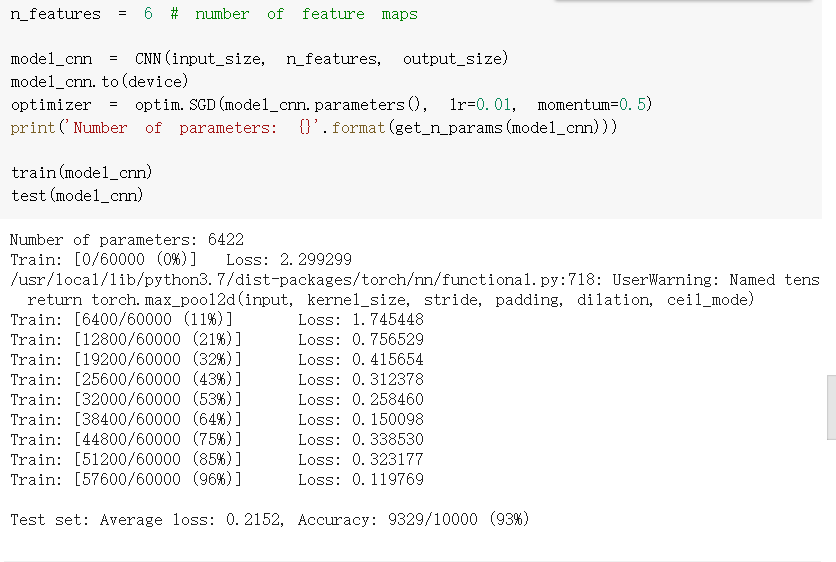
通过上面的测试结果发现,含有相同参数的 CNN 效果要明显优于简单的全连接网络,是因为 CNN 能够通过卷积和池化更好的挖掘图像中的信息
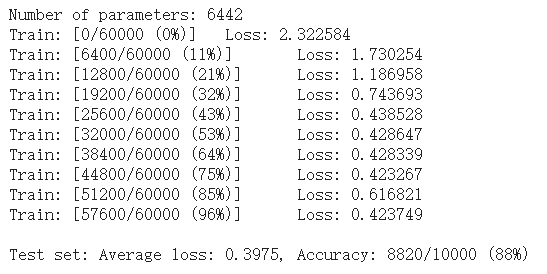
5. 打乱像素顺序再次在两个网络上训练与测试
下面代码展示随机打乱像素顺序后,图像的形态:
 1 # 这里解释一下 torch.randperm 函数,给定参数n,返回一个从0到n-1的随机整数排列
 2 perm = torch.randperm(784)
 3 plt.figure(figsize=(8, 4))
 4 for i in range(10):
 5     image, _ = train_loader.dataset.__getitem__(i)
 6     # permute pixels
 7     image_perm = image.view(-1, 28*28).clone()
 8     image_perm = image_perm[:, perm]
 9     image_perm = image_perm.view(-1, 1, 28, 28)
10     plt.subplot(4, 5, i + 1)
11     plt.imshow(image.squeeze().numpy(), 'gray')
12     plt.axis('off')
13     plt.subplot(4, 5, i + 11)
14     plt.imshow(image_perm.squeeze().numpy(), 'gray')
15     plt.axis('off')
 1 # 对每个 batch 里的数据,打乱像素顺序的函数
 2 def perm_pixel(data, perm):
 3     # 转化为二维矩阵
 4     data_new = data.view(-1, 28*28)
 5     # 打乱像素顺序
 6     data_new = data_new[:, perm]
 7     # 恢复为原来4维的 tensor
 8     data_new = data_new.view(-1, 1, 28, 28)
 9     return data_new
10
11 # 训练函数
12 def train_perm(model, perm):
13     model.train()
14     for batch_idx, (data, target) in enumerate(train_loader):
15         data, target = data.to(device), target.to(device)
16         # 像素打乱顺序
17         data = perm_pixel(data, perm)
18
19         optimizer.zero_grad()
20         output = model(data)
21         loss = F.nll_loss(output, target)
22         loss.backward()
23         optimizer.step()
24         if batch_idx % 100 == 0:
25             print('Train: [{}/{} ({:.0f}%)]\tLoss: {:.6f}'.format(
26                 batch_idx * len(data), len(train_loader.dataset),
27                 100. * batch_idx / len(train_loader), loss.item()))
28
29 # 测试函数
30 def test_perm(model, perm):
31     model.eval()
32     test_loss = 0
33     correct = 0
34     for data, target in test_loader:
35         data, target = data.to(device), target.to(device)
36
37         # 像素打乱顺序
38         data = perm_pixel(data, perm)
39
40         output = model(data)
41         test_loss += F.nll_loss(output, target, reduction='sum').item()
42         pred = output.data.max(1, keepdim=True)[1]
43         correct += pred.eq(target.data.view_as(pred)).cpu().sum().item()
44
45     test_loss /= len(test_loader.dataset)
46     accuracy = 100. * correct / len(test_loader.dataset)
47     print('\nTest set: Average loss: {:.4f}, Accuracy: {}/{} ({:.0f}%)\n'.format(
48         test_loss, correct, len(test_loader.dataset),
49         accuracy))
 1 perm = torch.randperm(784)
 2 n_hidden = 8 # number of hidden units
 3
 4 model_fnn = FC2Layer(input_size, n_hidden, output_size)
 5 model_fnn.to(device)
 6 optimizer = optim.SGD(model_fnn.parameters(), lr=0.01, momentum=0.5)
 7 print('Number of parameters: {}'.format(get_n_params(model_fnn)))
 8
 9 train_perm(model_fnn, perm)
10 test_perm(model_fnn, perm)
 1 perm = torch.randperm(784)
 2 n_features = 6 # number of feature maps
 3
 4 model_cnn = CNN(input_size, n_features, output_size)
 5 model_cnn.to(device)
 6 optimizer = optim.SGD(model_cnn.parameters(), lr=0.01, momentum=0.5)
 7 print('Number of parameters: {}'.format(get_n_params(model_cnn)))
 8
 9 train_perm(model_cnn, perm)
10 test_perm(model_cnn, perm)
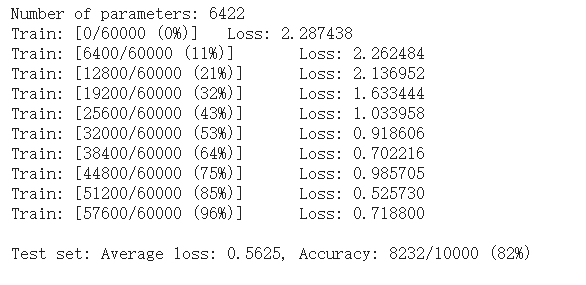
从打乱像素顺序的实验结果来看,全连接网络的性能基本上没有发生变化,但是 卷积神经网络的性能明显下降。
这是因为对于卷积神经网络,会利用像素的局部关系,但是打乱顺序以后,这些像素间的关系将无法得到利用。
二、CIFAR10数据分类
input[channel] = (input[channel] - mean[channel]) / std[channel]
 1 import torch
 2 import torchvision
 3 import torchvision.transforms as transforms
 4 import matplotlib.pyplot as plt
 5 import numpy as np
 6 import torch.nn as nn
 7 import torch.nn.functional as F
 8 import torch.optim as optim
 9
10 # 使用GPU训练,可以在菜单 "代码执行工具" -> "更改运行时类型" 里进行设置
11 device = torch.device("cuda:0" if torch.cuda.is_available() else "cpu")
12
13 transform = transforms.Compose(
14     [transforms.ToTensor(),
15      transforms.Normalize((0.5, 0.5, 0.5), (0.5, 0.5, 0.5))])
16
17 # 注意下面代码中:训练的 shuffle 是 True,测试的 shuffle 是 false
18 # 训练时可以打乱顺序增加多样性,测试是没有必要
19 trainset = torchvision.datasets.CIFAR10(root='./data', train=True,
20                                         download=True, transform=transform)
21 trainloader = torch.utils.data.DataLoader(trainset, batch_size=64,
22                                           shuffle=True, num_workers=2)
23
24 testset = torchvision.datasets.CIFAR10(root='./data', train=False,
25                                        download=True, transform=transform)
26 testloader = torch.utils.data.DataLoader(testset, batch_size=8,
27                                          shuffle=False, num_workers=2)
28
29 classes = ('plane', 'car', 'bird', 'cat',
30            'deer', 'dog', 'frog', 'horse', 'ship', 'truck')
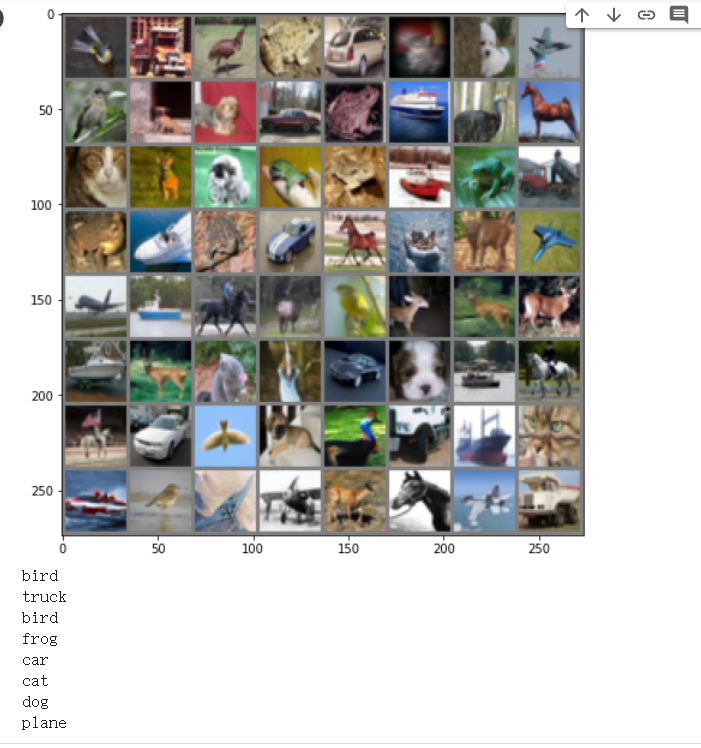
 1 def imshow(img):
 2     plt.figure(figsize=(8,8))
 3     img = img / 2 + 0.5     # 转换到 [0,1] 之间
 4     npimg = img.numpy()
 5     plt.imshow(np.transpose(npimg, (1, 2, 0)))
 6     plt.show()
 7
 8 # 得到一组图像
 9 images, labels = iter(trainloader).next()
10 # 展示图像
11 imshow(torchvision.utils.make_grid(images))
12 # 展示第一行图像的标签
13 for j in range(8):
14     print(classes[labels[j]])
 1 class Net(nn.Module):
 2     def __init__(self):
 3         super(Net, self).__init__()
 4         self.conv1 = nn.Conv2d(3, 6, 5)
 5         self.pool = nn.MaxPool2d(2, 2)
 6         self.conv2 = nn.Conv2d(6, 16, 5)
 7         self.fc1 = nn.Linear(16 * 5 * 5, 120)
 8         self.fc2 = nn.Linear(120, 84)
 9         self.fc3 = nn.Linear(84, 10)
10
11     def forward(self, x):
12         x = self.pool(F.relu(self.conv1(x)))
13         x = self.pool(F.relu(self.conv2(x)))
14         x = x.view(-1, 16 * 5 * 5)
15         x = F.relu(self.fc1(x))
16         x = F.relu(self.fc2(x))
17         x = self.fc3(x)
18         return x
19
20 # 网络放到GPU上
21 net = Net().to(device)
22 criterion = nn.CrossEntropyLoss()
23 optimizer = optim.Adam(net.parameters(), lr=0.001)
 1 for epoch in range(10):  # 重复多轮训练
 2     for i, (inputs, labels) in enumerate(trainloader):
 3         inputs = inputs.to(device)
 4         labels = labels.to(device)
 5         # 优化器梯度归零
 6         optimizer.zero_grad()
 7         # 正向传播 + 反向传播 + 优化
 8         outputs = net(inputs)
 9         loss = criterion(outputs, labels)
10         loss.backward()
11         optimizer.step()
12         # 输出统计信息
13         if i % 100 == 0:
14             print('Epoch: %d Minibatch: %5d loss: %.3f' %(epoch + 1, i + 1, loss.item()))
15
16 print('Finished Training')
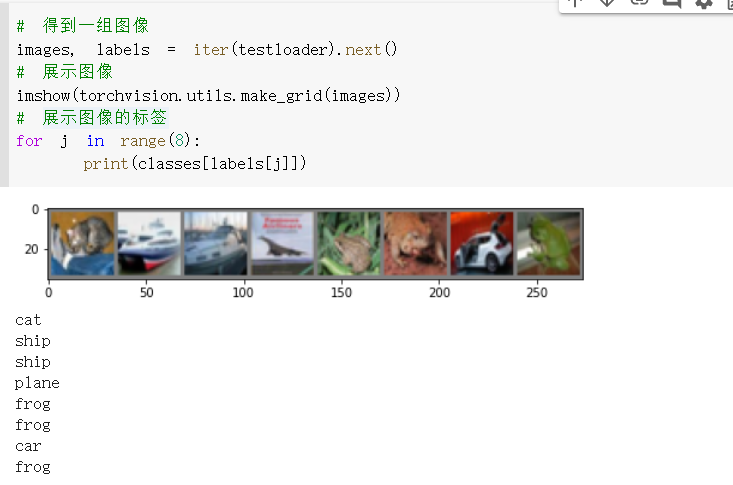
测试集中取八张图
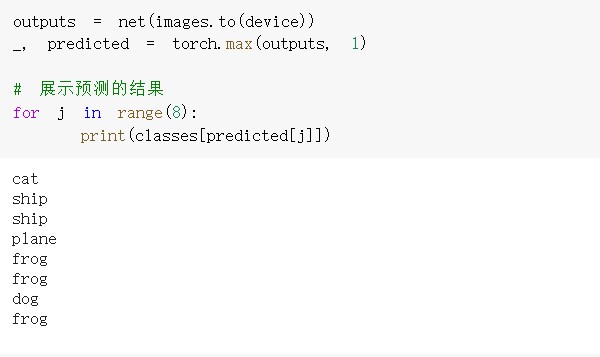
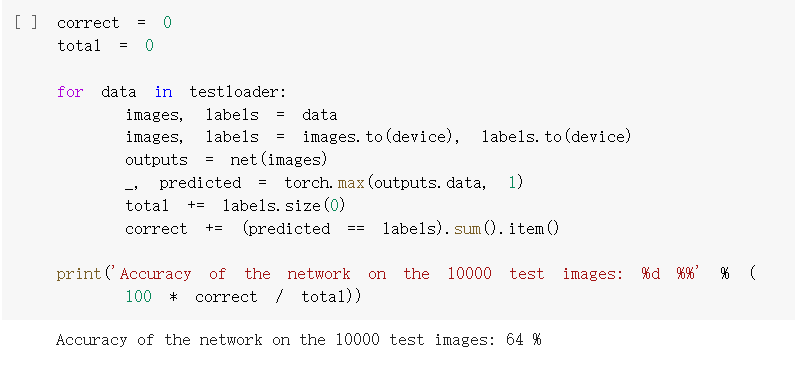
准确率64%
三、使用 VGG16 对 CIFAR10 分类
1.定义dataloader
 2.
2.
 1 cfg = [64, 'M', 128, 'M', 256, 256, 'M', 512, 512, 'M', 512, 512, 'M']
 2 class VGG(nn.Module):
 3     def __init__(self):
 4         super(VGG, self).__init__()
 5         #self.cfg = [64, 'M', 128, 'M', 256, 256, 'M', 512, 512, 'M', 512, 512, 'M']
 6         self.features = self._make_layers(cfg)
 7         #self.classifier = nn.Linear(2048, 10)
 8         self.classifier = nn.Linear(512, 10)
 9
10     def forward(self, x):
11         out = self.features(x)
12         out = out.view(out.size(0), -1)
13         out = self.classifier(out)
14         return out
15
16     def _make_layers(self, cfg):
17         layers = []
18         in_channels = 3
19         for x in cfg:
20             if x == 'M':
21                 layers += [nn.MaxPool2d(kernel_size=2, stride=2)]
22             else:
23                 layers += [nn.Conv2d(in_channels, x, kernel_size=3, padding=1),
24                            nn.BatchNorm2d(x),
25                            nn.ReLU(inplace=True)]
26                 in_channels = x
27         layers += [nn.AvgPool2d(kernel_size=1, stride=1)]
28         return nn.Sequential(*layers)
1 net = VGG().to(device)
2 criterion = nn.CrossEntropyLoss()
3 optimizer = optim.Adam(net.parameters(), lr=0.001)
3.
 1 for epoch in range(10):  # 重复多轮训练
 2     for i, (inputs, labels) in enumerate(trainloader):
 3         inputs = inputs.to(device)
 4         labels = labels.to(device)
 5         # 优化器梯度归零
 6         optimizer.zero_grad()
 7         # 正向传播 + 反向传播 + 优化
 8         outputs = net(inputs)
 9         loss = criterion(outputs, labels)
10         loss.backward()
11         optimizer.step()
12         # 输出统计信息
13         if i % 100 == 0:
14             print('Epoch: %d Minibatch: %5d loss: %.3f' %(epoch + 1, i + 1, loss.item()))
15
16 print('Finished Training')
4.测试验证准确率
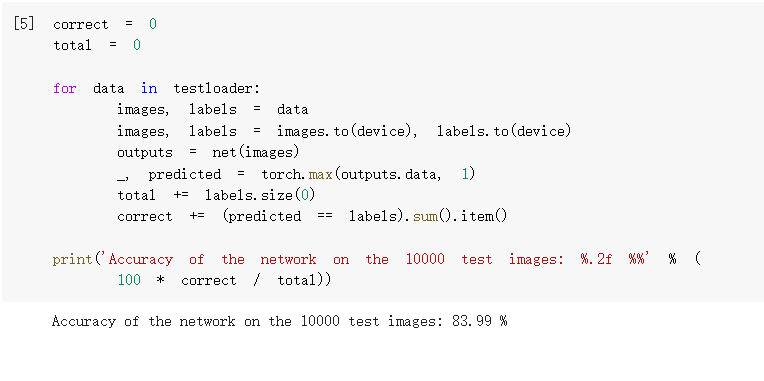
准确率为83.99%,相较之前有所提升。

 浙公网安备 33010602011771号