day1-6内置函数。
内置函数:
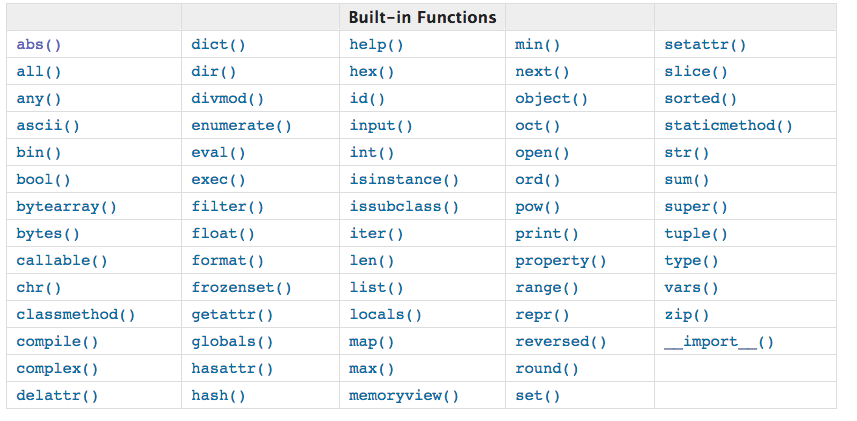
# all()   如果可迭代对象里面都为真则为True,如果有一个为假就为False
#非0为真,0为假。
a = all([0,5])
print(a)

# any()   如果可迭代对象里面都为假则为False,如果其中一个为真就为True
a1 = any([0,6])
print(a1)

#ascii()   将列表变为字符串的形式。
a = ascii([1,2,"开外挂"])
print(type(a))
print([a])

#bin()   十进制转二进制
print(bin(25))

#bool()  判断真假
print(bool())           #False
print(bool(0))          #False
print(bool(1))          #True
print(bool(2))          #True
print(bool([]))         #False
print(bool([1]))        #True


#bytearray()       二进制数组  将字符串变为数组的格式,可以修改。
a = bytes("abcde",encoding="utf-8")
print(a.capitalize(),a)
print(type(a))
#从上面可以看出字符串是不能修改,只能创建一个新的。


#下面通过bytearray() 将字符串变为数组的格式让二进制可以修改。
b = bytearray("abcde",encoding="utf-8")
print(type(b))
print(b)
print(b[1])
b[1] = 50
print(b)

#callable()  判断是否可以调用,后面可以加上()的就可以调用  可以调用的有函数和类
def test():pass
print(callable(test))        #返回True,函数可以调用
print(callable([]))          #返回False,列表不可调用


#chr()   ascii码表  数字--->字符
print(chr(97))      #返回 a,


#ord()    ascii码表   字符---->数字
print(ord("a"))

#classmethod()


#compile()    用于把代码进行编译的过程,  解释:将字符串转换为命令执行
code = "for i in range(10):print(i)"
c = compile(code,"","exec")
exec(c)

# 或者直接使用exec(code)实现将字符串转换为命令执行。
exec(code)
code1 = "1+3/2*6"
c1 = compile(code1,"","eval")
print(eval(c1))

#delattr()  以后讲


#dict()    生成字典
# 两种字典生成方式:
#                  1、dict()
#                  2、{}


# dir()    查看 使用方法即命令。
a = {}
print(dir(a))

# divmod()      #返回两个数相除的商和余数。
print(divmod(5,2))     #返回(2,1)


# enumerate()     遍历列表
list1=["这","是","一个","测试"]
for index,item in enumerate(list1,1):
    print(index,item)

#eval()  将字符串变为字典  将加减乘除算法转换为字典。


#exec()   将字符串转换为字典执行,


#filter()
def sayhi(n):
    print(n)
sayhi(3)

#匿名函数lambda实现上面sayhi函数的功能。  匿名函数只能实现三元运算。
calc = lambda n:print(n)
calc(5)

#在0-10之间将大于5的过滤出来。
res = filter(lambda n:n>5,range(10))
for i in res:
    print(i)

#map()  将传入的每个值按照一种方式处理。 现在按n*2处理
res1 = map(lambda n:n*2,range(10))     # 等同于 i*2 for i in range(10)
for i in res1:
    print(i)

#reduce()  需要调用functools工具,相加或者相乘等。
#利用reduce,实现0+1+2...+10
import functools
res2 = functools.reduce(lambda x,y:x+y,range(10))
print(res2)      #返回45 从0加到10,依次相加


#利用reduce,将从1一直乘到10. 1x2x3...x10
res3 = functools.reduce(lambda x,y:x*y,range(1,10))
print(res3)

# float()   转换为浮点数
print(float(10))

# format()


# frozenset()  不可变集合  a集合就有pop功能,a1就没有pop功能了。
a = set([1,2,444,44,55,44,12,4])
a.pop()
a1 = frozenset([1,2,444,44,55,44,12,4])

#getattr()   面向对象的时候讲


# globals()   返回当前程序(内置函数1)的全局变量,返回的是字典,key:values
# print(globals())


# hasattr()
# print(hasattr(alex))
print(hash("alex"))

# hex()    将十进制转换为十六进制
print(hex(16))

# id()   返回内存地址
print(id(10))

# input()


# int()


# isinstance()


# issubclass()  是不是一个子类


# iter()   迭代器


# len()   长度


# list()   列表


# locals()     显示局部变量
def test():
    local_var = 333
# print(globals())
    print(locals())
test()

# max()     返回列表里面的最大值


# min()      返回列表里面的最小值


# next()     迭代器两个下划线的next  __next


# object()     对象 ,python中一切皆对象。


# oct()        转换为八进制
print(oct(8))

# pow()    前面数的后面次方
print(pow(2,8))    #2的8次方。


# property()   以后讲

# range()   范围

# repr()    用字符串表示对象。

# reversed()   反转

# round()    保留有效数字
print(round(3.14159,2))   #保留两位有效数字

# setattr()   后面讲

# slice()    切片 可以忘记

# sorted()      字典排序。
a = {6:2,8:0,1:4,-5:6,99:11,4:22}
print(sorted(a.items()))    #默认按照key来排序
print(sorted(a.items(),key=lambda x:x[1]))   #按照value来排序。
print(a)


# staticmethod()   后面讲

# str( )

# sum()     列表求和

# super()    以后讲

# tuple()      元组

# type()       数据类型

# vars()     用不到

# zip()     列表合并
a = [1,2,3,4,5,6]
b = ["a","b","c","d"]
c = zip(a,b)
for i in c:
    print(i)
# __import__()  调用一个字符串   后面会用到
__import__("def")
posted on 2017-07-31 22:34 aptech2017 阅读(73) 评论(0) 收藏 举报


 浙公网安备 33010602011771号