

实验一
实验任务1:
// 现代C++标准库、算法库体验
// 本例用到以下内容:
// 1. 字符串string, 动态数组容器类vector、迭代器
// 2. 算法库:反转元素次序、旋转元素
// 3. 函数模板、const引用作为形参

#include <iostream>
#include <string>
#include <vector>
#include <algorithm>

using namespace std;

// 声明
// 模板函数声明
template<typename T>
void output(const T &c);

// 普通函数声明
void test1();
void test2();
void test3();

int main() {
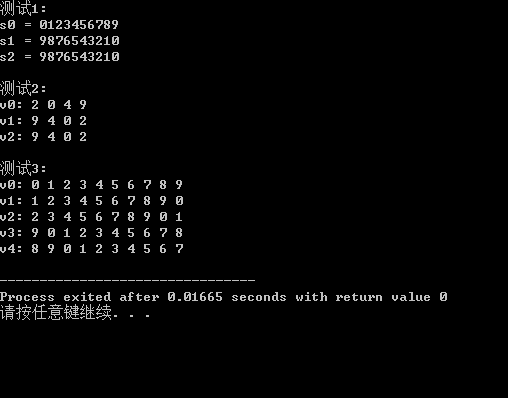
    cout << "测试1: \n";
    test1();

    cout << "\n测试2: \n";
    test2();

    cout << "\n测试3: \n";
    test3();
}

// 函数实现
// 输出容器对象c中的元素
template <typename T>
void output(const T &c) {
    for(auto &i: c)
        cout << i << " ";
    cout << endl;
}

// 测试1
// 组合使用算法库、迭代器、string反转字符串
void test1() {
    string s0{"0123456789"};
    cout << "s0 = " << s0 << endl;

    string s1{s0};
    reverse(s1.begin(), s1.end());  // 反转指定迭代器区间的元素
    cout << "s1 = " << s1 << endl;

    string s2{s0};
    reverse_copy(s0.begin(), s0.end(), s2.begin()); // 将指定迭代区间的元素拷贝到指定迭代器开始的目标区间,并且在复制过程中反转次序
    cout << "s2 = " << s2 << endl;
}

// 测试2
// 组合使用算法库、迭代器、vector反转动态数组对象vector内数据
void test2() {
    vector<int> v0{2, 0, 4, 9};
    cout << "v0: ";
    output(v0);

    vector<int> v1{v0};
    reverse(v1.begin(), v1.end());
    cout << "v1: ";
    output(v1);

    vector<int> v2{v0};
    reverse_copy(v0.begin(), v0.end(), v2.begin());
    cout << "v2: ";
    output(v2);
}

// 测试3
// 组合使用算法库、迭代器、vector实现元素旋转移位
void test3() {
    vector<int> v0{0, 1, 2, 3, 4, 5, 6, 7, 8, 9};
    cout << "v0: ";
    output(v0);

    vector<int> v1{v0};
    rotate(v1.begin(), v1.begin()+1, v1.end());  // 旋转指定迭代器区间[v1.begin(), v1.end())之间的数据项,旋转后从迭代器v1.begin()+1位置的数据项开始
    cout << "v1: ";
    output(v1);

    vector<int> v2{v0};
    rotate(v2.begin(), v2.begin()+2, v2.end());
    cout << "v2: ";
    output(v2);

    vector<int> v3{v0};
    rotate(v3.begin(), v3.end()-1, v3.end());
    cout << "v3: ";
    output(v3);

    vector<int> v4{v0};
    rotate(v4.begin(), v4.end()-2, v4.end());
    cout << "v4: ";
    output(v4);
}
实验任务2:
#include <iostream>
#include <vector>
#include <string>
#include <algorithm>
#include <numeric>
#include <iomanip>

using namespace std;

// 函数声明
// 模板函数声明
template<typename T>
void output(const T &c);

// 普通函数声明
int rand_int_100();
void test1();
void test2();

int main() {
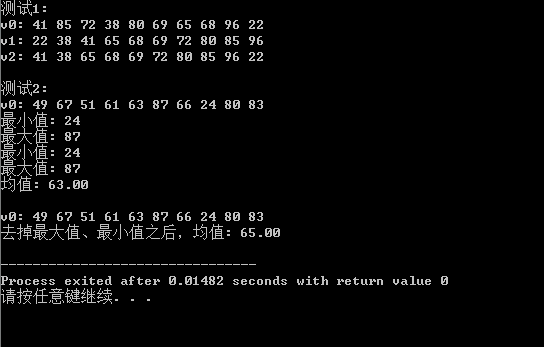
    cout << "测试1: \n";
    test1();

    cout << "\n测试2: \n";
    test2();
}

// 函数实现
// 输出容器对象c中的元素
template <typename T>
void output(const T &c) {
    for(auto &i: c)
        cout << i << " ";
    cout << endl;
}

// 返回[0, 100]区间内的一个随机整数
int rand_int_100() {
    return rand() % 101;
}

// 测试1
// 对容器类对象指定迭代器区间进行赋值、排序
void test1() {
    vector<int> v0(10);  // 创建一个动态数组对象v0, 对象大小为10
    generate(v0.begin(), v0.end(), rand_int_100); // 产生[0, 100]之间的随机整数赋值给指定迭代器区间[v0.begin(), v0.end())内的每个数据项
    cout << "v0: ";
    output(v0);

    vector<int> v1{v0};
    sort(v1.begin(), v1.end()); // 对指定迭代器区间[v1.begin(), v1.end())内数据项进行升序排序
    cout << "v1: ";
    output(v1);

    vector<int> v2{v0};
    sort(v2.begin()+1, v2.end()-1); // 对指定迭代器区间[v1.begin()+1, v1.end()-1)内数据项进行升序排序
    cout << "v2: ";
    output(v2);
}

// 测试2
// 对容器类对象指定迭代器区间进行赋值、计算最大值/最小值/均值
void test2() {
    vector<int> v0(10);
    generate(v0.begin(), v0.end(), rand_int_100);
    cout << "v0: ";
    output(v0);

    auto iter1 = min_element(v0.begin(), v0.end());
    cout << "最小值: " << *iter1 << endl;

    auto iter2 = max_element(v0.begin(), v0.end());
    cout << "最大值: " << *iter2 << endl;

    auto ans = minmax_element(v0.begin(), v0.end());
    cout << "最小值: " << *(ans.first) << endl;
    cout << "最大值: " << *(ans.second) << endl;
    double avg1 = accumulate(v0.begin(), v0.end(), 0)/v0.size();
    cout << "均值: " << fixed << setprecision(2) << avg1 << endl;

    cout << endl;

    vector<int> v1{v0};
    cout << "v0: ";
    output(v0);
    sort(v1.begin(), v1.end());
    double avg2 = accumulate(v1.begin()+1, v1.end()-1, 0)/(v1.size()-2);
    cout << "去掉最大值、最小值之后,均值: " << avg2 << endl;
}
实验任务3:
#include <iostream>
#include <string>
#include <algorithm>

bool is_palindrome(std::string s);

int main() {
    using namespace std;
    string s;

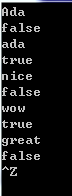
    while(cin >> s)  // 多组输入,直到按下Ctrl+Z后结束测试
        cout << boolalpha << is_palindrome(s) << endl;
}


bool is_palindrome(std::string s){
	std::string t{s};
	reverse(s.begin(),s.end());
	if(s==t)
	return true;
	else
	return false;
}
实验任务4:
#include <iostream>
#include <string>
#include <algorithm>
#include<vector>
std::string dec2n(int x, int n = 2);
int main() {
	using namespace std;
	int x;
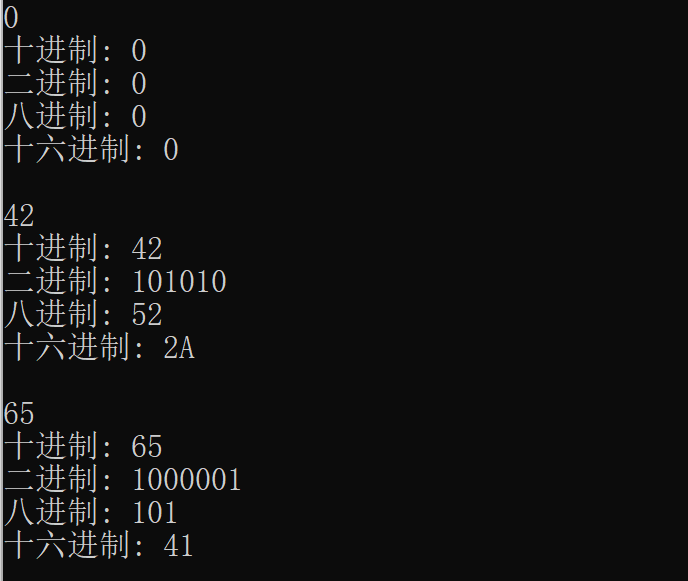
	while (cin >> x) {
		cout << "十进制: " << x << endl;
		cout << "二进制: " << dec2n(x) << endl;
		cout << "八进制: " << dec2n(x, 8) << endl;
		cout << "十六进制: " << dec2n(x, 16) << endl << endl;
	}

}
std::string dec2n(int x, int n) {
	if (x == 0)
	{
		std::string a;
		a = char(48);
		return a;
	}
	int num;
	std::vector<char> vec;
	while (x != 0) {
		num = x % n;
		x = x / n;
		if (num == 10)
			vec.insert(vec.begin(),num + 55);
		else if (num == 11)
			vec.insert(vec.begin(), num + 55);
		else if (num == 12)
			vec.insert(vec.begin(), num + 55);
		else if (num == 13)
			vec.insert(vec.begin(), num + 55);
		else if (num == 14)
			vec.insert(vec.begin(), num + 55);
		else if (num == 15)
			vec.insert(vec.begin(), num + 55);
		else
			vec.insert(vec.begin(), num + 48);
	}

	std::string s;
	for (auto i : vec) {
		s = s + i;
	}

	return s;
}
实验任务5:
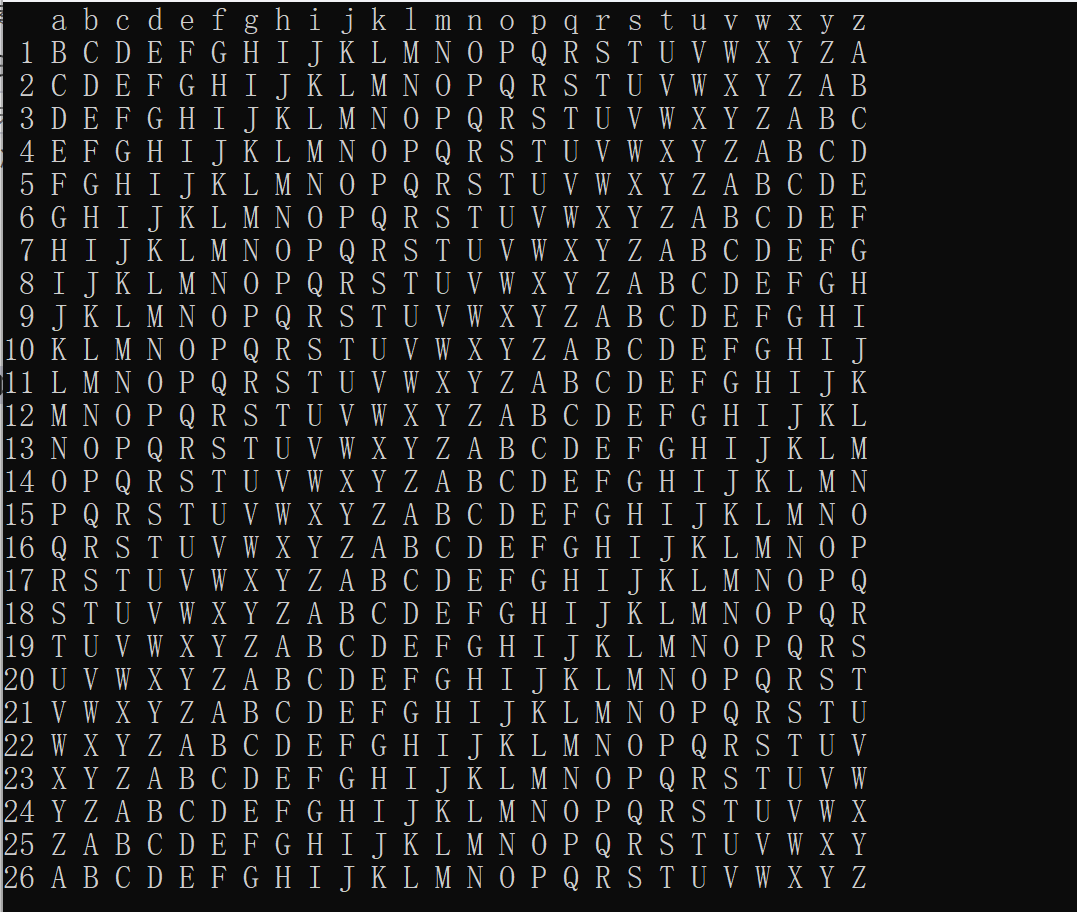
#include<iostream>
#include<string>
#include<vector>
#include<iomanip>
using namespace std;
int main() {
	vector<char> vec1;
	vector<char> vec2;
	vector<char> vec3;
	for (char i = 'A'; i <= 'Z'; ++i) {
		vec1.push_back(i);
	}
	for (char i = 'a'; i <= 'z'; ++i) {
		vec2.push_back(i);
	}
	cout <<"  ";
	for (auto i : vec2) {
		cout << setw(2) << i;
	}
	cout << endl;
	for (int i = 1; i <= 26; i++) {
		rotate(vec1.begin(), vec1.begin() + 1, vec1.end());
		cout << setw(2) << i;
		for (auto i : vec1) {
			cout << setw(2) << i;
		}
		cout << endl;
	}

}
实验任务6:
#include<iostream>
#include<vector>
#include<random>
#include<iomanip>
using namespace std;
int main() {
	vector<int> v1{ 0,1,2,3,4,5,6,7,8,9,10 };
	vector<char> v2{'+','-','*','/'};
	//创建随机数引擎
	random_device rd;
	mt19937 gen(rd());
	uniform_int_distribution<> dist1(0, v1.size() - 1);
	uniform_int_distribution<> dist2(0, v2.size() - 1);
	int N = 10;
	int a,c;
	char b;
	double correct = 0;
	while (N--) {

		int random_num1 = dist1(gen);
		int random_num2 = dist2(gen);
		a = v1[random_num1];
		b = v2[random_num2];
		cout << v1[random_num1] << setw(2) << v2[random_num2];
		random_num1 = dist1(gen);
		while (random_num1 == 0 && random_num2 == 3) {
			random_num1 = dist1(gen);
		}
		while (a < v1[random_num1]&&random_num2==1) {
			random_num1 = dist1(gen);
		}

		cout << setw(2) << v1[random_num1] << setw(2) << "==";
		int c;
		cin >> c;
		int ans=0;
		if (random_num2 == 0)
			ans = a + random_num1;
		else if(random_num2 == 1)
			ans = a - random_num1;
		else if (random_num2 == 2)
			ans = a * random_num1;
		else if (random_num2 == 3)
			ans = a / random_num1;
		if (c == ans)
			++correct;
	}
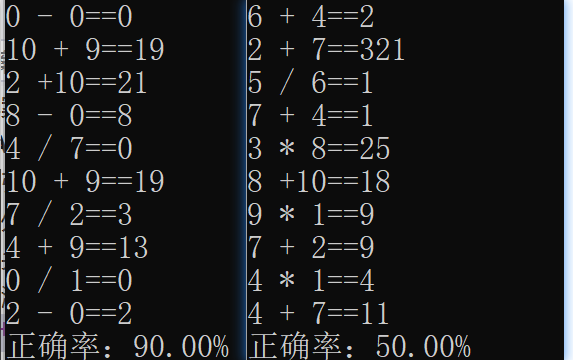
	cout << "正确率:" <<fixed << setprecision(2) << correct *10 << "%";

}

 浙公网安备 33010602011771号