
实验4 文件应用编程
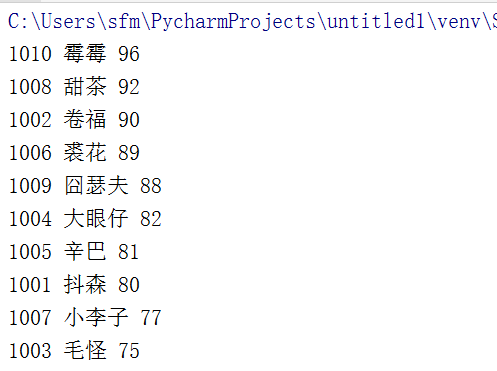
with open('data6_1.txt','r',encoding = 'utf-8') as f:
    l = []
    z = f.readlines()
    for i in z:
        p = []
        i.strip()
        p.append(i[0:5].strip())
        p.append(i[5:8].strip())
        p.append(int(i[8:11].strip()))
        l.append(list(p))
    y = lambda l: l[2]
    l.sort(key = y,reverse=True)
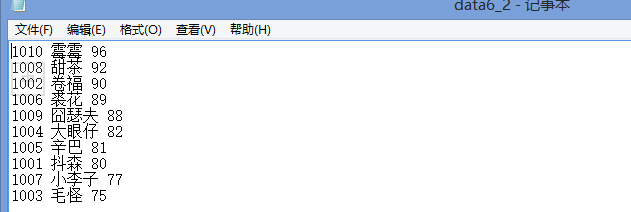
    n = open('data6_2.txt', 'w+')
    count = 0
    for i in l:
        for u in i:
            print(u,end = ' ')
            n.writelines(str(u))
            n.writelines(' ')
            count = count + 1
            if count %3 == 0:
                print(end = '\n')
                n.writelines('\n')
import random
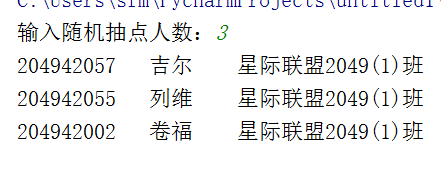
n = input('输入随机抽点人数:')
m = set()
with open('data7.txt','r') as f:
    f = f.readlines()
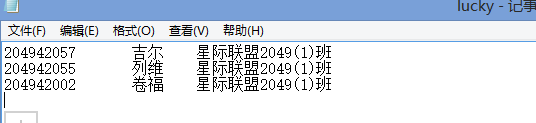
    g = open('lucky.txt', 'w+')
    while len(m) < int(n):
        x = random.randint(0,len(f) - 1)
        y = f[x]
        y.strip()
        m.add(y)
        g.writelines(y.strip())
        g.writelines('\n')
        print(y.strip())
import random
import datetime
t = datetime.datetime.now()
t.strftime('%Y%m%d')
t = str(t)[0:4]+str(t)[5:7]+str(t)[8:10]
k = t + '.txt'
n = input('输入随机抽点人数:')
m = set()
with open('data7.txt','r') as f:
    f = f.readlines()
    g = open( k,'w+')
    while len(m) < int(n):
        x = random.randint(0,len(f) - 1)
        y = f[x]
        y.strip()
        m.add(y)
        g.writelines(y.strip())
        g.writelines('\n')
        print(y.strip())
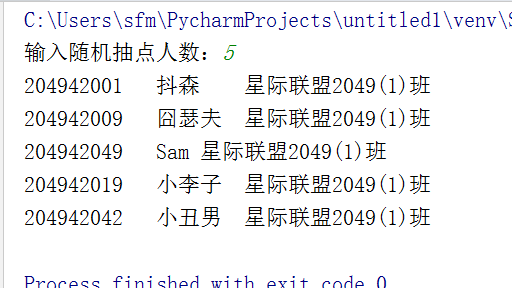
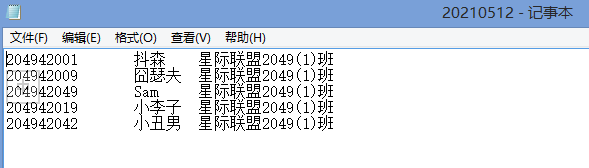
实验总结:
1.使用line.strip('\n') == ' '来处理空白行,适用于空白行只有\n的情形。
2.使用writelines()函数向文件中写入多行数据时,不会自动给各行添加换行符。
3.readline()函数在读取文件中一行内容时,会读取最后的换行符“\n”,再加上print()函数输出内容时会默认换行,所以输出结果中会看到多出了一个空行。

 浙公网安备 33010602011771号