//题目57:编写一个业务函数,实现字符串(前后各有三个空格,单词前后也均有空格)
//"   i am student, you are teacher   " ,
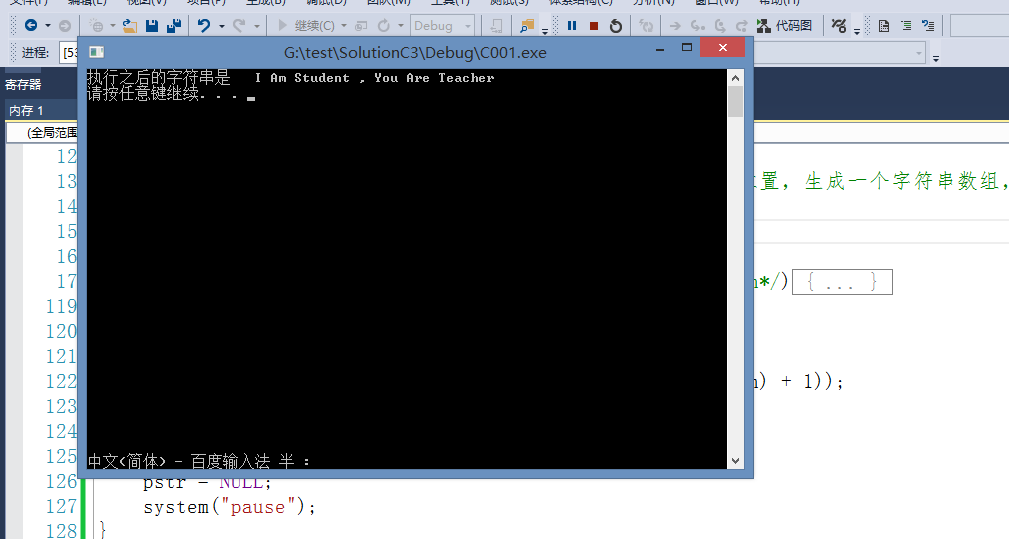
//各个单词首字符大写,结果如下"   i am student,  you are teacher   " ,
//要求1:实现所有接口  70
//要求2:写出测试程序  30

#include<stdio.h>
#include<stdlib.h>
#include<string.h>

//需求解析:实现英语句子中各个单词首字符大写(字符串不确定)
//思路:①遍历句子中所有的字符,找出所有的空格
//②只要发现非空格,就将字符一个个存入数组中,直到遇到空格位置,生成一个字符串数组,数组中存储所有的单词
//③ 重新拼接英文句子

//处理英语句子
int ProtectEnglish(const char * pinstr/*in*/, char *pout/*in*/){
    int ERRO_MSG = 0;
    if (pinstr == NULL || pout == NULL)
    {
        ERRO_MSG = 1;
        printf("pinstr == NULL || pout==NULL erro msg:%d\n", ERRO_MSG);
        return ERRO_MSG;
    }
    int i = 0, j = 0,k=3;
    //获取字符串的长度
    int index = strlen(pinstr);
    int index2 = index;
    //定义返回字符串
    char *resstr = pout;
    memset(resstr, 0, sizeof(char)*(index + 1));
    //定义单词个数
    int numx = 0;
    //定义存储字符串的二维数组
    char **ptemp1 = (char **)malloc(sizeof(char *));
    //定义单词个数
    int num2 = 0;
    //定义单词中字符个数
    int num = 1;
    //分配单个单词存数数组
    char *ptemp2 = NULL;
    while (index--){
        if (*pinstr!=' ')
        {
            char tempc = 0;
            if (num==1)
            {
                ptemp2 = (char *)malloc(sizeof(char));
                //处理非字母字符
                if ((int)*pinstr>96 && (int)*pinstr<123)
                {
                    //首字母大写
                    tempc = (int)*pinstr - 32;
                }
                else{
                    tempc = *pinstr;
                }

            }
            else{
                //重新分配内存空间
                ptemp2 = (char *)realloc(ptemp2, sizeof(char)*(num));
                tempc = *pinstr;
            }
            //存储单个字符
            ptemp2[num - 1] = tempc;
            num++;
        }
        else{
            //当遇到空格时开始计数下一个单词
            if (num>1)
            {
                //确保每个单词都是字符串
                ptemp2 = (char *)realloc(ptemp2, sizeof(char)*(num));
                ptemp2[num - 1] = '\0';
                if (num2>0)
                {
                    ptemp1 = (char **)realloc(ptemp1, sizeof(char *)*(num2+1));
                }
                //将上一个单词加入数组
                ptemp1[num2] = ptemp2;
                num2++;
                //开始下一个单词
                num = 1;
            }
        }

        pinstr++;
    }
    //重新拼接单词
    if (num2>0)
    {
        //前后各有三个空格,单词前后也均有空格
        resstr[0] = ' ';
        resstr[1] = ' ';
        resstr[2] = ' ';
        resstr[index2 - 1] = ' ';
        resstr[index2 - 2] = ' ';
        for (i = 0; i < num2; i++)
        {
            //判断每个单词的长度
            //暂时没有想到其他设计可以把每个单词填充到一个字符数组里
            int num3 = strlen(ptemp1[i]);
            for (j = 0; j < num3; j++)
            {
                resstr[k] = ptemp1[i][j];
                k++;//数组的自增设计--适用与根据内部条件自增
            }
            resstr[k] = ' ';
            k++;
            //释放内存
            free(ptemp1[i]);
            ptemp1[i] = NULL;
        }
        //释放内存
        free(ptemp1);
        ptemp1 = NULL;
    }
    return ERRO_MSG;
}

void main(){
    char *english = "   i am student , you are teacher   ";
    char *pstr = (char *)malloc(sizeof(char)*(strlen(english) + 1));
    ProtectEnglish(english, pstr);
    printf("执行之后的字符串是%s\n", pstr);
    free(pstr);
    pstr = NULL;
    system("pause");
}
![]()




 浙公网安备 33010602011771号