

函数的返回值 函数的类型 函数的参数(重要) 利用函数对注册登录代码进行封装 常见的内置函数
今日内容概要
-
函数的返回值
-
函数的类型
-
函数的参数(重要)
-
利用函数对注册登录代码进行封装
-
强调
# 1.定义与调用
    定义函数使用关键字def
    调用函数需要使用
        函数名加括号(如果函数需要参数那么则额外传递参数)
# 2.定义阶段
    函数在定义阶段只检测函数语法,不执行函数语法
# 3.调用阶段
    函数名加括号调用函数的时候才会执行函数体代码
函数的返回值
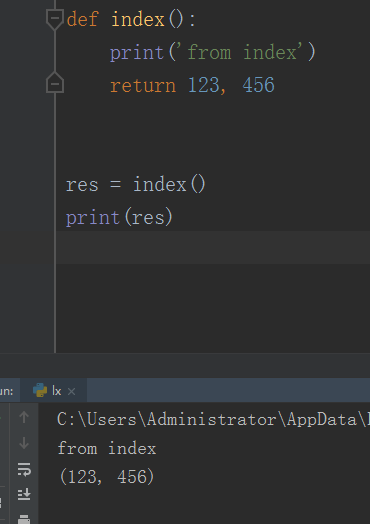
def index():
    print('from index')
    return 123,456
    print('from index')
index()
# 什么是返回值?
"""返回值就是执行完了某个方法该方法反馈出来的结果"""
# 如何获取返回值?
"""通过变量名与赋值符号即可
变量名 = 方法/函数()
"""

# 1.当函数体没有return关键字的时候 默认返回none
# res =index()
# print(res) # none即为空
# 2.return关键字后面写什么函数就返回什么
# res = index()
# print(res) # 123
# 3.return后面跟多个默认值会组成元组的形式返回
# res = index()
# print(res)
# 4.函数体代码遇到return立刻结束整个函数的运行
函数的类型
# 1.无参函数:函数在定义阶段没有参数,调用阶段也不需要给参数
# def index():
        print('from index')
# index()


# 2.有参函数:函数在定义阶段括号内填写了变量名即需要参数
# def index(x):
#     print('from index',x)
# index(1)


# 3.空函数(没有具体的函数体代码)
"""一般用于前期的架构搭建"""
def run():
    pass # 补全语法结构 本身没有任何含义
def fight():
    pass
def talk():
    pass:
函数的参数
"""
函数在定义阶段括号内书写的变量名称之为函数的形式参数
    简称为形参
           函数的形参相当于变量名
函数在调用阶段括号内书写的值称之为函数的实际参数
     简称为实参
            函数的实参相当于变量值
两者在调用函数的时候临时绑定 函数运行结束分开
def index(name):
    print(name)
index('jason') 实参 name = 'jason'
"""
# 1.位置参数:按照位置一一对应传值 多一个不行少一个也不行
    def index(x,y):
        print(x,y)
# index()  # 不传不可以
# index(1)  # 传少了也不行
# index(1,2)  # 个数正确可以
# index(1,2,3,4,5,6,7)  # 传多了也不行

# 2.关键字参数:指名道姓的给形参传值  可以打破位置限制
# index(y=111, x=222)
# index(111, y=222)
# index(111, x=222)  # 报错
# print(y=111,222)  # 报错 位置参数一定要在关键字参数的前面
# 3.默认参数:函数在定义阶段就给形参赋值了
# def register(name, age, gender='male'):
#     print(name, age, gender)
 '''默认参数不给值的情况下就使用默认的 给了就使用给了的'''
# register('jason', 18)
# register('tony', 28)
# register('kevin', 38)
# register('huahua', 18, 'female')
# 4.可变长参数(使用频率最高)
'''函数如何做到无论接收多少个位置参数都可以正常运行
*在形参中使用
    会接收多余的位置参数组织成元组的形式赋值给*后面的变量名
'''

# def func(a, *b):
#     print(a, b)
# func(1,2,3,4,5,6,7,8,9,10)
# func(1)
"""函数如何做到无论接收多少个关键字参数都可以正常运行
**在形参中使用
    会接收多余的关键字参数组织成字典的形式赋值给**后面的变量名
"""
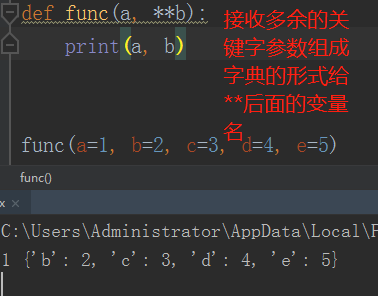
# def func(a,**b):
#     print(a,b)
# func(a=1,b=2,c=3,d=4,e=5)
# func(a=1)

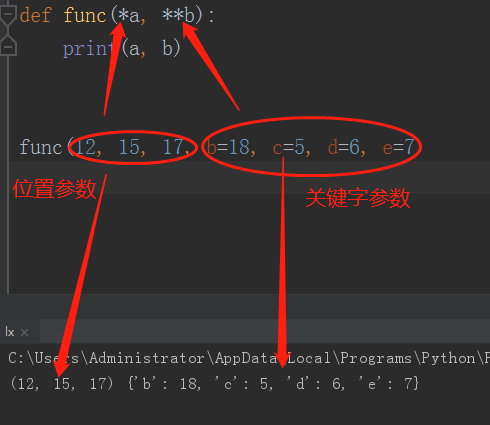
# 小练习  定义一个函数 该函数无论接收多少个位置参数还是关键字参数都可以正常运行de
def func(*a, **b):
    print(a, b)
"""
约定俗成
    针对形参中的可变长参数 变量名推荐使用
        *args  **kwargs
def login(*args, **kwargs):
    pass
"""
*与**在实参中的作用
l = [11, 22, 33, 44, 55]
d = {'username': 'jason', 'pwd': 123, 'hobby': 'read'}
def func(*args, **kwargs):
    print(args, kwargs)
"""
*在实参中使用
    会将列表/元组内的元素打散成一个个位置参数传递给函数
"""
func(*l)  # func(11,22,33,44,55)
"""
**在实参中使用
    会将字典内的元素打散成一个个关键字参数传递给函数
"""
func(**d)  # func(username='jason',pwd=123,hobby='read')


def register():
    username = input('username>>>:').strip()
    password = input('password>>>:').strip()
    # 校验用户名是否存在
    with open(r'userinfo.txt', 'r', encoding='utf8') as f:
        for line in f:
            real_name = line.split('|')[0]
            if real_name == username:
                print('用户名已存在')
                return
    # 将用户名和密码写入文件
    with open(r'userinfo.txt', 'a', encoding='utf8') as f:
        f.write('%s|%s\n' % (username, password))
        print('%s注册成功' % username)


def login():
    username = input('username>>>:').strip()
    password = input('password>>>:').strip()
    with open(r'userinfo.txt', 'r', encoding='utf8') as f:
        for line in f:
            real_name, real_pwd = line.split('|')
            if real_name == username and password == real_pwd.strip('\n'):
                print('登录成功')
                return
    print('用户名或密码错误')


func_dict = {'1': register,
             '2': login
             }
while True:
    print("""
    1 注册
    2 登录
    """)
    choice = input('请输入执行功能编号>>>:').strip()
    if choice in func_dict:
        func_name = func_dict.get(choice)
        func_name()
    else:
        print('请输入正确的编号')
"""
将面条版代码封装成函数版
    1.先写def和函数名
    2.将代码缩进
    3.查看内部需要哪些数据
    4.在形参中定义出来即可

尽量做到一个函数就是一个具体的功能

"""
def auth_username(username):
    # 校验用户名是否存在
    with open(r'userinfo.txt', 'r', encoding='utf8') as f:
        for line in f:
            real_name = line.split('|')[0]
            if real_name == username:
                print('用户名已存在')
                return True
    return False


def get_info():
    username = input('username>>>:').strip()
    password = input('password>>>:').strip()
    return username, password


def write_data(username, password):
    # 将用户名和密码写入文件
    with open(r'userinfo.txt', 'a', encoding='utf8') as f:
        f.write('%s|%s\n' % (username, password))
        print('%s注册成功' % username)


def register():
    username, password = get_info()
    # 调用校验用户名是否存在的函数
    is_exist = auth_username(username)
    if is_exist:
        return
    write_data(username, password)


def login():
    username, password = get_info()
    with open(r'userinfo.txt', 'r', encoding='utf8') as f:
        for line in f:
            real_name, real_pwd = line.split('|')
            if real_name == username and password == real_pwd.strip('\n'):
                print('登录成功')
                return
    print('用户名或密码错误')


func_dict = {'1': register,
             '2': login
             }
while True:
    print("""
    1 注册
    2 登录
    """)
    choice = input('请输入执行功能编号>>>:').strip()
    if choice in func_dict:
        func_name = func_dict.get(choice)
        func_name()
    else:
        print('请输入正确的编号')
内置参数
# print(abs(-111))
# print(all([1, 2, 3, 4, 0]))
# print(any([1, 2, 3, 4, 0]))
# print(bin(100))
# print(oct(100))
# print(hex(100))
# name = 'jason'
# def index():
#     pass
# 判断变量是否可以调用
# print(callable(name))  # False
# print(callable(index))  # True
# 返回ASCII码中数字对应的字符
# print(chr(65))  # A     65-90
# print(chr(122))  # z    97-122
# format字符串格式化输出
# print('my name is {} and my age is {}'.format('jason',18))
# print('my name is {0} {1} {1} and my age is {1} {0}'.format('jason',18))
# print('my name is {name} {name} {age} and my age is {age}'.format(name='jason',age=18))

# l = ['jason', 'kevin', 'tony', 'jerry', 'tom']
# count = 1
# for name in l:
#     print(count,name)
#     count += 1

# for i, name in enumerate(l, 10):
#     print(i, name)


# l = [11, 22, 33, 44, 55, 66, 77, 88, 99]
# print(max(l))
# print(min(l))
# print(sum(l))

 浙公网安备 33010602011771号