  1 import numpy as np
  2
  3 '''
  4 数组:一维,秩为1
  5     利用Numpy中random模块中的randn函数生成的一维数组,
  6     既不是行向量,也不是列向量,而是秩为1的数组,
  7     特点:
  8         只有一个'[]'
  9         是数组,不是向量或矩阵
 10 '''
 11 a = np.random.randn(5)
 12 print(a)
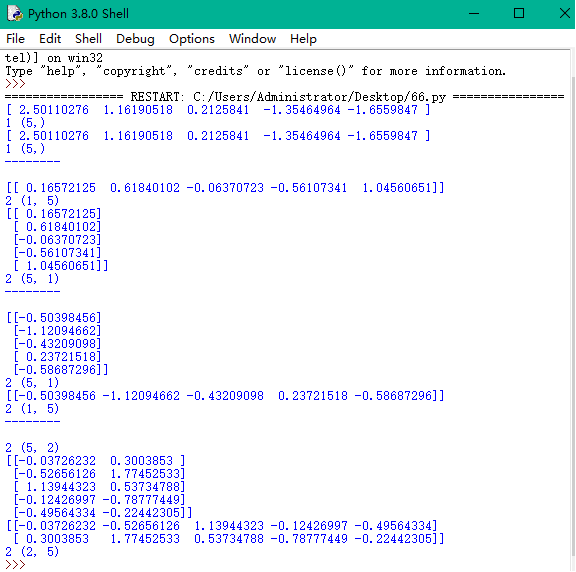
 13 #[ 2.50110276  1.16190518  0.2125841  -1.35464964 -1.6559847 ]
 14 print(a.ndim, a.shape)
 15 # 1, (5,)
 16 print(a.T)
 17 #[ 2.50110276  1.16190518  0.2125841  -1.35464964 -1.6559847 ]
 18 print((a.T).ndim, (a.T).shape)
 19 # 1, (5,)
 20 print("--------\n")
 21
 22
 23
 24 '''
 25 向量和矩阵都是为二维数组
 26 '''
 27
 28 '''
 29 行向量:
 30     特点:两个方括号'[]'
 31 '''
 32 b = np.random.randn(1,5)  #1行5列的行向量
 33 print(b)
 34 #[[ 0.16572125  0.61840102 -0.06370723 -0.56107341  1.04560651]]
 35 print(b.ndim, b.shape)
 36 # 2, (1, 5)
 37 print(b.T)
 38 '''
 39 [[ 0.16572125]
 40  [ 0.61840102]
 41  [-0.06370723]
 42  [-0.56107341]
 43  [ 1.04560651]]
 44 '''
 45 print((b.T).ndim, (b.T).shape)
 46 # 2, (5,1)
 47 print("--------\n")
 48
 49
 50 '''
 51 列向量
 52 '''
 53 e = np.random.randn(5,1) #5行1列的列向量
 54 print(e)
 55 '''
 56 [[-0.50398456]
 57  [-1.12094662]
 58  [-0.43209098]
 59  [ 0.23721518]
 60  [-0.58687296]]
 61 '''
 62 print(e.ndim, e.shape)
 63 #2, (5,1)
 64 print(e.T)
 65 #[[-0.50398456 -1.12094662 -0.43209098  0.23721518 -0.58687296]]
 66 print((e.T).ndim, (e.T).shape)
 67 #2 (1, 5)
 68 print("--------\n")
 69
 70
 71 '''
 72 矩阵:
 73     既有行向量也有列向量,两个方括号'[]'
 74 '''
 75 c = np.random.randn(5,2)
 76 print(c.ndim, c.shape)
 77 #2 (5, 2)
 78 print(c)
 79 '''
 80 [[-0.03726232  0.3003853 ]
 81  [-0.52656126  1.77452533]
 82  [ 1.13944323  0.53734788]
 83  [-0.12426997 -0.78777449]
 84  [-0.49564334 -0.22442305]]
 85
 86  1. 最外层的方括号表示矩阵
 87  2. 内层的方括号是每行有一对:内层有5对方括号,表示5行
 88  3. 内层每对方括号内有2个元素,表示2列
 89 '''
 90 print(c.T)
 91 '''
 92 [[-0.03726232 -0.52656126  1.13944323 -0.12426997 -0.49564334]
 93  [ 0.3003853   1.77452533  0.53734788 -0.78777449 -0.22442305]]
 94 '''
 95 print((c.T).ndim, (c.T).shape)
 96 #2 (2, 5)
 97
 98 '''
 99 数组、向量、矩阵的区别:
100     可以以方括号的形式判断数组是否能够代表一个向量或者矩阵,
101     又或者通过转置看前后是否变化来判断。
102 '''


 浙公网安备 33010602011771号