转换为COCO指标及计算small、middle、large
本文实现了
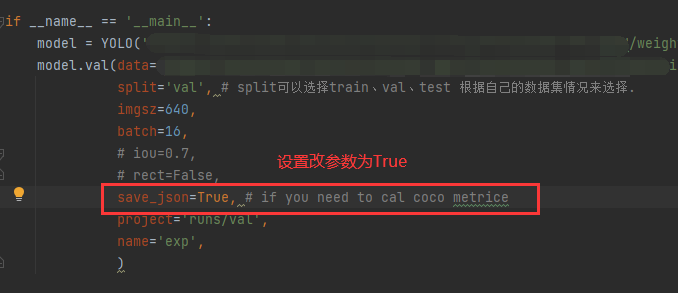
1.运行val.py生成predictions.json

import warnings
warnings.filterwarnings('ignore')
from ultralytics import YOLO

if __name__ == '__main__':
    model = YOLO('/******/weights/best.pt') # 选择训练好的权重路径
    model.val(data='/*****/ultralytics/cfg/datasets/kitti.yaml',
              split='val', # split可以选择train、val、test 根据自己的数据集情况来选择.
              imgsz=640,
              batch=16,
              save_json=True, # if you need to cal coco metrice
              project='runs/val',
              name='exp',
              )
2.运行yolo2coco.py生成anno_json


import os
import cv2
import json
from tqdm import tqdm
from sklearn.model_selection import train_test_split
import argparse

classes = ['Pedestrian', 'Car', 'Truck', 'Van', 'Cyclist','Person','Tram']
parser = argparse.ArgumentParser()
parser.add_argument('--image_path', default='/*****/dataset/kitti_yolo/images/val',type=str, help="")
parser.add_argument('--label_path', default='/******/dataset/kitti_yolo/labels/val',type=str, help="")
parser.add_argument('--save_path', default='/******/data_for_json/kitti_data.json', type=str, help="")
arg = parser.parse_args()

def yolo2coco(arg):
    print("Loading data from ", arg.image_path, arg.label_path)

    assert os.path.exists(arg.image_path)
    assert os.path.exists(arg.label_path)

    originImagesDir = arg.image_path
    originLabelsDir = arg.label_path
    # images dir name
    indexes = os.listdir(originImagesDir)

    dataset = {'categories': [], 'annotations': [], 'images': []}
    for i, cls in enumerate(classes, 0):
        dataset['categories'].append({'id': i, 'name': cls, 'supercategory': 'mark'})

    # 标注的id
    ann_id_cnt = 0
    for k, index in enumerate(tqdm(indexes)):
        # 支持 png jpg 格式的图片.
        txtFile = f'{index[:index.rfind(".")]}.txt'
        stem = index[:index.rfind(".")]
        # 读取图像的宽和高
        try:
            im = cv2.imread(os.path.join(originImagesDir, index))
            height, width, _ = im.shape
        except Exception as e:
            print(f'{os.path.join(originImagesDir, index)} read error.\nerror:{e}')
        # 添加图像的信息
        if not os.path.exists(os.path.join(originLabelsDir, txtFile)):
            # 如没标签,跳过,只保留图片信息.
            continue
        dataset['images'].append({'file_name': index,
                            'id': stem,
                            'width': width,
                            'height': height})
        with open(os.path.join(originLabelsDir, txtFile), 'r') as fr:
            labelList = fr.readlines()
            for label in labelList:
                label = label.strip().split()
                x = float(label[1])
                y = float(label[2])
                w = float(label[3])
                h = float(label[4])

                # convert x,y,w,h to x1,y1,x2,y2
                H, W, _ = im.shape
                x1 = (x - w / 2) * W
                y1 = (y - h / 2) * H
                x2 = (x + w / 2) * W
                y2 = (y + h / 2) * H
                # 标签序号从0开始计算, coco2017数据集标号混乱,不管它了。
                cls_id = int(label[0])
                width = max(0, x2 - x1)
                height = max(0, y2 - y1)
                dataset['annotations'].append({
                    'area': width * height,
                    'bbox': [x1, y1, width, height],
                    'category_id': cls_id,
                    'id': ann_id_cnt,
                    'image_id': stem,
                    'iscrowd': 0,
                    # mask, 矩形是从左上角点按顺时针的四个顶点
                    'segmentation': [[x1, y1, x2, y1, x2, y2, x1, y2]]
                })
                ann_id_cnt += 1

    # 保存结果
    with open(arg.save_path, 'w') as f:
        json.dump(dataset, f)
        print('Save annotation to {}'.format(arg.save_path))

if __name__ == "__main__":
    yolo2coco(arg)
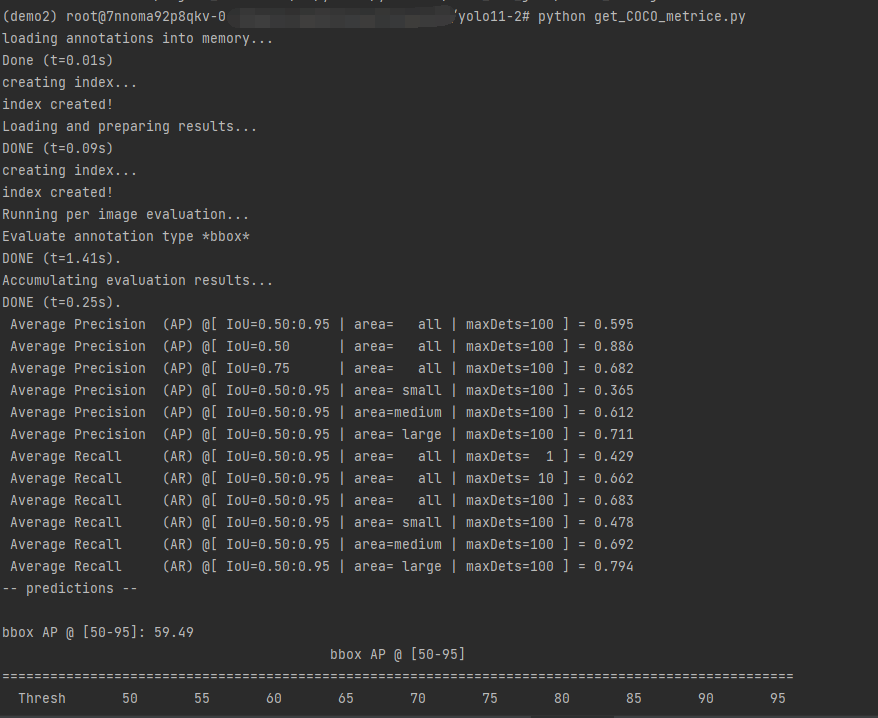
3.运行get_COCO_metrice.py得到结果

import warnings
warnings.filterwarnings('ignore')
import argparse
from pycocotools.coco import COCO
from pycocotools.cocoeval import COCOeval
from tidecv import TIDE, datasets

def parse_opt():
    parser = argparse.ArgumentParser()
    parser.add_argument('--anno_json', type=str, default='/******/data_for_json/kitti_data.json', help='label coco json path')
    parser.add_argument('--pred_json', type=str, default='/*******/runs/val/exp33/predictions.json', help='pred coco json path')

    return parser.parse_known_args()[0]

if __name__ == '__main__':
    opt = parse_opt()
    anno_json = opt.anno_json
    pred_json = opt.pred_json

    anno = COCO(anno_json)  # init annotations api
    pred = anno.loadRes(pred_json)  # init predictions api
    eval = COCOeval(anno, pred, 'bbox')
    eval.evaluate()
    eval.accumulate()
    eval.summarize()

    tide = TIDE()
    tide.evaluate_range(datasets.COCO(anno_json), datasets.COCOResult(pred_json), mode=TIDE.BOX)
    tide.summarize()
    tide.plot(out_dir='result')

 浙公网安备 33010602011771号