


密码学|实验三 RSA算法
实验目的:
掌握模幂和模逆的实现算法;通过 RSA 加密和签名算法,了解基于大数分解问题的公钥密码。
实验内容:
- 实现模幂和模逆算法
- 实现 RSA 加密算法
- 实现 RSA 签名算法
实验步骤:
- 采用从右到左算法实现模幂运算。
- 采用扩展欧几里得算法实现模逆运算。
- 生成公私钥对。
- 对消息 m,利用模幂程序得到 RSA 密文 c,再验证 c 解密后验证是否为 m
- 对消息 m,得到 RSA 签名 s,再验证 s 的正确性。
- 改变密钥对和消息,重复上述过程,将实验结果填入表
实验过程
使用Miller-Rabin素性测试确保生成大素数
生成素数
import random
def Miller_Rabin_is_prime(n, k=5):
    """Miller-Rabin素性测试"""
    if n <= 1:
        return False
    elif n <= 3:
        return True
    elif n % 2 == 0:
        return False
    d = n - 1
    s = 0
    while d % 2 == 0:
        d //= 2
        s += 1

    for _ in range(k):
        a = random.randint(2, n - 2)
        x = pow(a, d, n)
        if x == 1 or x == n - 1:
            continue
        for __ in range(s - 1):
            x = pow(x, 2, n)
            if x == n - 1:
                break
        else:
            return False
    return True

def generate_prime(bits):
    """生成指定位数的素数"""
    while True:
        p = random.getrandbits(bits)
        p |= (1 << bits - 1) | 1
        if Miller_Rabin_is_prime(p):
            return p
使用拓展欧几里得算法实现模逆运算
拓展欧几里得算法
def extended_gcd(a, b):
    if a == 0:
        return (b, 0, 1)
    else:
        g, y, x = extended_gcd(b % a, a)
        return (g, x - (b // a) * y, y)

def mod_inverse(a, m):
    g, x, y = extended_gcd(a, m)
    if g != 1:
        raise ValueError("模逆不存在")
    else:
        return x % m
实现快速模幂运算
快速模幂运算
def fast_modular_exponentiation(m, d, n):
    """
    快速模幂运算
    """
    # 将指数d转换为二进制字符串
    binary_d = bin(d)[2:]
    k = len(binary_d)
    x = 1
    y = m % n

    for i in range(k):
        a_i = int(binary_d[i])
        if a_i == 1:
            x = (x * y) % n
            y = (y * y) % n
        else:
            y = (y * y) % n
    return x
密钥生成
def generate_keypair(bits=1024):
    p = generate_prime(bits // 2)
    q = generate_prime(bits // 2)
    while p == q:
        q = generate_prime(bits // 2)

    n = p * q
    phi = (p - 1) * (q - 1)
    print(f"φ(n) = {phi}")
    while True:
        try:
            e = int(input("输入e值(建议为65537): "))
            if math.gcd(e, phi) != 1:
                print("Error,e必须与φ(n)互质")
            elif e < 2 or e >= phi:
                print("Error,e必须在2和φ(n)-1之间")
            else:
                break
        except ValueError:
            print("错误:请输入一个有效的整数。")

    d = mod_inverse(e, phi)

    public_key = (e, n)
    private_key = (d, n)

    return public_key, private_key
完成具体RSA功能
RSA功能实现
def rsa_encrypt(public_key, plaintext):
    e, n = public_key
    if plaintext >= n:
        raise ValueError("明文必须小于n")
    return fast_modular_exponentiation(plaintext, e, n)

def rsa_decrypt(private_key, ciphertext):
    d, n = private_key
    return fast_modular_exponentiation(ciphertext, d, n)

def rsa_sign(private_key, message):
    return rsa_encrypt(private_key, message)

def rsa_verify(public_key, signature, message):
    decrypted = rsa_decrypt(public_key, signature)
    return decrypted == message
实验结果
| n | e | d | m | s 签名 | c | decrypt |
|---|---|---|---|---|---|---|
| 6607361578056698093 | 65537 | 743236179797604353 | 231213 | 4782700734081529582 | 2836956322425680191 | 231213 |
| 5872539187104964069 | 65537 | 896154300040522913 | 12345 | 2830542832659584526 | 2830542832659584526 | 12345 |
| 52259664338030243 | 65537 | 12057591550917377 | 231213 | 14506512871382930 | 14506512871382930 | 231213 |
| 26487264889 | 65537 | 1181337469 | 10101100 | 10505105852 | 10505105852 | 10101100 |
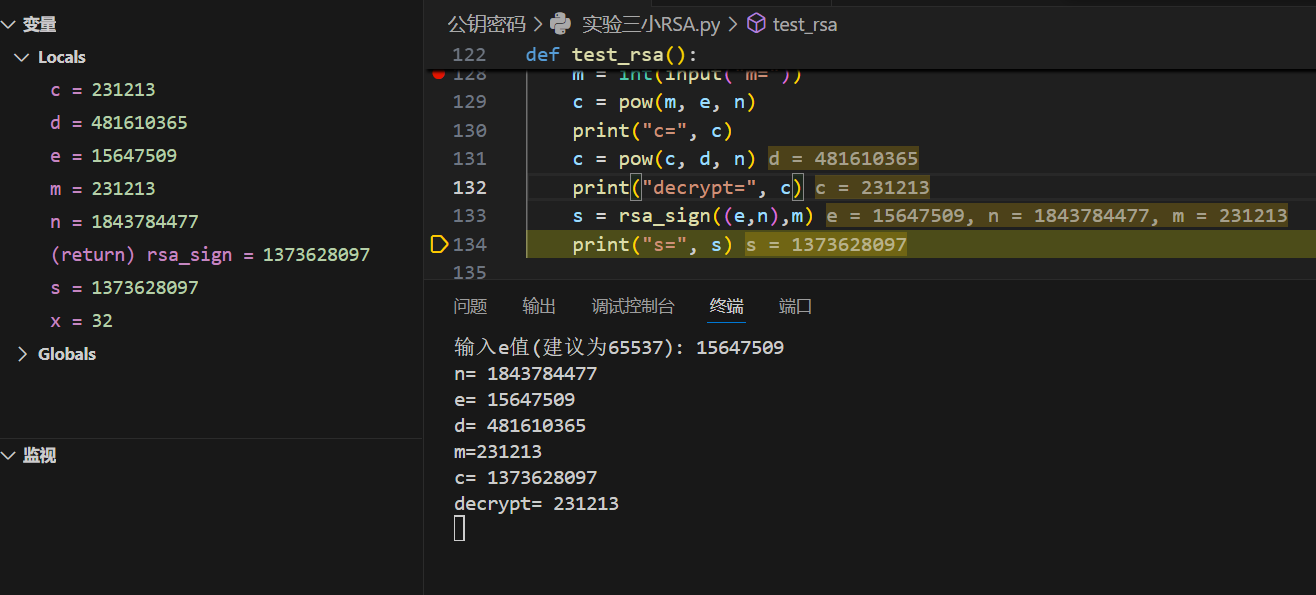
| 50665843 | 15647509 | 3856949 | 250616 | 38387790 | 38387790 | 250616 |
实验代码
import math
import random

def Miller_Rabin_is_prime(n, k=5):
    """Miller-Rabin素性测试"""
    if n <= 1:
        return False
    elif n <= 3:
        return True
    elif n % 2 == 0:
        return False
    d = n - 1
    s = 0
    while d % 2 == 0:
        d //= 2
        s += 1

    for _ in range(k):
        a = random.randint(2, n - 2)
        x = pow(a, d, n)
        if x == 1 or x == n - 1:
            continue
        for __ in range(s - 1):
            x = pow(x, 2, n)
            if x == n - 1:
                break
        else:
            return False
    return True

def generate_prime(bits):
    """生成指定位数的素数"""
    while True:
        p = random.getrandbits(bits)
        p |= (1 << bits - 1) | 1
        if Miller_Rabin_is_prime(p):
            return p


def extended_gcd(a, b):
    if a == 0:
        return (b, 0, 1)
    else:
        g, y, x = extended_gcd(b % a, a)
        return (g, x - (b // a) * y, y)

def mod_inverse(a, m):
    g, x, y = extended_gcd(a, m)
    if g != 1:
        raise ValueError("模逆不存在")
    else:
        return x % m
def fast_modular_exponentiation(m, d, n):
    """
    快速模幂运算
    """
    # 将指数d转换为二进制字符串
    binary_d = bin(d)[2:]
    k = len(binary_d)
    x = 1
    y = m % n

    for i in range(k):
        a_i = int(binary_d[i])
        if a_i == 1:
            x = (x * y) % n
            y = (y * y) % n
        else:
            y = (y * y) % n

    return x

def generate_keypair(bits=1024):
    p = generate_prime(bits // 2)
    q = generate_prime(bits // 2)
    while p == q:
        q = generate_prime(bits // 2)

    n = p * q
    phi = (p - 1) * (q - 1)
    print(f"φ(n) = {phi}")
    while True:
        try:
            e = int(input("输入e值(建议为65537): "))
            if math.gcd(e, phi) != 1:
                print("Error,e必须与φ(n)互质")
            elif e < 2 or e >= phi:
                print("Error,e必须在2和φ(n)-1之间")
            else:
                break
        except ValueError:
            print("错误:请输入一个有效的整数。")

    d = mod_inverse(e, phi)

    public_key = (e, n)
    private_key = (d, n)

    return public_key, private_key

def rsa_encrypt(public_key, plaintext):
    e, n = public_key
    if plaintext >= n:
        raise ValueError("明文必须小于n")
    return fast_modular_exponentiation(plaintext, e, n)

def rsa_decrypt(private_key, ciphertext):
    d, n = private_key
    return fast_modular_exponentiation(ciphertext, d, n)

def rsa_sign(private_key, message):
    return rsa_encrypt(private_key, message)

def rsa_verify(public_key, signature, message):
    decrypted = rsa_decrypt(public_key, signature)
    return decrypted == message

def main():
    print("\n生成RSA密钥对")
    public_key, private_key = generate_keypair()
    print(f"\n公钥 (e, n): {public_key}")
    print(f"私钥 (d, n): {private_key}")

    while True:
        print("\n请选择操作:")
        print("1. 加密")
        print("2. 解密")
        print("3. 签名")
        print("4. 验证签名")
        print("5. 退出")

        choice = input("请输入选项(1-5): ")

        if choice == '1':
            try:
                plaintext = int(input("请输入要加密的明文: "))
                ciphertext = rsa_encrypt(public_key, plaintext)
                print(f"加密结果: {ciphertext}")
            except ValueError as e:
                print(f"错误: {e}")

        elif choice == '2':
            try:
                ciphertext = int(input("请输入要解密的密文: "))
                plaintext = rsa_decrypt(private_key, ciphertext)
                print(f"解密结果: {plaintext}")
            except ValueError as e:
                print(f"错误: {e}")

        elif choice == '3':
            try:
                message = int(input("请输入要签名的消息: "))
                signature = rsa_sign(private_key, message)
                print(f"签名结果: {signature}")
            except ValueError as e:
                print(f"错误: {e}")

        elif choice == '4':
            try:
                signature = int(input("请输入要验证的签名: "))
                message = int(input("请输入原始消息: "))
                if rsa_verify(public_key, signature, message):
                    print("验证成功: 签名有效")
                else:
                    print("验证失败: 签名无效")
            except ValueError as e:
                print(f"错误: {e}")

        elif choice == '5':
            print("退出系统。")
            break

        else:
            print("无效选项,请重新输入。")

def test_rsa():
    x = int(input("请输入素数位数:"))
    (e,n),(d,n) = generate_keypair(x)
    print("n=", n)
    print("e=", e)
    print("d=", d)
    m = int(input("m="))
    c = fast_modular_exponentiation(m, e, n)
    print("c=", c)
    c = fast_modular_exponentiation(c, d, n)
    print("decrypt=", c)
    s = rsa_sign((e,n),m)
    print("s=", s)


if __name__ == "__main__":
    test_rsa()

 浙公网安备 33010602011771号