
Oracle 11g Release 1 (11.1) PL/SQL Collection 方法
http://docs.oracle.com/cd/B28359_01/appdev.111/b28370/collections.htm#i27396
本文内容
- EXISTS 方法
- COUNT 方法
- LIMIT 方法
- FIRST 和 LAST 方法
- PRIOR 和 NEXT 方法
- EXTEND 方法
- TRIM 方法
- DELETE 方法
collection 方法是一个内置的 PL/SQL 子程序,可以返回 collection 信息,或是在 collection 上执行操作,很方便。
你可以通过点记号来调用 collection 方法。语法如下图所示:
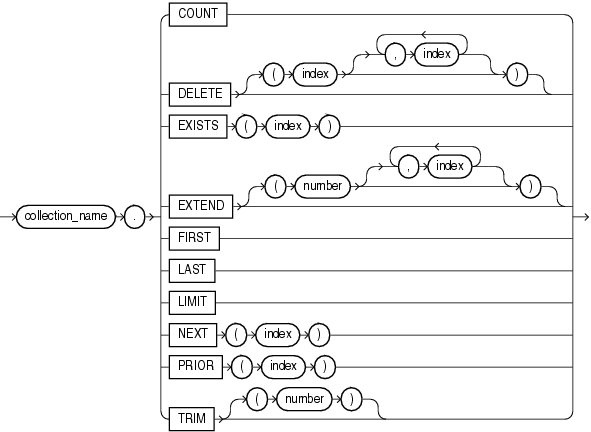
图1 Collection Method 调用
不能在 SQL 语句调用 collection 方法。
当 collection 为空时,你只能使用 EXISTS 方法,使用其他方法都会抛出 COLLECTION_IS_NULL 异常。
EXISTS 方法
若 collection 中第 n 个元素存在,则 EXISTS(n) 返回 TRUE;否则,返回 FALSE。EXISTS 方法结合 DELETE 方法,会把 collection 变成稀疏 nested tables(sparse nested tables)。通过 EXISTS 方法,避免引用一个不存在的元素,从而产生异常。当传递一个超出范围的标值时,EXISTS 方法返回 FALSE,而不是产生 SUBSCRIPT_OUTSIDE_LIMIT 异常。
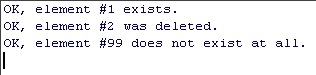
示例1:演示检查元素是否存在
DECLARE
TYPE NumList IS TABLE OF INTEGER;
n NumList := NumList(1,3,5,7);
BEGIN
n.DELETE(2); -- Delete the second element
IF n.EXISTS(1) THEN
DBMS_OUTPUT.PUT_LINE('OK, element #1 exists.');
END IF;
IF n.EXISTS(2) = FALSE THEN
DBMS_OUTPUT.PUT_LINE('OK, element #2 was deleted.');
END IF;
IF n.EXISTS(99) = FALSE THEN
DBMS_OUTPUT.PUT_LINE('OK, element #99 does not exist at all.');
END IF;
END;
/
COUNT 方法
COUNT 返回 collection 中元素的当前数量。当你不知道 collection 中有多少元素时,很有用。例如,当你把获取的表的一列,放到一个 nested table 时,元素的数量取决于结果集的大小。
对于 varray,COUNT 总是等于 LAST。通过 EXTEND 和 TRIM 方法,你可以增加或减少 varray 的大小,因此,COUNT 值是变化的,取决于 LIMIT 方法的值。
对于 nested tables,COUNT 方法通常等于 LAST 方法。然而,若你从 nested table 删除元素,则 COUNT 小于 LAST。当你整理元素时,COUNT 会忽略已删除的元素。使用不带参数的 DELETE 方法会设置 COUNT 为 0。
备注:FIRST 方法和 LAST 方法返回最大和最小的索引数。后面说明。
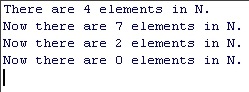
示例2:演示 collection 中元素的个数
DECLARE
TYPE NumList IS TABLE OF NUMBER;
n NumList := NumList(2,4,6,8);
-- Collection starts with 4 elements.
BEGIN
DBMS_OUTPUT.PUT_LINE
('There are ' || n.COUNT || ' elements in N.');
n.EXTEND(3); -- Add 3 new elements at the end.
DBMS_OUTPUT.PUT_LINE
('Now there are ' || n.COUNT || ' elements in N.');
n := NumList(86,99); -- Assign a completely new value with 2 elements.
DBMS_OUTPUT.PUT_LINE
('Now there are ' || n.COUNT || ' elements in N.');
n.TRIM(2); -- Remove the last 2 elements, leaving none.
DBMS_OUTPUT.PUT_LINE
('Now there are ' || n.COUNT || ' elements in N.');
END;
/
LIMIT 方法
LIMIT 返回 collection 可以容纳元素的最大数量。若 collection 没有最大大小,则 LIMIT 回返 NULL。
示例3:演示检查 collection 的最大容量
DECLARE
TYPE dnames_var IS VARRAY(7) OF VARCHAR2(30);
dept_names dnames_var :=
dnames_var('Shipping','Sales','Finance','Payroll');
BEGIN
DBMS_OUTPUT.PUT_LINE
('dept_names has ' || dept_names.COUNT || ' elements now');
DBMS_OUTPUT.PUT_LINE
('dept_names''s type can hold a maximum of '
|| dept_names.LIMIT || ' elements');
DBMS_OUTPUT.PUT_LINE
('The maximum number you can use with '
|| 'dept_names.EXTEND() is '
|| (dept_names.LIMIT - dept_names.COUNT));
END;
/

FIRST 和 LAST 方法
FIRST 方法和 LAST 方法返回的值,取决于 collection 的索引类型,是 integer,还是 string。
对于使用 integer 索引的 collection,FIRST 方法和 LAST 方法返回第一个和最后一个(最小和最大)的索引数。
对于使用 string 索引的 associative array,FIRST 方法和 LAST 方法返回最前和最后的键值。若 NLS_COMP 初始化参数设置为 ANSI,顺序是基于指定的 NLS_SORT 初始化参数。
若 collection 是空的,则 FIRST 和 LAST 返回 NULL。若 collection 只包含一个元素,则 FIRST 和 LAST 返回相同的值。
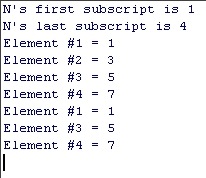
示例4:演示使用 FIRST 和 LAST 方法
DECLARE
TYPE NumList IS TABLE OF NUMBER;
n NumList := NumList(1,3,5,7);
counter INTEGER;
BEGIN
DBMS_OUTPUT.PUT_LINE('N''s first subscript is ' || n.FIRST);
DBMS_OUTPUT.PUT_LINE('N''s last subscript is ' || n.LAST);
-- When the subscripts are consecutive starting at 1,
-- it's simple to loop through them.
FOR i IN n.FIRST .. n.LAST
LOOP
DBMS_OUTPUT.PUT_LINE('Element #' || i || ' = ' || n(i));
END LOOP;
n.DELETE(2); -- Delete second element.
-- When the subscripts have gaps
-- or the collection might be uninitialized,
-- the loop logic is more extensive.
-- Start at the first element
-- and look for the next element until there are no more.
IF n IS NOT NULL THEN
counter := n.FIRST;
WHILE counter IS NOT NULL
LOOP
DBMS_OUTPUT.PUT_LINE
('Element #' || counter || ' = ' || n(counter));
counter := n.NEXT(counter);
END LOOP;
ELSE
DBMS_OUTPUT.PUT_LINE('N is null, nothing to do.');
END IF;
END;
/
PRIOR 和 NEXT 方法
PRIOR(n) 方法和 NEXT(n) 方法的返回值取决于 collection 的索引类型,是 integer,还是 string。
PRIOR(n) 返回 collection 中索引为 n 的前一个的索引数。NEXT(n) 返回索引为 n 的后一个的索引数。若 n 没有前一个,则 PRIOR(n) 返回 NULL。若 n 没有后一个,则 NEXT(n) 返回 NULL。
对于使用 VARCHAR2 键的 associative arrays,这两个方法返回相应的键值。若没有指定 NLS_COMP 为 ANSI,则顺序取决于字符串中字符的二进制值。否则,顺序取决于 NLS_SORT 参数。
这两个方法比通过一个固定的标值来循环更可靠,因为元素在循环期间可能被从 collection 插入或删除。特别是 associative arrays,标值可能不是连续的,可能是 (1,2,4,8,16) 或 ('A','E','I','O','U')。
示例5:演示使用 PRIOR 和 NEXT 访问 Collection 元素
DECLARE
TYPE NumList IS TABLE OF NUMBER;
n NumList := NumList(1966,1971,1984,1989,1999);
BEGIN
DBMS_OUTPUT.PUT_LINE('The element after #2 is #' || n.NEXT(2));
DBMS_OUTPUT.PUT_LINE('The element before #2 is #' || n.PRIOR(2));
n.DELETE(3);
-- Delete an element to show how NEXT can handle gaps.
DBMS_OUTPUT.PUT_LINE
('Now the element after #2 is #' || n.NEXT(2));
IF n.PRIOR(n.FIRST) IS NULL THEN
DBMS_OUTPUT.PUT_LINE
('Can''t get PRIOR of the first element or NEXT of the last.');
END IF;
END;
/

示例6:演示使用 NEXT 访问 Nested
DECLARE
TYPE NumList IS TABLE OF NUMBER;
n NumList := NumList(1,3,5,7);
counter INTEGER;
BEGIN
n.DELETE(2); -- Delete second element.
-- When the subscripts have gaps,
-- loop logic is more extensive.
-- Start at first element and look for next element
-- until there are no more.
counter := n.FIRST;
WHILE counter IS NOT NULL
LOOP
DBMS_OUTPUT.PUT_LINE
('Counting up: Element #' || counter || ' = ' || n(counter));
counter := n.NEXT(counter);
END LOOP;
-- Run the same loop in reverse order.
counter := n.LAST;
WHILE counter IS NOT NULL
LOOP
DBMS_OUTPUT.PUT_LINE
('Counting down: Element #' || counter || ' = ' || n(counter));
counter := n.PRIOR(counter);
END LOOP;
END;
/
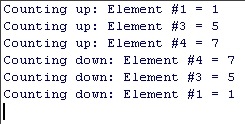
EXTEND 方法
EXTEND 方法用于增加 nested table 或 varray 的大小(容量)。
该方法有三个形式:
- EXTEND 追加一个 null 元素到 collection。
- EXTEND(n) 追加 n 个 null 元素到 collection。
- EXTEND(n,i) 追加第 i 个元素的 n 个副本到 collection。
不能在带索引的表使用 EXTEND。不能对一个为初始化的 collection 使用 EXTEND。若在 TABLE 或 VARRAY 类型上规定约束 NOT NULL,则不能使用 EXTEND 的前两个形式。
EXTEND 方法在一个 collection 的内部大小上操作,包含任何被已删除的元素。使用 DELETE(n) 后,饮用已删除的元素,但是不能引用无参的 DELETE,因此所有元素已完全删除。若 EXTEND 遇到已删除的元素,它会仍然包含他们的空间。PL/SQL 会维持已删除元素的空间,因此,你可以通过赋新值来重新创建。
示例7:演示增加 collection 的大小
DECLARE
TYPE NumList IS TABLE OF INTEGER;
n NumList := NumList(2,4,6,8);
x NumList := NumList(1,3);
PROCEDURE print_numlist(the_list NumList) IS
output VARCHAR2(128);
BEGIN
FOR i IN the_list.FIRST .. the_list.LAST
LOOP
output :=
output || NVL(TO_CHAR(the_list(i)),'NULL') || ' ';
END LOOP;
DBMS_OUTPUT.PUT_LINE(output);
END;
BEGIN
DBMS_OUTPUT.PUT_LINE
('At first, N has ' || n.COUNT || ' elements.');
n.EXTEND(5); -- Add 5 elements at the end.
DBMS_OUTPUT.PUT_LINE
('Now N has ' || n.COUNT || ' elements.');
-- Elements 5, 6, 7, 8, and 9 are all NULL.
print_numlist(n);
DBMS_OUTPUT.PUT_LINE
('At first, X has ' || x.COUNT || ' elements.');
x.EXTEND(4,2); -- Add 4 elements at the end.
DBMS_OUTPUT.PUT_LINE
('Now X has ' || x.COUNT || ' elements.');
-- Elements 3, 4, 5, and 6 are copies of element #2.
print_numlist(x);
END;
/
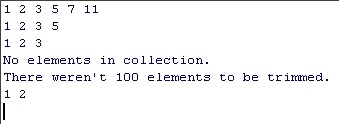
备注:
若初始化一个有 5 个元素的 nested table,之后,删除元素 2 和 5,内部大小为 5,COUNT 方法返回 3,LAST 方法返回 4。所有已删除的元素,不管其位置如何,都同等对待。
TRIM 方法
该方法有如下两个形式:
- TRIM 从 collection 末尾移除一个元素。
- TRIM(n) 从 collection 末尾移除 n 个元素。
若想移除所有元素,使用无参的 DELETE 方法。
不能在 associative array 上使用 TRIM 方法。
示例8:演示使用 TRIM 减少 collection 的大小
DECLARE
TYPE NumList IS TABLE OF NUMBER;
n NumList := NumList(1,2,3,5,7,11);
PROCEDURE print_numlist(the_list NumList) IS
output VARCHAR2(128);
BEGIN
IF n.COUNT = 0 THEN
DBMS_OUTPUT.PUT_LINE('No elements in collection.');
ELSE
FOR i IN the_list.FIRST .. the_list.LAST
LOOP
output :=
output || NVL(TO_CHAR(the_list(i)),'NULL') || ' ';
END LOOP;
DBMS_OUTPUT.PUT_LINE(output);
END IF;
END;
BEGIN
print_numlist(n);
n.TRIM(2); -- Remove last 2 elements.
print_numlist(n);
n.TRIM; -- Remove last element.
print_numlist(n);
n.TRIM(n.COUNT); -- Remove all remaining elements.
print_numlist(n);
-- If too many elements are specified,
-- TRIM raises the exception SUBSCRIPT_BEYOND_COUNT.
BEGIN
n := NumList(1,2,3);
n.TRIM(100);
EXCEPTION
WHEN SUBSCRIPT_BEYOND_COUNT THEN
DBMS_OUTPUT.PUT_LINE
('There weren''t 100 elements to be trimmed.');
END;
-- When elements are removed by DELETE,
-- placeholders are left behind.
-- TRIM counts these placeholders
-- as it removes elements from the end.
n := NumList(1,2,3,4);
n.DELETE(3); -- delete element 3
-- At this point, n contains elements (1,2,4).
-- TRIMming the last 2 elements
-- removes the 4 and the placeholder, not 4 and 2.
n.TRIM(2);
print_numlist(n);
END;
/
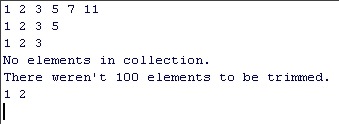
备注:
若 n 太大,则会产生 SUBSCRIPT_BEYOND_COUNT 异常。
示例9:演示对已删除的元素使用
TRIM 方法在一个 collection 的内部大小上操作,包含任何被已删除的元素。已删除的元素是指调用 DELETE(n) 后,不能是删除了的所有的元素、无参数的 DELETE。
DECLARE
TYPE CourseList IS TABLE OF VARCHAR2(10);
courses CourseList;
BEGIN
courses := CourseList('Biol 4412', 'Psyc 3112', 'Anth 3001');
courses.DELETE(courses.LAST); -- delete element 3
/* At this point, COUNT equals 2, the number of valid
elements remaining. So, you might expect the next
statement to empty the nested table by trimming
elements 1 and 2. Instead, it trims valid element 2
and deleted element 3 because TRIM includes deleted
elements in its tally. */
courses.TRIM(courses.COUNT);
DBMS_OUTPUT.PUT_LINE(courses(1)); -- prints 'Biol 4412'
END;
/

备注:
一般,不要依赖 TRIM 和 DELETE 之间的互操作。最好把 nested tables 当作固定大小的数组,只用 DELETE,或是把它们当作栈,只使用 TRIM 和 EXTEND。
因为,PL/SQL 不会维持已经 trim 的元素的空间,你不能对一个已经 trim 的元素重新赋值。
DELETE 方法
该方法有如下三个形式:
- DELETE 不带参数的 DELETE 删除所有元素,并设置 COUNT 为 0。
- DELETE(n) 对于数字键的 associative array 或 nested table,删除第 n 个元素。若 associative array 是字符串键,则对应键的元素被删除。若 n 为 null,则 DELETE(n) 什么都不做。
- DELETE(m,n) 从 associative array 或 nested table 删除范围 m..n 的所有元素。若 m 大于 n,或 m 和 n 其中一个为 null,则 DELETE(n) 什么都不做。
示例10:演示删除 collection 元素
DECLARE
TYPE NumList IS TABLE OF NUMBER;
n NumList := NumList(10,20,30,40,50,60,70,80,90,100);
TYPE NickList IS TABLE OF VARCHAR2(64) INDEX BY VARCHAR2(32);
nicknames NickList;
BEGIN
n.DELETE(2); -- deletes element 2
n.DELETE(3,6); -- deletes elements 3 through 6
n.DELETE(7,7); -- deletes element 7
n.DELETE(6,3); -- does nothing since 6 > 3
n.DELETE; -- deletes all elements
nicknames('Bob') := 'Robert';
nicknames('Buffy') := 'Esmerelda';
nicknames('Chip') := 'Charles';
nicknames('Dan') := 'Daniel';
nicknames('Fluffy') := 'Ernestina';
nicknames('Rob') := 'Robert';
-- following deletes element denoted by this key
nicknames.DELETE('Chip');
-- following deletes elements with keys in this alphabetic range
nicknames.DELETE('Buffy','Fluffy');
END;
/
varrays 总是有连续的标值,因此,你不能删除单个元素,除非通过 TRIM 方法删除末尾的元素。你可以使用无参的 DELETE 删除所有元素。
若要删除的元素不存在,则 DELETE(n) 简单掠过;不会产生异常。PL/SQL 为已删除的元素保持其空间,因此,你可以为该空间重新赋值。使用 DELETE(n) 后,饮用已删除的元素,但是不能引用无参的 DELETE,因此所有元素已完全删除。
DELETE 可以让你维护稀疏的 nested tables。你可以在数据库存储稀疏的 nested tables,就像任何 nested tables 一样。
分配给 collection 的内存大小随着 collection 的大小而增加。若你删除整个 collection ,或单独删除所有元素,则 collection 存储元素的内存才会释放。


 浙公网安备 33010602011771号