
MongoDB入门学习(一)简介与基本操作、整合SpringBoot集合操作、整合SpringBoot文档操作
1. 简介
1.1 NoSQL和MongoDB
NoSQL与SQL的区别:
- SQL(关系型数据库)
- 关系型网格充分的体现了现实事务。
一般由rows、columns组成tables,而各个tables之间又存在一定的关系Relations
一个table包含着另一个和他有关系的数据比如说teams和players表中就存在这种关系。 - 语句遵循SQL(Structured Query Language)例如
SELECT FROM players WHERE last name “yzzy”;
- 关系型网格充分的体现了现实事务。
- NoSQL
- 没有关系
- 不支持SQL
- 查询数据手段多样,比如Http,JavaScript来查询
1.2 MongoDB特点
- 灵活易于扩展
- 分布式文档数据库
- 支持json与bson格式
- 使用JavaScripti语句
- 事务的ACID
1.2.1 MongoDB 技术优势
MongoDB基于灵活的JSON文档模型(从错综复杂的关系模型到对象模型)。适合敏捷开发,能快速响应业务变化。其高可用(自恢复、多中心容灾能力)、高水平扩展能力(横向无缝扩展,多种数据分布策略,分片,TB-PB级别)使得在处理海量、高并发的数据应用时颇具优势。
1.2.2 Json 模型快速特性
- 数据库引擎只需要写在一个存储区
- 反范式、无关联的组织极大优化查询速度
- 程序API自然,开发快速
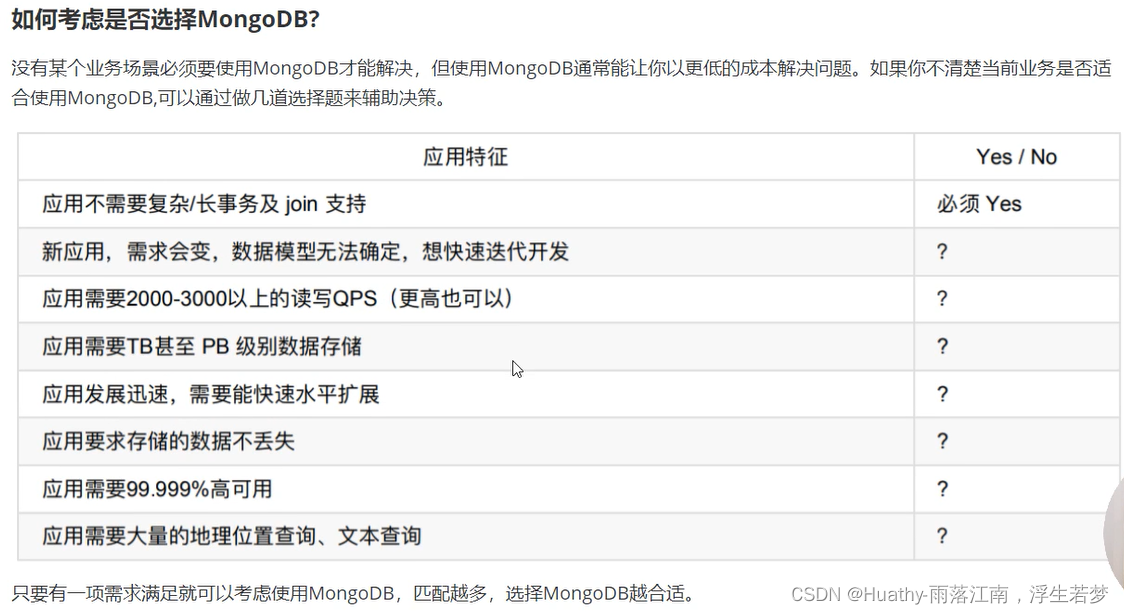
1.3 MongoDB 应用场景
游戏(积分、装备);物流(订单);社交(朋友圈、地点、附近的人);物联网(设备信息、日志);视频直播(用户信息、礼物);大数据;CRM、ERP
1.4 MongoDB与MongoDB Tool安装
Mongo安装
- 下载网址https:/www.mongodb.com/try/download/community
windows下载msi,其他操作系统可以参考文档 - 安装时注意
Data Directory:数据存放的路径;Log Dirctory:日志存放的路径;MongoDB Compass(界面化数据库管理工具)建议安装
检测安装是否成功WIN+R输入“services.msc"指令查看是否服务启动
1.5 MongoDB数据导入导出
导入
命令:mongoimport --db dbname --type json xxx.json(也可以是jsonArray的形式导入)
示例:mongoimport --db test_db --type json product.json
以下是 products.json 文件
{ "_id" : "ac3", "name" : "AC3 Phone", "brand" : "ACME", "type" : "phone", "price" : 200, "rating" : 3.8,"warranty_years" : 1, "available" : true }
{ "_id" : "ac7", "name" : "AC7 Phone", "brand" : "ACME", "type" : "phone", "price" : 320, "rating" : 4,"warranty_years" : 1, "available" : false }
{ "_id" : { "$oid" : "507d95d5719dbef170f15bf9" }, "name" : "AC3 Series Charger", "type" : [ "accessory", "charger" ], "price" : 19, "rating" : 2.8,"warranty_years" : 0.25, "for" : [ "ac3", "ac7", "ac9" ] }
{ "_id" : { "$oid" : "507d95d5719dbef170f15bfa" }, "name" : "AC3 Case Green", "type" : [ "accessory", "case" ], "color" : "green", "price" : 12, "rating" : 1,"warranty_years" : 0 }
{ "_id" : { "$oid" : "507d95d5719dbef170f15bfb" }, "name" : "Phone Extended Warranty", "type" : "warranty", "price" : 38, "rating" : 5,"warranty_years" : 2, "for" : [ "ac3", "ac7", "ac9", "qp7", "qp8", "qp9" ] }
导出
命令:mongoexport -d dbname -c collectionname -o filepath --type json/csv -f field
示例:mongoexport -d test_db -products -o pro.json
2. MongoDB 基本操作
2.1 MongoDB创建数据
查看有那些数据库show dbs
获取当前数据库的名称
创建数据库use db name
创建一个Collections Document
db.cool_new_stff.insertOne()db.cool.new.stff.insertOne()
show dbs
	admin    180.00 KiB
	config    72.00 KiB
	local     72.00 KiB
	test_db  232.00 KiB
show databases
	admin    180.00 KiB
	config    72.00 KiB
	local     72.00 KiB
	test_db  232.00 KiB
use example
	'switched to db example'
doc = {"title":"A","desc":"demo"}
	{ title: 'A', desc: 'demo' }
db.name.insertOne(doc);
	{ acknowledged: true,
	  insertedId: ObjectId("6357ed0001c87366b1808a96") }
db.name.insertOne(doc);
	{ acknowledged: true,
	  insertedId: ObjectId("6357ed0001c87366b1808a96") }
db.cool_new_stff.insertOne({});
	{ acknowledged: true,
	  insertedId: ObjectId("6357ee6601c87366b1808a97") }
db.cool.new.stff.insertOne({});
	{ acknowledged: true,
	  insertedId: ObjectId("6357ee7f01c87366b1808a98") }
show collections
	cool_new_stff
	cool.new.stff
	name
2.2 Collections简介与基础操作
- 清屏cls
- 切换到数据库查找
查找所有:db.products.find()
查找类型等于’service’的:db.products.find({“type”:“service”});
格式化显示:db.products.find({“type”:“service”}).pretty();
只展示type该字段:db.products.find({),{“type”:1});
db.products.find({“type”:“service”),{“type”:1}).pretty();
支持正则表达式
db.products.find({“name”:{$regex:/phone/i}})
db.products.find({“name”:{Sregex:/phone/i)),{“type”:1))
db.name.find()
{ _id: ObjectId("6357ed0001c87366b1808a96"), title: 'A', desc: 'demo' }
{ _id: ObjectId("6357f15101c87366b1808a9c"), type: 123 }
{ _id: ObjectId("6357f17e01c87366b1808a9e"), name: 'Huathy' }
db.name.find({"type":"1"})
db.name.find({"type":1})
db.name.find({"type":123})
{ _id: ObjectId("6357f15101c87366b1808a9c"), type: 123 }
3. Query
3.1 Limit 与 Count
db.name.find({"title":"A"}).count()
	4
db.name.find({"title":"A"}).limit(2)
	{ _id: ObjectId("6357ed0001c87366b1808a96"),
	  title: 'A',
	  desc: 'demo' }
	{ _id: ObjectId("6357f13001c87366b1808a99"),
	  title: 'A',
	  desc: 'demo' }
3.2 Sort 与 Skip
注意:skip()对于count()无效。也就是说不论是否跳过,统计总数都不变。
db.names.find()
	{ _id: ObjectId("63593ffb2108eeaab632e0d8"), num: 11 }
	{ _id: ObjectId("635940002108eeaab632e0d9"), num: 22 }
	{ _id: ObjectId("635940032108eeaab632e0da"), num: 33 }
db.names.find().sort({"num":1})
	{ _id: ObjectId("63593ffb2108eeaab632e0d8"), num: 11 }
	{ _id: ObjectId("635940002108eeaab632e0d9"), num: 22 }
	{ _id: ObjectId("635940032108eeaab632e0da"), num: 33 }
db.names.find().sort({"num":-1})
	{ _id: ObjectId("635940032108eeaab632e0da"), num: 33 }
	{ _id: ObjectId("635940002108eeaab632e0d9"), num: 22 }
	{ _id: ObjectId("63593ffb2108eeaab632e0d8"), num: 11 }
db.names.find().sort({"num":-1}).skip(2)
	{ _id: ObjectId("63593ffb2108eeaab632e0d8"), num: 11 }
3.3 $gt 与 $lt
注意:大于小于比较的前提是有该字段,如果没有这个字段的记录,则不会被查询出来。(这里建议设置collections的标准)
db.names.find()
	{ _id: ObjectId("63593ffb2108eeaab632e0d8"), num: 11 }
	{ _id: ObjectId("635940002108eeaab632e0d9"), num: 22 }
	{ _id: ObjectId("635940032108eeaab632e0da"), num: 33 }
	{ _id: ObjectId("635940082108eeaab632e0db"), num: 44 }
	{ _id: ObjectId("6359400c2108eeaab632e0dc"), num: 55 }
	{ _id: ObjectId("635942d72108eeaab632e0dd"), name: 'Huathy' }
db.names.find({"num":{$gt:33}})
	{ _id: ObjectId("635940082108eeaab632e0db"), num: 44 }
	{ _id: ObjectId("6359400c2108eeaab632e0dc"), num: 55 }
db.names.find({"num":{$lt:33}})
	{ _id: ObjectId("63593ffb2108eeaab632e0d8"), num: 11 }
	{ _id: ObjectId("635940002108eeaab632e0d9"), num: 22 }
3.4 $or(或)、$and(并)、$all(全)、$in(有)
3.4.1 $or(或)、$and(并)
db.prod.find({$or:[{"price":{$lt:100}},{"rating":{$gt:3}}]});
	{ _id: ObjectId("63594a882108eeaab632e0de"),
	  price: 55,
	  rating: 1 }
	{ _id: ObjectId("63594a8c2108eeaab632e0df"),
	  price: 55,
	  rating: 2 }
	{ _id: ObjectId("63594a902108eeaab632e0e0"),
	  price: 55,
	  rating: 3 }
	{ _id: ObjectId("63594aa02108eeaab632e0e2"),
	  price: 205,
	  rating: 4 }
db.prod.find({$and:[{"price":{$lt:100}},{"rating":{$gt:2}}]});
	{ _id: ObjectId("63594a902108eeaab632e0e0"),
	  price: 55,
	  rating: 3 }
db.prod.find({$and:[{"price":{$lt:100}},{"rating":{$gt:2}}]}).count();
	1
3.4.2 $all(全)、$in(有)
-- 所有都要满足
db.prod.find({"price":{$all:[55,100]}});
	{ _id: ObjectId("635c000507b9962cd04d608f"),
	  price: [ 55, 100 ] }
-- 满足条件之一即可
db.prod.find({"price":{$in:[55,105]}});
	{ _id: ObjectId("63594a882108eeaab632e0de"),
	  price: 55,
	  rating: 1 }
	{ _id: ObjectId("63594a962108eeaab632e0e1"),
	  price: 105,
	  rating: 3 }
    { _id: ObjectId("635c000507b9962cd04d608f"),
 	  price: [ 55, 100 ] }
4. 修改数据
update修改所有;updateOne修改一个
4.1 字符操作
4.1.1 $set 修改
db.prod.find()
	{ _id: ObjectId("63594aa02108eeaab632e0e2"),
	  price: 205,
	  rating: 4 }
	  -- 条件属性和值 设置 修改的属性和值
db.prod.updateOne({"rating":4},{$set:{"price":100}})
	{ acknowledged: true,
	  insertedId: null,
	  matchedCount: 1,
	  modifiedCount: 1,
	  upsertedCount: 0 }
db.prod.find()
	{ _id: ObjectId("63594aa02108eeaab632e0e2"),
	  price: 100,
	  rating: 4 }
4.1.2 $unset 删除字段
db.prod.updateOne({"rating":4},{$unset:{"price":1}})
	{ acknowledged: true,
	  insertedId: null,
	  matchedCount: 1,
	  modifiedCount: 1,
	  upsertedCount: 0 }
db.prod.find()
	{ _id: ObjectId("63594aa02108eeaab632e0e2"), rating: 4 }
4.1.3 $inc 增加
db.prod.updateOne({"rating":4},{$inc:{"price":1000}})
	{ acknowledged: true,
	  insertedId: null,
	  matchedCount: 1,
	  modifiedCount: 1,
	  upsertedCount: 0 }
db.prod.find()
	{ _id: ObjectId("63594aa02108eeaab632e0e2"),
	  rating: 4,
	  price: 1000 }
-- 如果再次执行操作,则会再次增加
db.prod.updateOne({"rating":4},{$inc:{"price":1000}})
db.prod.find()
{ _id: ObjectId("63594aa02108eeaab632e0e2"),
  rating: 4,
  price: 2000 }
4.2 Arrays : $push $pull 增加 / 移除
4.2.1 $push
db.prod.find()
	{ _id: ObjectId("635c000507b9962cd04d608f"),
	  price: [ 55, 100 ],
	  rating: 5 }
db.prod.updateOne({"rating":5},{$push:{"price":1000}})
	{ acknowledged: true,
	  insertedId: null,
	  matchedCount: 1,
	  modifiedCount: 1,
	  upsertedCount: 0 }
db.prod.find()
	  { _id: ObjectId("635c000507b9962cd04d608f"),
	  price: [ 55, 100, 1000 ],
	  rating: 5 }
4.3 delete
- 尽量少删除元素,而是采用逻辑删除,用deleted字段来标识。
- delete删除所有,deleteOne删除一个
- 建议按照_id来删除元素。
db.prod.deleteOne({"_id":"63594a8c2108eeaab632e0df"})
	{ acknowledged: true, deletedCount: 0 }
db.prod.find({"_id":"63594a8c2108eeaab632e0df"})
5、MongoDB整合SpringBoot集合操作
5.1 环境准备
- 引入依赖
<dependency>
  <groupId>org.springframework.boot</groupId>
  <artifactId>spring-boot-starter-data-mongodb</artifactId>
</dependency>
- 配置yml
spring:
    data:
      mongodb:
          uri: mongodb://admin:123456@172.25.196.210:27017/example?authSource=admin
- 使用的时候注入mongoTemplate
@Autowired
private MongoTemplate mongoTemplate;
5.2 集合操作
public class MongoTest1 extends ApplicationTests{
    @Autowired
    private MongoTemplate mongoTemplate;
    /**
     * 创建集合
     */
    @Test
    public void test_create(){
        boolean exists = mongoTemplate.collectionExists("emp");
        if(exists){
            mongoTemplate.dropCollection("emp");
        }
        mongoTemplate.createCollection("emp");
    }
}
6、MongoDB整合SpringBoot文档操作
6.1 文档操作-相关注解
- @Document
- 修饰范围:Class类
- 作用:用来映射这个类的一个对象为mongo中的一条文档数据
- 属性:(value、collection)用来指定操作的集合
- @Id
- 修饰范围:成员变量、方法
- 作用:用来将成员变量的值映射为文档的_id的值
- @Id
- 修饰范围:成员变量、方法
- 作用:将成员变量及其值,映射为文档中的一个Key:Value对。
- 属性:(name、value)用来指定在文档中key的名称,默认为成员变量名
- @Transient
- 修饰范围:成员变量、方法
- 作用:指定此成员变量不参与文档序列号
测试:
@Test
public void test_insert() {
   Employee employee = new Employee(1001, "Huathy", 20, 10000.0, new Date());
   Employee emp1 = mongoTemplate.insert(employee);
   System.out.println("TEST 1 ==> " + emp1.toString());
   Employee emp2 = mongoTemplate.save(employee);
   System.out.println("TEST 2 ==> " + emp2.toString());
   List<Employee> list = Arrays.asList(
           new Employee(1002, "嘻嘻", 20, 20000.0, new Date()),
           new Employee(1003, "嘿嘿", 20, 30000.0, new Date())
   );
   Collection<Employee> coll = mongoTemplate.insert(list, Employee.class);
   coll.forEach(c -> {
       System.out.println("COLL INSERT ==> " + c.toString());
   });
}
 注意:通过SpringDataMongoDB还会给集合中增加一个class属性,存储新增时Document对应Java中类的全路径。这么做是为了查询的时候能够把Doucument转为Java类型。
6.2 查询文档
Criteria是标准查询的接口。可以引用静态的Criteria.where把多个条件组合到一起,就可以轻松的将多个方法标准和查询条件相结合,方便查询语句操作。
| Criteria | MongoDB | 说明 |
|---|---|---|
| and | $and | 并且 |
| andOperator | $and | 并且 |
| orOperator | $or | 或者 |
| gt | $gt | 大于 |
| gte | $gte | 大于等于 |
| in | $in | 包含 |
| is | $is | 等于 |
| lt | $lt | 小于 |
| lte | $lte | 小于等于 |
| nin | $nin | 不包含 |
测试:
/**
 * 查询与条件查询
 */
@Test
public void test_find() {
    System.out.println("==============查询所有文档=================");
    List<Employee> allemps = mongoTemplate.findAll(Employee.class);
    List<Employee> allemps2 = mongoTemplate.find(new Query(), Employee.class);
    allemps.forEach(e -> {
        System.out.println(e.toString());
    });

    System.out.println("============根据_id查询===================");
    Employee emp1 = mongoTemplate.findById(1001, Employee.class);
    System.out.println("findByID ==> " + emp1.toString());

    System.out.println("============findOne返回第一个文档===================");
    Employee emp2 = mongoTemplate.findOne(new Query(), Employee.class);
    System.out.println("findOne ==> " + emp2.toString());

    System.out.println("============find 单 条件查询===================");
    Query query = new Query(Criteria.where("salary").gt(6000).lte(10000));
    List<Employee> emps3 = mongoTemplate.find(query, Employee.class);
    emps3.forEach(e -> {
        System.out.println("find ==> " + e.toString());
    });

    System.out.println("============find 多 条件查询===================");
    Criteria criteria = new Criteria();
    criteria.orOperator(Criteria.where("salary").gt(6000).lte(10000), Criteria.where("name").regex("嘻"));
    List<Employee> emps4 = mongoTemplate.find(new Query(criteria), Employee.class);
    emps4.forEach(e -> {
        System.out.println("find ==> " + e.toString());
    });
}

/**
 * 排序与分页
 */
@Test
public void test_sort() {
    System.out.println("============ sort ===================");
    Query query = new Query();
    query.with(Sort.by(Sort.Order.desc("salary")));
    List<Employee> emps = mongoTemplate.find(query, Employee.class);
    emps.forEach(e -> {
        System.out.println("order find ==> " + e.toString());
    });
    System.out.println("============ page ===================");
    // skip limit 分页。skip跳过记录数、limit限定返回结果数
    Query query1 = new Query();
    query1.with(Sort.by(Sort.Order.desc("salary"))).skip(0).limit(1);
    List<Employee> emps1 = mongoTemplate.find(query1, Employee.class);
    emps1.forEach(e -> {
        System.out.println("limit find ==> " + e.toString());
    });
}

@Test
public void test_findByJson() {
    System.out.println("========等值查询=========");
    String eqJson = "{name:'Huathy'}";
    Query query1 = new BasicQuery(eqJson);
    List<Employee> emps1 = mongoTemplate.find(query1, Employee.class);
    emps1.forEach(System.out::println);
    System.out.println("========多条件查询=========");
    String json = "{ $or:[{age:{$gte:22}},{salary:{$gt:10000}}] }";
    Query query = new BasicQuery(json);
    List<Employee> emps = mongoTemplate.find(query, Employee.class);
    emps.forEach(System.out::println);
}
6.3 更新文档
在MongoDB中无论使用客户端API还是使用SpringData,更新返回结果一定是受影响行数。若更新后的结果与更新前的结果相同,则返回0;
- updateFirst():只更新满足条件的第一条记录
- updateMulti():更新所有满足条件的记录
- upsert():没有符合条件的记录则插入一条数据
测试:
@Test
public void test_update(){
    Query query = new Query(Criteria.where("salary").is(10000));
    List<Employee> emps = mongoTemplate.find(query, Employee.class);
    System.out.println("=========== 更新前 ==========");
    emps.forEach(System.out::println);
    Update update = new Update();
    update.set("salary",12000);
    UpdateResult res1 = mongoTemplate.updateFirst(query, update, Employee.class);
    System.out.println("更新成功记录数1 => " + res1);
    UpdateResult res2 = mongoTemplate.updateMulti(query, update, Employee.class);
    System.out.println("更新成功记录数2 => " + res2);

    Query query1 = new Query(Criteria.where("salary").is(50000));
    List<Employee> emps1 = mongoTemplate.find(query1, Employee.class);
    emps1.forEach(System.out::println);
    System.out.println("=========== 更新前 ==========");
    UpdateResult res3 = mongoTemplate.upsert(query, update, Employee.class);
    System.out.println("更新成功记录数3 => " + res3);
}
6.4 删除操作
测试:
@Test
public void test_delete(){
//        删除所有文档   // 不如使用dorpCollection()
//        mongoTemplate.remove(new Query(),Employee.class);
   Query query = new Query(Criteria.where("salary").is(12000));
   DeleteResult res = mongoTemplate.remove(query, Employee.class);
   System.out.println("删除记录数 => " + res);
}
本文来自博客园,作者:Huathy,遵循 CC 4.0 BY-NC-SA 版权协议。转载请注明原文链接:https://www.cnblogs.com/huathy/p/17253805.html

 浙公网安备 33010602011771号