



实验1 现代C++编程初体验
#include <iostream>
#include <string>
#include <vector>
#include <algorithm>
// 模板函数声明
template<typename T>
void output(const T & c);
void test1();
void test2();
void test3();
int main() {
    std::cout << "测试1: \n";
    test1();
    std::cout << "\n测试2: \n";
    test2();
    std::cout << "\n测试3: \n";
    test3();
}
// 输出容器对象c中的元素
template <typename T>
void output(const T& c) {
    for (auto& i : c)
        std::cout << i << ' ';
    std::cout << '\n';
}
// 测试1:组合使用算法库、迭代器、string反转字符串
void test1() {
    using namespace std;
    string s0{ "0123456789" };
    cout << "s0 = " << s0 << endl;
    string s1(s0);
    // 反转s1自身
    reverse(s1.begin(), s1.end());
    cout << "s1 = " << s1 << endl;
    string s2(s0.size(), ' ');
    // 将s0反转后结果拷贝到s2, s0自身不变
    reverse_copy(s0.begin(), s0.end(), s2.begin());
    cout << "s2 = " << s2 << endl;
}
// 测试2:组合使用算法库、迭代器、vector反转动态数组对象vector内数据
void test2() {
    using namespace std;
    vector<int> v0{ 2, 0, 4, 9 };
    cout << "v0: "; output(v0);

        vector<int> v1{ v0 };
    reverse(v1.begin(), v1.end());
    cout << "v1: "; output(v1);
    vector<int> v2{ v0 };
    reverse_copy(v0.begin(), v0.end(), v2.begin());
    cout << "v2: "; output(v2);
}
// 测试3:组合使用算法库、迭代器、vector实现元素旋转移位
void test3() {
    using namespace std;
    vector<int> v0{ 0, 1, 2, 3, 4, 5, 6, 7, 8, 9 };
    cout << "v0: "; output(v0);
    vector<int> v1{ v0 };
    // 将[v1.begin(), v1.end())区间内元素循环左移1位
    rotate(v1.begin(), v1.begin() + 1, v1.end());
    cout << "v1: "; output(v1);
    vector<int> v2{ v0 };
    // 将[v1.begin(), v1.end())区间内元素循环左移2位
    rotate(v2.begin(), v2.begin() + 2, v2.end());
    cout << "v2: "; output(v2);
    vector<int> v3{ v0 };
    // 将[v1.begin(), v1.end())区间内元素循环右移1位
    rotate(v3.begin(), v3.end() - 1, v3.end());
    cout << "v3: "; output(v3);
    vector<int> v4{ v0 };
    // 将[v1.begin(), v1.end())区间内元素循环右移2位
    rotate(v4.begin(), v4.end() - 2, v4.end());
    cout << "v4: "; output(v4);
}
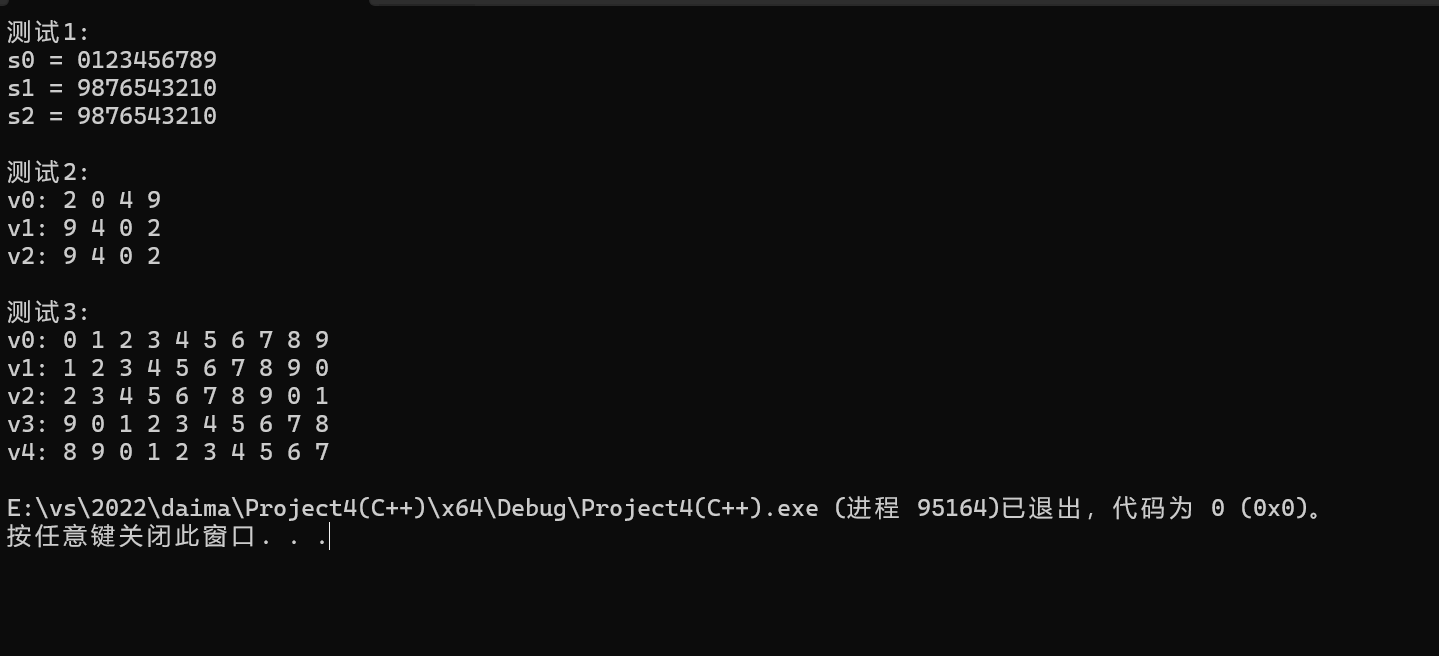
问题一:reverse会直接反转源数据,copy会把原数据的反转赋值给新数组
问题二:将第一个参数到第二个参数的元素拼接到第三个元素后面,三个参数是三个位置的迭代器
实验2
#include <iostream>
#include <vector>
#include <algorithm>
#include <numeric>
#include <iomanip>
#include <cstdlib>
#include <ctime>
// 模板函数声明
template<typename T>
void output(const T& c);
int generate_random_number();
void test1();
void test2();
int main() {
    std::srand(std::time(0)); // 添加随机种子
    std::cout << "测试1: \n";
    test1();
        std::cout << "\n测试2: \n";
    test2();
}
// 输出容器对象c中的元素
template <typename T>
void output(const T& c) {
    for (auto& i : c)
        std::cout << i << ' ';
    std::cout << '\n';
}
// 返回[0, 100]区间内的一个随机整数
int generate_random_number() {
    return std::rand() % 101;
}
// 测试1:对容器类对象指定迭代器区间赋值、排序
void test1() {
    using namespace std;
    vector<int> v0(10); // 创建一个动态数组对象v0, 对象大小为10
    generate(v0.begin(), v0.end(), generate_random_number); // 生成随机数填充v0
    cout << "v0: "; output(v0);
    vector<int> v1{ v0 };
    sort(v1.begin(), v1.end()); // 对整个vector排序
    cout << "v1: "; output(v1);
    vector<int> v2{ v0 };
    sort(v2.begin() + 1, v2.end() - 1); // 只对中间部分排序,不包含首尾元素
    cout << "v2: "; output(v2);
}
// 测试2:对容器类对象指定迭代器区间赋值、计算最大值/最小值/均值
void test2() {
    using namespace std;
    vector<int> v0(10);
    generate(v0.begin(), v0.end(), generate_random_number);
    cout << "v0: "; output(v0);
    // 求最大值和最小值
    auto min_iter = min_element(v0.begin(), v0.end());
    auto max_iter = max_element(v0.begin(), v0.end());
    cout << "最小值: " << *min_iter << endl;
    cout << "最大值: " << *max_iter << endl;
    // 同时求最大值和最小值
    auto ans = minmax_element(v0.begin(), v0.end());
    cout << "最小值: " << *(ans.first) << endl;
    cout << "最大值: " << *(ans.second) << endl;
    // 求平均值
    double avg1 = accumulate(v0.begin(), v0.end(), 0.0) / v0.size();
    cout << "均值: " << fixed << setprecision(2) << avg1 << endl;
    sort(v0.begin(), v0.end());
    double avg2 = accumulate(v0.begin() + 1, v0.end() - 1, 0.0) / (v0.size() - 2);
    cout << "去掉最大值、最小值之后,均值: " << avg2 << endl;
}
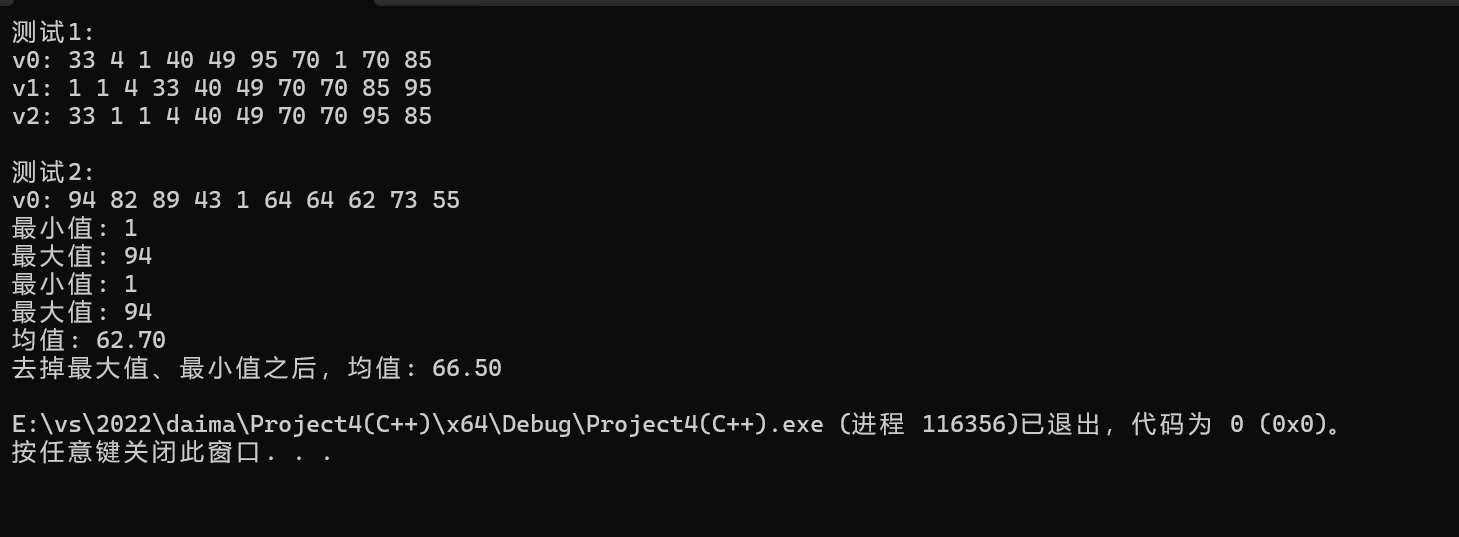
1: 给范围内数组赋0到100的随机值
2:效率高,只需要遍历一遍
3:效果相同,lambda是匿名函数
实验3
#include <iostream>
#include <string>
#include <algorithm>
#include <cctype>
unsigned char func(unsigned char c);
void test1();
void test2();
int main() {
    std::cout << "测试1: 字符串大小写转换\n";
    test1();
    std::cout << "\n测试2: 字符变换\n";
    test2();
}
unsigned char func(unsigned char c) {
    if (c == 'z')
        return 'a';
    if (c == 'Z')
        return 'A';
    if (std::isalpha(c))
        return static_cast<unsigned char>(c + 1);
    return c;
}
void test1() {
    std::string s1{ "Hello World 2049!" };
    std::cout << "s1 = " << s1 << '\n';
    std::string s2;
    for (auto c : s1)
        s2 += std::tolower(c);
    std::cout << "s2 = " << s2 << '\n';
    std::string s3;
    for (auto c : s1)
        s3 += std::toupper(c);
    std::cout << "s3 = " << s3 << '\n';
}
void test2() {
    std::string s1{ "I love cosmos!" };
    std::cout << "s1 = " << s1 << '\n';
    std::string s2(s1.size(), ' ');
    std::transform(s1.begin(), s1.end(),
        s2.begin(),
        func);
    std::cout << "s2 = " << s2 << '\n';
}
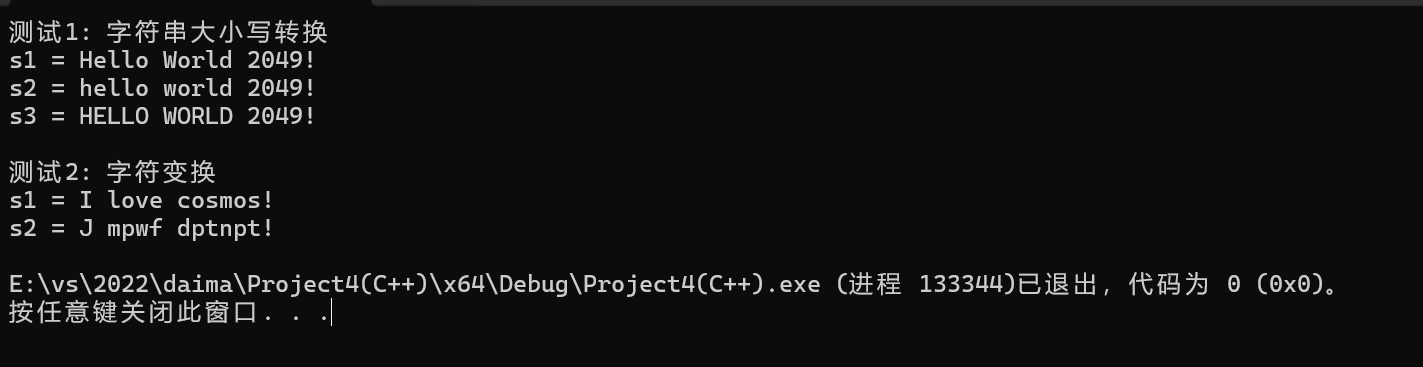
1:将所有数组字母循环转化成后一个字母
2:tolower:将数组字母转化成小写字母,toupper:将数组字母转化成大写字母
3:first:输入初始迭代器,end:输入结束迭代器,result:输出初始迭代器,unary_op:对每个元素执行的操作函数或者lambda
实验4
#include <iostream>
#include <string>
#include <algorithm>
bool is_palindrome(const std::string& s);
bool is_palindrome_ignore_case(const std::string& s);
int main() {
    using namespace std;
    string s;
    // 多组输入,直到按下Ctrl+Z结束测试
    while (cin >> s) {
        cout << boolalpha
            << "区分大小写: " << is_palindrome(s) << "\n"
            << "不区分大小写: " << is_palindrome_ignore_case(s) << "\n\n";
    }
}

bool is_palindrome(const std::string& s)
{
    int first, rear;
    first = 0;
    rear = s.size()-1;
    while (first < rear)
    {
        if (s[first] != s[rear])
            return false;
        first++;
        rear--;
    }
    return true;
}

bool is_palindrome_ignore_case(const std::string& s)
{
    std::string s2(s.size(), ' ');
    std::transform(s.begin(), s.end(), s2.begin(),
        [](char x) { return (x >= 'A' && x <= 'Z') ? x + ('a' - 'A') : x; });
    int n = s2.size();
    for (int i = 0; i < n / 2; ++i) {
        if (s2[i] != s2[n - 1 - i])
            return false;
    }
    return true;
}
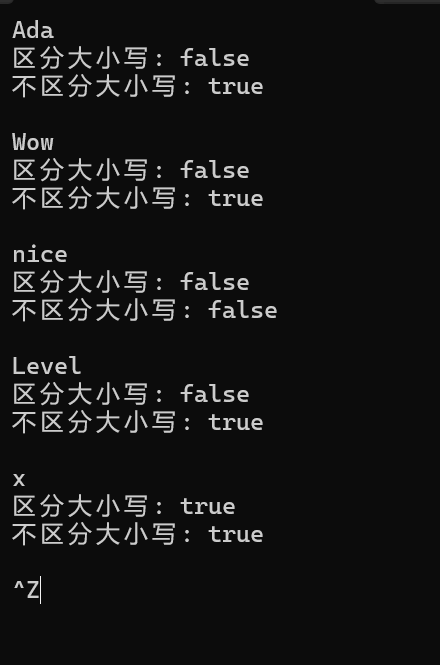
1:使用getline
实验5
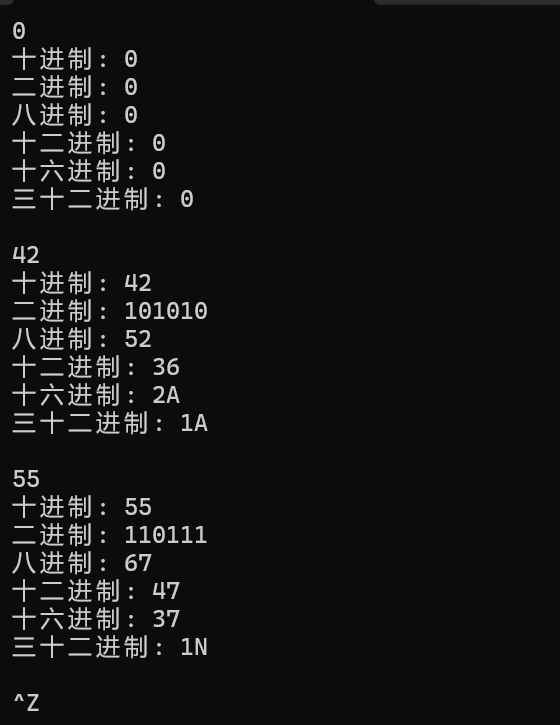
#include <iostream>
#include <string>
#include <algorithm>
std::string dec2n(int x, int n = 2);
int main() {
    int x;
    while (std::cin >> x) {
        std::cout << "十进制: " << x << '\n'
            << "二进制: " << dec2n(x) << '\n'
            << "八进制: " << dec2n(x, 8) << '\n'
            << "十二进制: " << dec2n(x, 12) << '\n'
            << "十六进制: " << dec2n(x, 16) << '\n'
            << "三十二进制: " << dec2n(x, 32) << "\n\n";
    }
}
std::string dec2n(int x, int n) {
    if (x == 0) return "0";
    std::string digits = "0123456789ABCDEFGHIJKLMNOPQRSTUVWXYZ";
    std::string result;
    while (x > 0) {
        int rem = x % n;
        result += digits[rem];
        x /= n;
    }
    std::reverse(result.begin(), result.end());  // 因为余数是从低位到高位,所以要反转
    return result;
}
实验6
#include <iostream>
#include <vector>
#include <iomanip>
#include <algorithm>
#include<cmath>
#include<set>
using namespace std;
const int w = 2;

int main()
{
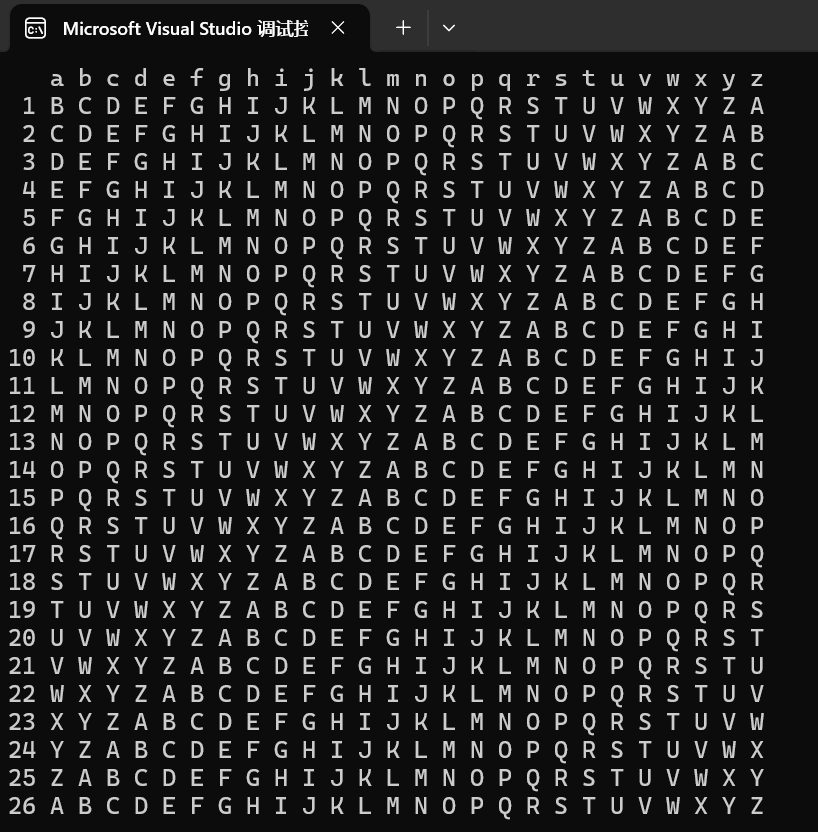
    string s1("abcdefghijklmnopqrstuvwxyz");
    cout << setw(w) << ' ';
    for (const auto& i : s1)
        cout << setw(w) << i;
    cout << '\n';
    for (auto& i : s1)
        i= toupper(i);
    for (int i = 1; i <= 26; i++)
    {
        rotate(s1.begin(), s1.begin() + 1, s1.end());
        cout << setw(w) << i;
        for (auto& x : s1)
            cout << setw(w) << x;
        cout << '\n';
    }
}
实验7:
#include <iostream>
#include <vector>
#include <iomanip>
#include <algorithm>
#include<cmath>
#include<set>
using namespace std;

int main() {
    srand(time(0));
    const int NUM_QUESTIONS = 10;
    int correct = 0;
    for (int i = 1; i <= NUM_QUESTIONS; ++i) {
        int a, b;
        char op;
        int answer;
        int type = rand() % 4 + 1;

        switch (type) {
        case 1:
            a = rand() % 10 + 1;
            b = rand() % 10 + 1;
            op = '+';
            break;
        case 2:
            a = rand() % 10 + 1;
            b = rand() % 10 + 1;
            if (a < b) swap(a, b);
            op = '-';
            break;
        case 3:
            a = rand() % 10 + 1;
            b = rand() % 10 + 1;
            op = '*';
            break;
        case 4:
            int num = 0;
            int b2[10];
            a = rand() % 10 + 1;
            for (int i = 1; i <= a; ++i)
            {
                if (a % i == 0)
                    b2[num++] = i;
            }
            int factor;
            factor = rand() % num;
            b = b2[factor];
            op = '/';
            break;
        }


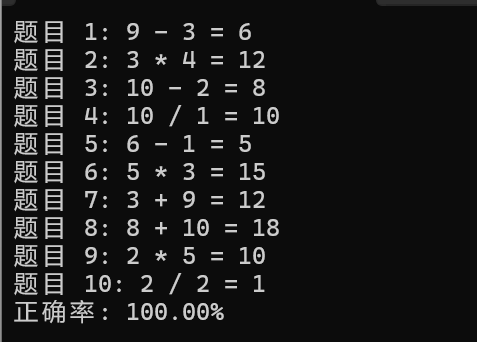
        cout << "题目 " << i << ": " << a << " " << op << " " << b << " = ";
        cin >> answer;


        bool isCorrect = false;
        switch (op) {
        case '+': isCorrect = (answer == a + b); break;
        case '-': isCorrect = (answer == a - b); break;
        case '*': isCorrect = (answer == a * b); break;
        case '/': isCorrect = (answer == a / b); break;
        }

        if (isCorrect) correct++;
    }

    double rate = correct * 100.0 / NUM_QUESTIONS;
    cout << fixed << setprecision(2);
    cout << "正确率: " << rate << "%" << endl;

    return 0;
}

 浙公网安备 33010602011771号